国际科技信息
2011-11-14 03:45:38
中国科技信息
2011年24期
国际科技信息
The blackest substance on Earth: Nasa creates material that absorbs almost all light
Scientists already planning range of space applications, from light suppression to heat and weight reduction
Nasa engineers have come up with a material that absorbs more than 99 per cent of all light that strikes it.
Absorbent material usually pulls in ultraviolet and visible light - but this new material also captures infrared and far infrared light.
The development has even taken fellow Nasa scientists by surprise, and it promises to open new frontiers in space technology.

The team of engineers at Nasa's Goddard Space Flight Center in Greenbelt, Maryland, reported the findings recently at the SPIE Optics and Photonics conference.
John Hagopian, leading the team, said reflectance tests were extremely positive, showing that the material has 50 times more absorbtion qualities than its rivals.
He said: 'Though other researchers are reporting nearperfect absorption levels, mainly in the ultraviolet and visible, our material is darn near perfect across multiple wavelength bands - from the ultraviolet to the far infrared.
'No one else has achieved this milestone yet.'
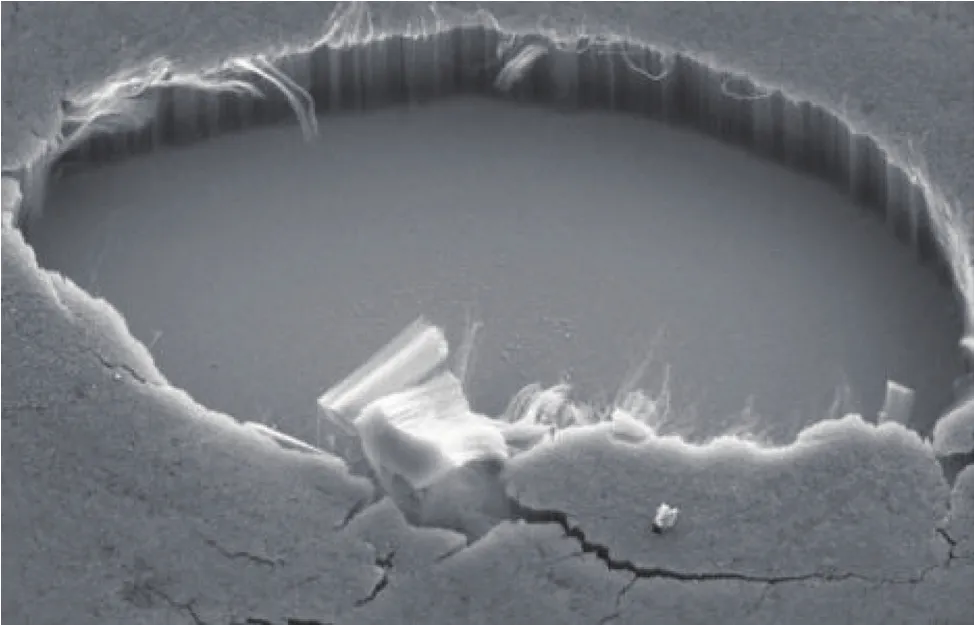
The material is a thin coating of carbon nanotubes - hollow and multi-walled tubes about 10,000 times thinner than a strand of human hair.
They stand at 90 degrees from the surface they coat, which Nasa scientists have referred to as looking like shag-pile carpet.
It can be applied to a variety of surfaces, including silicon, silicon nitride, titanium, and stainless steel -the materials most commonly used in space science instruments.
Nasa is already thinking about practical applications for the material - the most obvious being as light-suppression on sensitive equipment.
The tiny gaps between the tubes collect and trap background light to prevent it from refl ecting off surfaces and interfering with the light that scientists actually want to measure.
Because only a small fraction of light refl ects off the coating, the human eye and sensitive detectors see the material as black.
The material could dramatically slash light refl ected off deep space equipment that is already straining to detect the faintest and farthest light sources.
Less obvious, however, is the fact that the material could also be used as a coolant.
The blacker the material, the more heat it radiates away, so the coating could be used on devices that remove heat from instruments and radiate it away to deep space.
Finally, it is a lot lighter than other materials that off less absorbtion - and weight is a critical factor in any payload being sent into space.
Goddard engineer Manuel Quijada, who co-authored the SPIE paper and carried out the refl ectance tests, said: 'We are a litile surprised by the results'.
He added: 'We knew it was absorbent. We just didn't think it would be this absorbent from the ultraviolet to the far infrared.'
Goddard scientist Ed Wollack summed it up by saying: 'This is a very promising material. It's robust, lightweight, and extremely black. It is betier than black paint by a long shot.'
美科学家研制出一种新超黑材料
美国科学家研制出一种新的超黑材料,能吸收几乎所有照射在其上的光,吸收率超过99%,在从紫外线到远红外线多个波段都获得了几近完美的吸光效果。科学家们表示,这种材料可广泛应用于从光抑制到为太空设备降温和“瘦身”等领域,有望开启太空技术研究的新时代。
新材料是由中空且多壁的碳纳米管组成的一层纤薄涂层,纳米管之间细小的孔隙能收集和捕获背景光以防止其从表面反射出去对要测量的光造成干扰,由于只有很少一部分光反射离开,人眼和灵敏的探测器看到该材料为黑色。该材料可用在太空科学仪器中主要使用的硅、氮化硅、钛、不锈钢等不同表面上。
科学家们表示,这种材料能显著减少用于探测宇宙中最微弱和最遥远的光的深空设备的发射光数量,因此,其最有可能用做太空传感装置的光抑制剂。另外,因为材料越黑,其辐射的热量就越多,所以,这种涂层也可作为冷却剂,用在一些为太空装置移除热量并将热量辐射回深空的设备中。在宇宙探索中,这些太空装置必须在超冷环境下工作,以收集宇宙深处物体发出的非常微弱的远红外信号。如果这些装置的冷度不够,其产生的热会淹没微弱信号。而且,这种涂层比其他吸光材料更轻,而对任何发往太空的装置来说,重量都是一个非常关键的因素。
领导该研究的美国航空航天局(NASA)戈达德太空飞行中心的科学家约翰·哈格比安表示:“反射测试的结果表明,该材料的吸收能力是目前吸收能力最强材料的50多倍,其在从紫外线到远红外线多个波段都获得了几近完美的吸收效果,这是前所未有的创新。……
登录APP查看全文