
踝臂指数与2型糖尿病合并冠心病的相关性的研究
2012-09-03 03:05:36汪池凤肖丽华罗震
中国当代医药
2012年21期
汪池凤 肖丽华 罗震
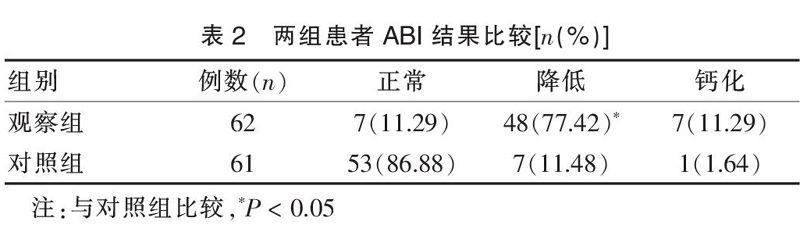

[摘要] 目的 研究踝臂指数与2型糖尿病合并冠心病的相关性。 方法 选择本院2010年6月~2011年12月糖尿病患者123例,按有无冠心病分为两组,观察组62例均为2型糖尿病合并冠心病患者,另61例无冠心病患者为对照组,观察两组患者空腹血糖(FPG)、血脂、餐后2 h血糖(2hPG)及踝臂指数(ABI)。 结果 两组患者平均空腹血糖(FPC)、餐后2 h血糖(2hPG)、总胆固醇(TC)、三酰甘油(TG)、肌酐(Cr)比较差异无统计学意义(P > 0.05)。观察组平均ABI为0.87±0.11,对照组平均ABI为1.04±0.19,两组比较差异有统计学意义(P < 0.05)。观察组ABI正常7例,降低48例,降低者占77.42%,降低比例大大高于对照组,两组比较差异有统计学意义(P < 0.05)。 结论 对患者踝臂指数(ABI)的测定,可对患者冠状动脉病变进行早期预测,判断病变的严重程度,对于早期病变可及时干预,减少心血管事件的发生率。
[关键词] 踝臂指数;2型糖尿病合并冠心病;相关性;血糖
[中图分类号] R587.1[文献标识码] A[文章编号] 1674-4721(2012)07(c)-0071-02
The relevance of ankle brachial index and type 2 diabetes with coronary heart disease
WANG Chifeng XIAO Lihua LUO Zhen
People's Hospital of Promising New Developed Area in Shenzhen City in Guangdong Province, Shenzhen 518106, China
[Abstract] Objective To study the relevance of ankle brachial index and type 2 diabetes with coronary heart disease. Methods One hundred and twenty-three patients with diabetes from June 2010 to December 2011 were selected and divided into two groups according whether or not with coronary heart disease, 62 cases of the observation group were type 2 diabetes mellitus with coronary heart disease, the other 61 cases of control group were not with coronary artery disease, fasting plasma glucose (FPG), blood lipid and 2-hour postprandial blood glucose(2hPG) and ankle brachial index(ABI) of two groups were observed. Results There were no statistical differences in the average FBC, 2hPG, TC, TG and Cr between two groups (P > 0.05). The average ABI of observation group was 0.87±0.11, and which of control group was 1.04±0.19, there was statistical difference between two groups (P < 0.05). In the observation group, ABI decreased in 48 cases, accounting for 77.42%, which was much more than the control group, there was statistical difference between two groups (P < 0.05). Conclusion Determination of patients ankle brachial index(ABI) can early predict the coronary artery disease and judge the severity of the disease, give timely intervention to early lesions, reduce the incidence of cardiovascular events.
[Key words] Ankle brachial index; Type 2 diabetes with coronary heart disease; Relevance; Blood glucose
作為护理上的早期诊断与评估指标,踝臂指数(ankle brachial index,ABI)近年来已广泛应用于临床,特别是对心脑血管疾病[1]、外周动脉缺血性疾病、肾血管疾病及糖尿病等病情严重程度的判断。ABI是踝动脉与肱动脉收缩压的比值,在临床上具有检测容易、价格低廉、安全无创、可重复、患者易于接受等优点[2],因此适合在临床护理上推广应用。为探讨踝臂指数与2型糖尿病合并冠心病的相关性,本研究选择本院2010年6月~2011年12月糖尿病患者123例,按有无冠心病分为两组,对其相关性进行观察,为早期诊断和评估该病的预后提供临床护理参数。现报道如下:
1 资料与方法
1.1 一般资料
选择本院2010年6月~2011年12月糖尿病患者123例,按有无冠心病分为两组,观察组62例均为2型糖尿病合并冠心病患者,其中,男41例,女21例,年龄42~79岁,平均(57.5±15.5)岁,病程1~23年;另61例无冠心病患者为对照组,其中,男40例,女21例,年龄41~80岁,平均(58.5±16.5)岁;……
登录APP查看全文
猜你喜欢
中老年保健(2022年5期)2022-08-24 02:35:42
中老年保健(2022年1期)2022-08-17 06:14:56
保健医苑(2022年6期)2022-07-08 01:26:34
家庭科学·新健康(2022年3期)2022-05-10 00:32:13
中老年保健(2021年5期)2021-08-24 07:07:20
中老年保健(2021年11期)2021-08-22 03:15:16
天津医科大学学报(2021年4期)2021-08-21 02:14:32
基层中医药(2020年10期)2020-11-27 01:58:58
智慧健康(2019年36期)2020-01-14 15:22:58
妈妈宝宝(2017年3期)2017-02-21 01:22:30
