古代涂鸦——身份的标志
2013-10-12 06:11:43
疯狂英语·原声版
2013年9期
关键词:研究
Host: Today, graffiti: ancient stuff, modern stuff, and a kind of a clash between the ancient and the modern. You may have heard about the case earlier of the Chinese graffiti in Egypt. OK, so this kid gets given a really hard time, but maybe its just a bit unfair. Maybe he was just channeling the habits of antiquity,cause, in ancient times, graffiti, it didnt really 2)connote 3)vandalism the way that it does today. That may have been out of place in ancient Roman or Greek or Egyptian times, but graffiti certainly was around then, and not only was it around, it was kind of encouraged. So says Chloé Ragozalie. She studies ancient graffiti. Thats gotta be a fun job.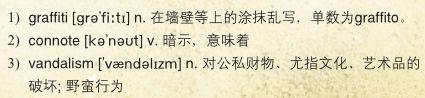
主持人:今天要谈的是涂鸦,这是古老的东西,也是现代的东西,有点像古今碰撞的产物。你也许听说过早些时候关于中国人在埃及留下涂鸦的事情。这个孩子因此受到了严厉的谴责,但这样对他可能不太公平,也许他只不过是给我们呈现古时候的一种常见做法罢了,因为在古代,涂鸦并不像今天这样被看成是一种恣意破坏的行为。涂鸦在古罗马、古希腊或者古埃及也许不是平常事,但在当时,涂鸦肯定是存在的,而且不仅如此,这种行为可以说还受到了鼓励。克洛伊·雷各扎立正是这样告诉我们的,古代涂鸦是她的研究内容,那一定是个有意思的工作。
Chloé: I would say that in ancient Egypt, it was socially accepted and maybe even expected on its part of showing off your status in life, where nowadays we see it as a 4)subversive 5)hooliganism attitude.
Host: Did leaders in ancient Egypt kind of encourage graffiti?
Chloé: Well, you have graffiti in pretty official places—a tomb, a temple—so you have the feeling that they were some kind of official, like a privilege, which was granted.
Host: And as you say, I mean it was kind of just an impulse for people, who were in a place, and they wanted to leave a memory that they were there to say“I was here,” but I mean, have you found anything 6)risqué that kind of corresponds to contemporary graffiti, 7)foul language, insults,…?
Chloé: Yeah, absolutely. You find criticism, you find private joke, you find 8)witticism, you even have 9)pornographic graffiti.
Host: So Im just curious, I mean as for the writing—not the drawings, but the writing—how was literacy at the time? Could the average ancient Egyptian read what was written in this graffiti?
Chloé: No, absolutely not, and I think thats the mistake we made for a very long time. As Egyptologists, we considered this as, you know, secondary inscriptions, not realizing that they had to be made by very high officials because they were those who could write at the time. We consider that maybe one percent of the ancient Egyptian population could read and write.
克洛伊:在古代的埃及,涂鸦行为在社会上是被大家接受的,而且如果你想炫耀自己的身份,这种行为甚至是意料之中的事,但在当今社会,我们视之为具破坏性的流氓行为。
主持人;古埃及的领导人会鼓励涂鸦行为吗?
克洛伊:呃,涂鸦通常出现在带官方色彩的地方,如陵墓、神庙等,所以你感觉得到这种行为有点像是官方赋予的特权。
主持人:正如你说的,我的意思是那通常是人的一时冲动,他们身处某处,会想在所到之处留下一点记忆,想说“我来过了”,但是,在你的研究当中,有没有看到与我们现代社会相似的一些有伤风雅的涂鸦,比如说粗俗的语言、对其他人的侮辱……克洛伊:当然,绝对有。你会看到批评性涂鸦、私密的笑话、俏皮话,你还会看到色情涂鸦。
主持人:我很好奇,说到涂写——我是指涂写,而不是涂画——当时有多少埃及人识字?
登录APP查看全文
猜你喜欢
体育科技文献通报(2022年3期)2022-05-23 13:46:54
天津外国语大学学报(2021年3期)2021-08-13 08:32:18
辽金历史与考古(2021年0期)2021-07-29 01:06:54
科技传播(2019年22期)2020-01-14 03:06:54
辽金历史与考古(2019年0期)2020-01-06 07:45:20
民用飞机设计与研究(2019年4期)2019-05-21 07:21:24
电子制作(2018年11期)2018-08-04 03:26:04
汽车工程学报(2017年2期)2017-07-05 08:13:02
国际商务财会(2017年8期)2017-06-21 06:14:14
电子制作(2017年23期)2017-02-02 07:17:19