粒子滤波算法改进及其应用研究
2015-05-30 10:48:04王永翔陈国初
计算机时代
2015年8期
王永翔 陈国初


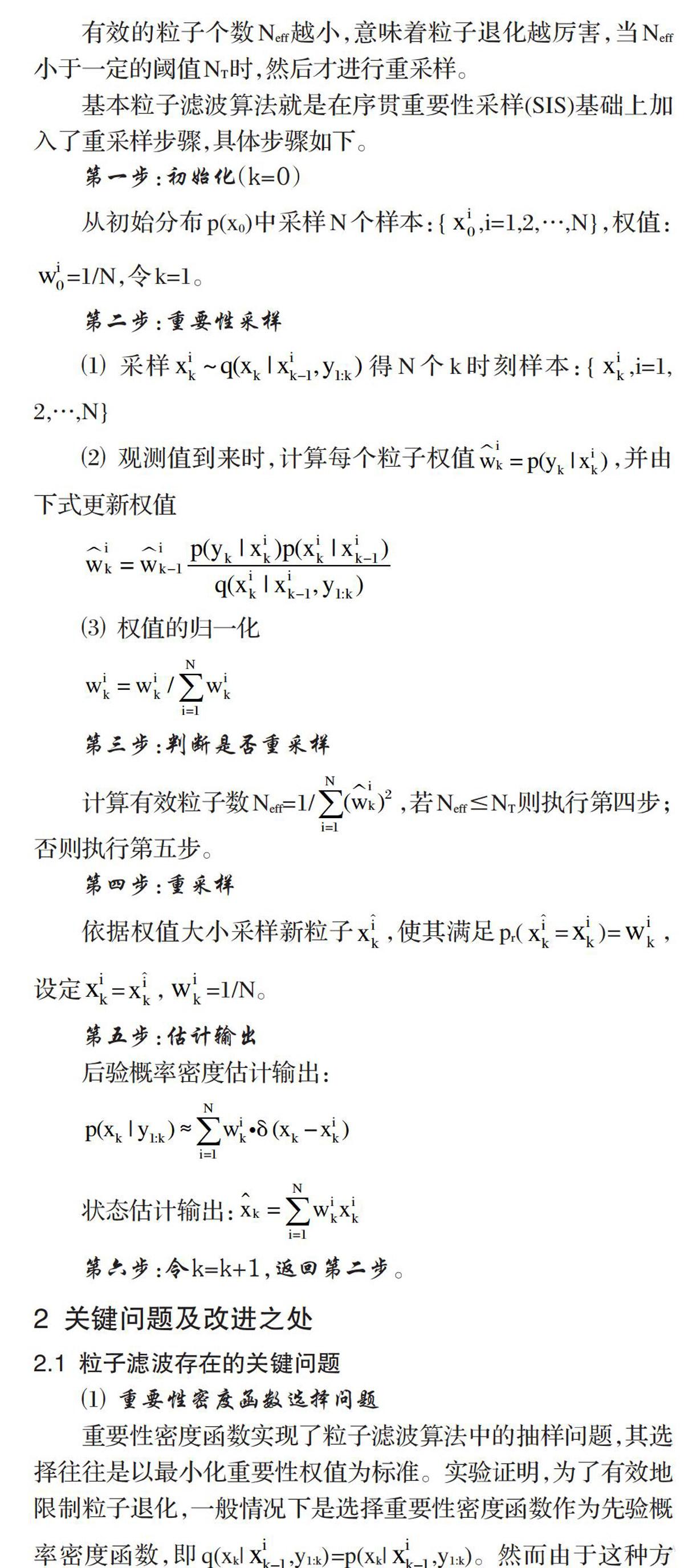
摘 要: 粒子滤波算法是一种基于贝叶斯估计和非参数化蒙特卡罗模拟的新型算法。详细介绍了粒子滤波算法的基本原理,阐述了递推贝叶斯估计方法、序贯重要性采样以及序贯重要性重采样算法;分析了粒子滤波主要存在的问题及关键改进之处,然后介绍粒子滤波算法的应用,并对算法未来发展进行了展望。
关键词: 贝叶斯估计; 序贯重要性采样; 重采样; 粒子滤波
中图分类号:TP301.6 文献标志码:A 文章编号:1006-8228(2015)08-01-04
Research on development of particle filtering algorithm
Wang Yongxiang, Chen Guochu
(College of Electrical Engineering, Shanghai Dianji University, Shanghai 200240, China)
Abstract: Particle filtering is a new algorithm based on Bayesian estimation and non-parametric Monte Carlo simulation. This paper introduces in detail the basic principle of particle filtering algorithm, describes the recursive Bayesian estimation method, sequential importance sampling and sequential importance resample algorithm, analyzes the main problems and the key improvements on the particle filter. Then, the application and the future development of particle filtering algorithm is discussed.
Key words: Bayesian estimation; sequential importance sampling; resample; particle filter
0 引言
许多复杂的系统都存在着滤波处理、参数估计等问题,尤其在通信、自动控制、金融、弹道武器等领域滤波处理显得更加重要。1960年,卡尔曼滤波器(KF)[1]被提出,其作为一种线性、无偏的最小方差状态估计器得到很广泛应用。然而,由于卡尔曼滤波对系统要求比较苛刻,其只能处理一些线性并且噪声服从高斯分布的线性系统,对于非线性、非高斯噪声的复杂系统,其往往达不到滤波要求。尽管后来有些学者提出了扩展Kalman滤波器(EKF)[2]、无迹Kalman滤波器(UKF)[3]等,处理的系统也往往是高斯噪声分布的弱非线性的,对于强非线性的系统,其滤波精度及稳定性等仍然达不到要求。
20世纪50年代,Hammersley等人提出了一种序贯重要性采样(SIS)蒙特卡罗方法[4],通过离散的随机样本来逼近概率分布。该算法主要是从一个重要性分布中抽取一个带有权值的样本集合来代表所研究的系统状态的后验概率密度函数,并利用这些样本及其权值对系统状态进行估计。……
登录APP查看全文