产后尿失禁妇女的时间分布及针对性治疗策略
2015-08-29 20:17:02邢东亮宋东奎康郑军酒涛
中外医疗
2015年13期
邢东亮 宋东奎 康郑军 酒涛
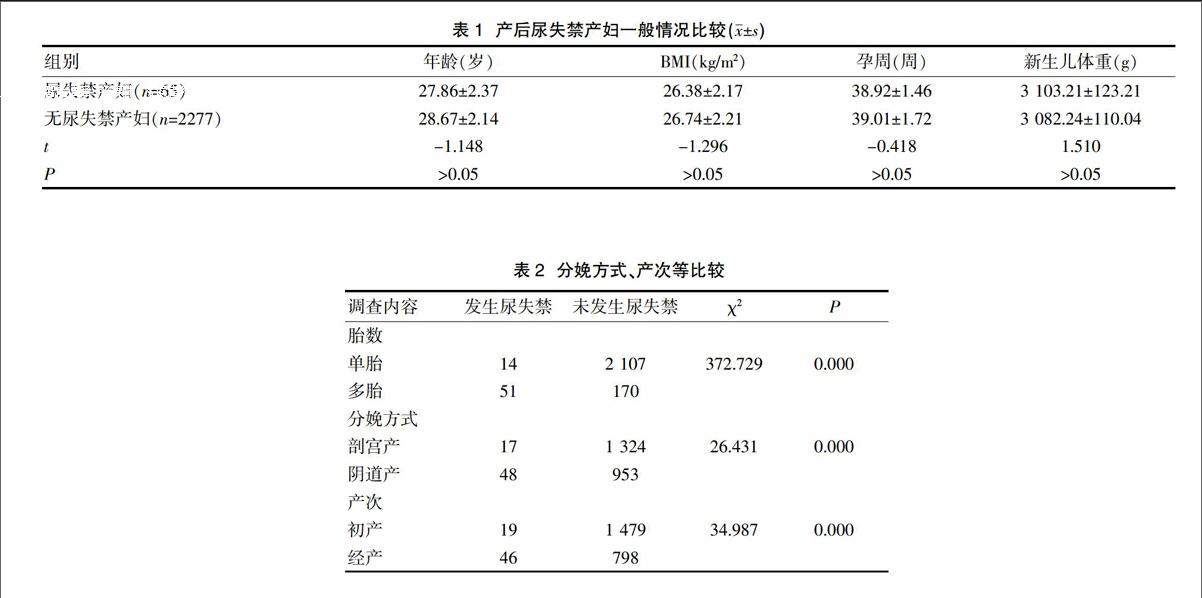
[摘要] 目的 探讨产后发生尿失禁的时间分布,以及不同分娩方式等产科因素对产后尿失禁的影响,为针对性治疗提供策略。方法 选取2011年1月—2014年7月在该院分娩所有的产妇2 432例,采用国际尿失禁咨询委员会尿失禁问卷表(ICI-Q-SF)对产妇进行问卷调查。结果 该次调查2 432例孕产妇,回收有效问卷2 342份(96.30%),其中发生尿失禁者65例,发生率为2.78%;多胎产妇、阴道产产妇、经产产妇尿失禁发生率分别为30.00%、5.04%和5.76%,高于单胎产妇、剖宫产产妇和初产妇,差异有统计学意义(P<0.05)。结论 尿失禁主要发生在产后8周以上,其中胎数、分娩方式和产次是产后尿失禁的独立危险因素,做好产前预防,加强盆底肌肉训练避免尿失禁风险。
[关键词] 尿失禁;分娩方式;产科;治疗策略
[中图分类号] R78 [文献标识码] A [文章编号] 1674-0742(2015)05(a)-0025-02
Postpartum Urinary Incontinence Women Time Distribution and Pertinence Treatment Strategies
XING Dong-liang1,SONG Dong-kui2,KANG Zheng-jun1,JIU Tao1
1.Department of Urology,the fifth Affiliated Hospital of Zhengzhou University, Henan Province,450052 China;2.Department of Urology,the First Affiliated Hospital of Zhengzhou University, Henan Province,450052 China
[Abstract] Objective To investigate postpartum urinary incontinence in time distribution, and the influence of different delivery mode obstetric factors on postpartum urinary incontinence. Methods Selected 2432 cases of maternal childbirthFrom in our hospital, used the ICI-Q-SF conducted a questionnaire survey on maternal. Results The survey of 2432 pregnant women,2342 valid questionnaires recovered (96.30%),including 65 cases of urinary incontinence,the incidence rate was 2.78%;Multiple pregnancy maternal, vaginal birth maternal, multiparous maternal urinary incontinence rates were 30%, 5.04% and 5.76%,higher than that of single fetal maternal, cesarean section and primipara, the difference was statistically significant (P<0.05).Conclusion Urinary incontinence occurred mainly during the 8 postnatal week above,one fetus number,mode of delivery and delivery times are independent risk factors for postpartum urinary incontinence.
[Key words] Urinary incontinence;Mode of delivery;Department of Obstetrics;Treatment strategies
产后尿失禁(post partum urinary incontinence,PPUI)是指女性生产过后不能如意约束小便而自遗[1]。主要临床表现为小便频繁,排尿疼痛,尿时淋沥不断。产后尿失禁的发病原因主要为生产过程中胎儿经过产道时拉伤骨盆底肌肉群或损伤相应的血管神经,从而导致提肛肌松弛、萎缩,影响尿道外括约肌的功能。目前对于尿失禁尚无特别有效的治疗方法,主要通过盆底锻炼来加强肌肉功能。该文2011年1月—2014年7月间通过对2 432例产妇进行问卷调查,旨在探究产后发生尿失禁的时间分布和产科因素,现报道如下。
1 资料与方法
1.1 一般资料
整群选取在该院分娩的产妇2432例为研究对象,纳入标准:①临床资料保存完好;②依从性高、能配合完成随访;③产妇及家属知情同意,签署知情同意书。排除标准:中止妊娠者;有盆腔手术史;有肝肾等功能不全者。该次研究共纳入2 432例孕产妇,年龄19~41岁,平均(28.61±2.75)岁,其中单胎2 124例,多胎309例;……
登录APP查看全文