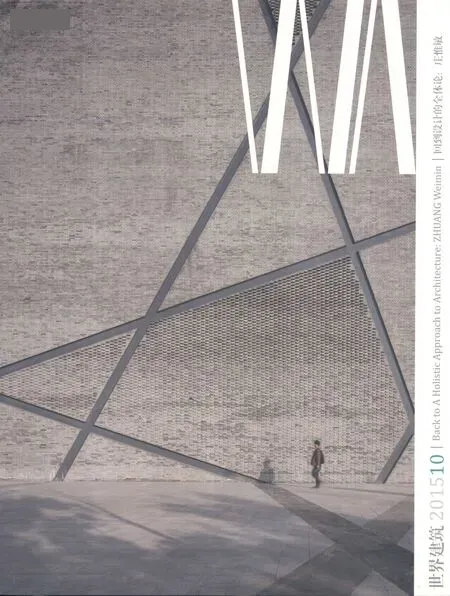
改进建筑60秒
2015-12-21 05:34:14栏目主持叶扬
世界建筑
2015年10期
关键词:建筑
栏目主持:叶扬
改进建筑60秒
Sixty Second Idea to Improve Architecture
栏目主持:叶扬
我们仿效BBC的广播节目“60秒改进世界”(Sixty Second Idea to Improve the World)推出了“改进建筑60秒”栏目,每期将在世界范围内采访两位人物,请他们就建筑、城市、景观、技术等相关问题在60秒的时间里讲出一个或两个有启发性、批判性甚至有争议性的观点。本栏目如实记录了他们的话,采访所拍摄的视频将会出现在我们的相关网页上。所述观点只代表嘉宾本人,与本杂志立场无关。□

柯石安
西交利物浦大学建筑系主任,教授
Pierre-Alain Croset
Professor, Head of the Department of Architecture, Xi'an Jiaotong-Liverpool University
You ask me how architects can improve architecture. I would say that firstly we have to consider that architecture cannot be considered as an autonomous art or science. In fact, architecture is not something that has to do only with buildings, forms, tiles, it has to do with real lives and real humans, it has to do with political programs and social programs. As architects, we need to continue to invent new forms of housing, new ways to stay together, like new communities. In this sense, architects are global thinkers; they cannot only limit themselves to design excellent buildings. We have excellent architects at the moment, we have excellent buildings, but it is not sufficient to improve what is the most important-the quality of life, the society. We have to remember that Le Corbusier was probably the most important architect of the 20th century, who made excellent buildings; but he was a disaster as a politician, because he was a kind of dictator, he wanted to influence the life of the people. And we have to think now that a good design is something that has to be done in consultation and in discussion with the users. In fact, we are living in a complex society with complex processes of decision. the architect has to consider architecture as a global issue, no more only single buildings.□

奥雷·伯曼
蛇口设计博物馆总监
Ole Bouman
Director, Shekou Design Museum
the question "how to improve the world through architecture" has many looklikes: "how architecture can heal the world", "how to make the world a better place relying on architecture". And it's a question ultimately about purpose. It's an effort to give this discipline a lasting relevance in terms of positioning it in the wilder cultural field, and it's totally understandable that architecture currently wants to go into that direction to find new foundations for itself, and once again, to give it a position and kind of the energy to contribute, to serve. Well, currently there is a very interesting and immediate reference that makes this question much more than just a philosophical exercise or theoretical endeavor.
Because last week, at the General Assembly of the United Nations, a set of new Millennium Goals has been launched. If we take a quick look at these goals, it's easy to see how architecture can play a role in getting these goals closer to realization. For instance, No.13 "Protecting the Planet", if architects have to do with that objective, it instantly directs many of their choices. If it comes to, for instance, "Responsible Consumption", think about all the choices architects make in terms of materialization and use of energy. But also something less tangible like contributing to more equality or enhancing good health. Even things like reducing hunger and reducing poverty could be part of the architectural agenda.
this is my point: in many respects, each of these Millennium Goals does have a spatial dimension, and by having a spatial dimension. It also implies that it may have a design dimension: architects can make choices and architects can take a stance. And that's exactly what at stake here: now with the fresh support of the United Nations.□

回眸京城:北京老城街景同视角比较
A Glance Back at City of Beijing
编著:刘文豹,周雷雷;吴蕾译;施卫良主审
出版:中国建筑工业出版社,2015
十多年前,北规院的一位友人曾经送给我一本书,名为《北京旧城》。此书并不是正式出版物,书中刊登了大量1950、1960年代北京旧城的老照片。这些照片由北规院拍摄,记录了当时北京老城区的大量街道场景,极富史料性。我极为珍惜,时常拿出来阅读;但这本书在多年前遗失了,从此不知去向。我一直很遗憾,直至发现了《回眸京城:北京老城街景同视角比较》一书。
此书由我的同事刘文豹老师和建筑师周雷雷共同编著,它以《北京旧城》一书中的老照片为蓝本,重返原拍摄地点,以同样的视角拍摄记录原场景的现状,并将新老照片直接地并置在一起。显然,作者希望利用图片的力量来说话。而事实上,也的确做到了这一点。同视角的新老照片在同一时空中被呈现,黑白对应彩色,历史对应当下,一个北京城市街景空间的整体演变轮廓被勾勒出来。……
登录APP查看全文
猜你喜欢
北方建筑(2021年6期)2021-12-31 03:03:54
文苑(2020年10期)2020-11-07 03:15:36
现代装饰(2020年6期)2020-06-22 08:43:12
现代装饰(2020年4期)2020-05-20 08:55:08
摄影之友(影像视觉)(2019年2期)2019-03-05 08:27:16
艺术家(2017年3期)2018-01-26 08:54:49
文学自由谈(2016年3期)2016-06-15 13:01:16
福建农业科技(2016年10期)2016-03-07 09:46:49
少儿科学周刊·儿童版(2015年6期)2015-11-24 03:49:38
中国工程咨询(2015年4期)2015-02-14 03:49:56