钻孔引流在稳定型硬脑膜下血肿治疗中的应用价值分析
2016-02-05 08:33:12高洪伟
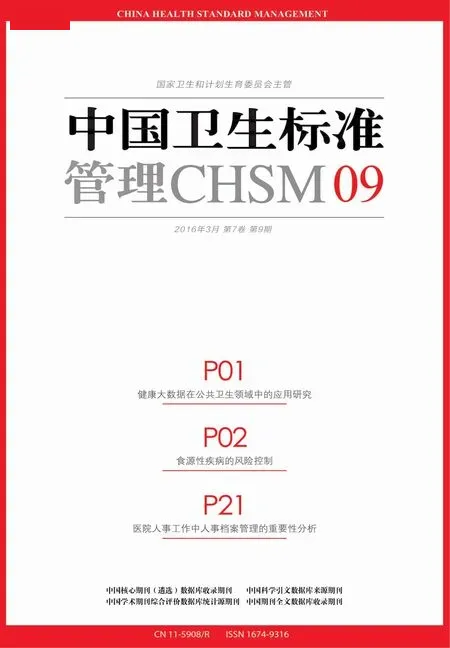
中国卫生标准管理
2016年9期
关键词:应用价值
高洪伟
钻孔引流在稳定型硬脑膜下血肿治疗中的应用价值分析
高洪伟
【摘要】目的 分析钻孔引流在稳定型硬脑膜下血肿治疗中的应用价值。方法 将90例稳定型硬脑膜下血肿患者随机分为实验组和对照组,实验组患者行钻孔引流术,对照组患者行骨窗开颅术,比较两组患者手术的疗效。结果 实验组患者的手术疗效明显优于对照组患者,差异有统计学意义(P<0.05)。结论 对于稳定型硬脑膜下血肿的患者,采用钻孔引流术能够取得更好的疗效。
【关键词】钻孔引流;稳定型硬脑膜下血肿;应用价值
doi∶10.3969/j.issn.1674-9316.2016.09.037
Objective To analyze the application value of borehole drainage in the treatment of stable subdural hematoma. Methods 90 patients with stable subdural hematoma were randomly divided into experimental group and control group. The patients in the experimental group were treated with drainage,and the control group were treated with bone window craniotomy. The curative effect of the two groups were compared. Results Patients in the experimental group were significantly better than the control group,the difference was statistically significant(P<0.05). Conclusion For patients with stable subdural hematoma,the use of drilling and drainage can achieve better efficacy.
【Key words】Trepanation and drainage,Stable subdural hematoma,Application value
稳定型硬脑膜下血肿是颅脑损伤最常见的继发损害,治疗方式首选钻孔引流术[1]。为了更好的了解钻孔引流术和骨窗开颅术对稳定型硬脑膜下血肿的疗效,我院对符合手术指征的稳定型硬脑膜下血肿的患者行钻孔引流术和骨窗开颅术,并进行对比,现报告如下:
1 资料与方法
1.1一般资料
将在我院2012年10月~2014年4月的90例符合手术指征的稳定型硬脑膜下血肿患者,所有患者均经临床及头部MRI确诊,血肿量在30 ml以上,外伤患者受伤时间7~21天,GCS评分在6分以上。将所有患者随机分为实验组45例和对照组45例,其中试验组患者男32例,女13例,平均年龄(58.4±1.5)岁;对照组患者男28例,女17例,平均年龄(55.6±2.8)岁。两组患者性别、年龄的差异不具有统计学意义(P>0.05),有可比性。
1.2方法
1.2.1实验组患者行钻孔引流术 在局麻下,根据术前用颅脑MRI片中显示的血肿情况,在血肿最厚部位做一长为3.5 cm的直开口,进行颅骨钻孔,直径2 cm左右,“十”字形切开硬脑膜后,用吸引器吸出部分凝血块,并用生理盐水冲洗,尽量将血凝块冲出,后留置引流管,进行包扎固定[2]。……
登录APP查看全文
猜你喜欢
中外医学研究(2016年24期)2016-11-30 02:17:15
中外医学研究(2016年24期)2016-11-30 01:31:51
中外医学研究(2016年24期)2016-11-30 00:57:45
今日健康(2016年12期)2016-11-17 19:25:57
今日健康(2016年12期)2016-11-17 19:22:17
今日健康(2016年12期)2016-11-17 12:41:33
体育时空·上半月(2016年11期)2016-11-11 12:42:29
中国科技博览(2016年22期)2016-11-01 15:56:28
企业导报(2016年5期)2016-04-05 12:48:38