
电针肝俞、足三里对抑郁型功能性消化不良大鼠脑肠相互作用的研究
2016-03-02 08:40:40姜开妍李海波张可郭晓苇任路
中国中医药信息杂志
2016年3期
姜开妍 李海波 张可 郭晓苇 任路
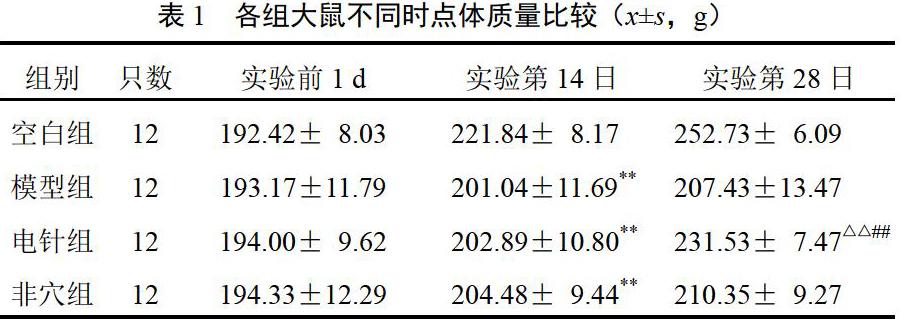
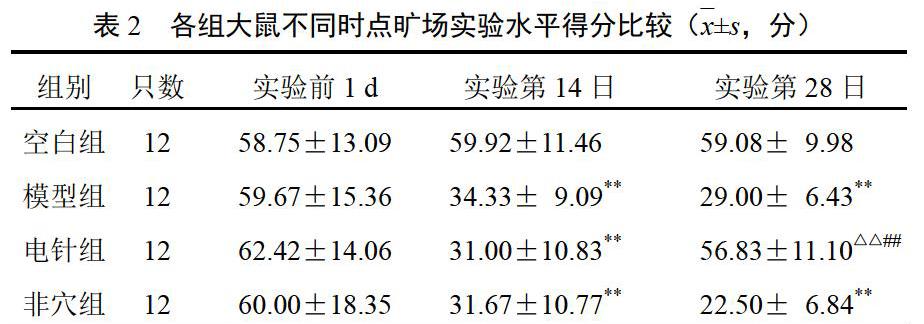
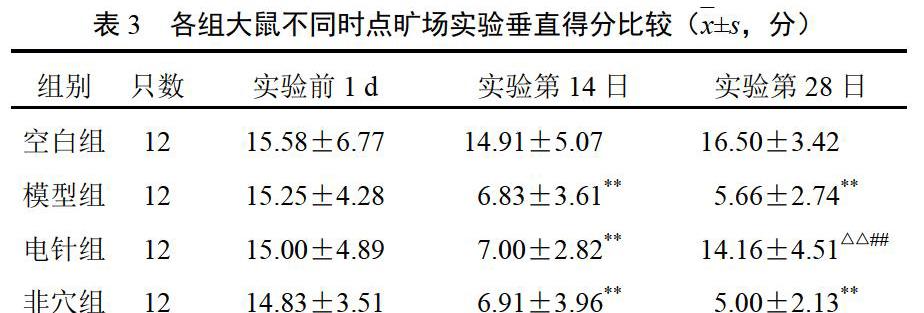
摘要:目的 观察电针“肝俞”“足三里”对抑郁型功能性消化不良大鼠抑郁状态、胃肠动力及脑内相关蛋白表达的影响,探讨电针治疗抑郁型功能性消化不良的机制。方法 将48只雌性Wistar大鼠随机分为空白组、模型组、电针组和非穴组,每组12只。应用慢性不可预见性温和应激法建立抑郁型功能性消化不良大鼠模型。于造模第15日开始,电针组每日予电针“肝俞”“足三里”干预,非穴组给予距尾尖1/3、2/3处电针刺激,干预14 d。于实验前1 d和实验第14、28日对各组大鼠进行体质量检测、旷场实验和蔗糖偏好实验;于取材前对各组大鼠进行黑色糊状物灌胃,40 min后检测大鼠胃内残留率和小肠推进率;Western blot检测大鼠外侧缰核βCaMKⅡ、海马脑源性神经营养因子(BDNF)蛋白的表达。结果 与空白组比较,模型组和非穴组大鼠体质量、蔗糖偏好率、行为学评分、小肠推进率、海马BDNF表达明显下降(P<0.01),胃内残留率和外侧缰核βCaMKⅡ表达明显升高(P<0.01);与模型组比较,电针组大鼠体质量、蔗糖偏好率、行为学评分、小肠推进率、海马BDNF表达明显升高(P<0.01),胃内残留率和外侧缰核βCaMKⅡ表达明显降低(P<0.01);与非穴组比较,电针组大鼠外侧缰核βCaMKⅡ表达量显著降低、海马组织BDNF表达量显著增加(P<0.01)。结论 电针“肝俞”“足三里”可改善抑郁型功能性消化不良大鼠的抑郁状态和胃肠动力。
关键词:抑郁型功能性消化不良;电针;肝俞;足三里;βCaMKⅡ;脑源性神经营养因子;大鼠
DOI:10.3969/j.issn.1005-5304.2016.03.017
中图分类号:R245 文献标识码:A 文章编号:1005-5304(2016)03-0062-05
Abstract: Objective To observe the effects of electroacupuncture at Ganshu (BL18) and Zusanli (ST36) on depression state and gastrointestinal motility and relevant protein expressions in brain of rats with stress-induced depressive functional dyspepsia. Methods Totally 48 Wistar rats were randomly divided into normal, model, electroacupuncture (EA) and sham-operation group, with 12 rats in each group. Depressive functional dyspepsia model was established by chronic unpredictable mild stress protocols. From day 15 to day 28, the EA group was given electroacupuncture at BL18 and ST36, and the sham-operation group was stimulated by electroacupuncture at 1/3 and 2/3 of the tail. Body weight test, open field test and sucrose preference test were measured on day 0, day 14 and day 28. After 14-day administration, gastric residual volume and intestinal propulsion rate of semisolid paste were detected. The expression of βCaMKⅡin lateral habenulas and BDNF in hippocampus were measured by Western blot. Results Compared with the normal group, the weight, the sucrose preference rate, the behavior score, the small intestinal propulsion rate of semisolid paste and the expression of BDNF in hippocampus decreased significantly both in the model group and sham-operation group (P<0.01), and the gastric residual volume of semisolid paste and the expression of βCaMKⅡin lateral habenulas increased significantly (P<0.01). Compared with the model group, the weight, the sucrose preference rate, the behavior score, the small intestinal propulsion rate of semisolid paste and the expression of BDNF in hippocampus increased significantly in EA group (P<0.01), and the gastric residual volume of semisolid paste and the expression of βCaMKⅡin lateral habenulas decreased significantly (P<0.01). Compared with the sham-operation group, the expression of βCaMKⅡ in lateral habenulas decreased significantly, the expression of BDNF in hippocampus increased significantly in EA group (P<0.01). Conclusion Electroacupuncture at Ganshu (BL18) and Zusanli (ST36) can improve depression and gastrointestinal motility of rats with depressive functional dyspepsia, which may be related to the inhibition of βCaMKⅡin lateral habenulas and the activation of BDNF in hippocampus dyspepsia.
Key words: depressive functional dyspepsia; electroacupuncture; Ganshu (BL18); Zusanli (ST36); βCaMKⅡ; BDNF; rats
功能性消化不良是一种常见的慢性非器质性胃肠功能紊乱性疾病,临床表现主要为嗳气、厌食、腹胀、腹痛等。目前,西药治疗多采用促进胃动力药物,虽然能有效缓解症状,但具有较高的复发率,并且有部分患者对药物治疗无效,给患者生活质量带来明显的影响。本实验通过模拟人类每日应激引起抑郁状态和胃肠不适的方法,建立抑郁型功能性消化不良大鼠模型,观察电针对模型大鼠的抑郁状态及胃肠动力的影响,检测外侧缰核βCaMKⅡ及海马脑源性神经营养因子(BDNF)蛋白的表达,探讨电针对抑郁型功能性消化不良的作用机制。……
登录APP查看全文
