
In2S3—Ag/TiO2三元纳米体系光催化降解2,4—D的实验研究
2016-03-05 11:57:04余健赵令晖唐浩刘承斌李玥
湖南大学学报·自然科学版
2015年12期
余健++赵令晖++唐浩++刘承斌++李玥
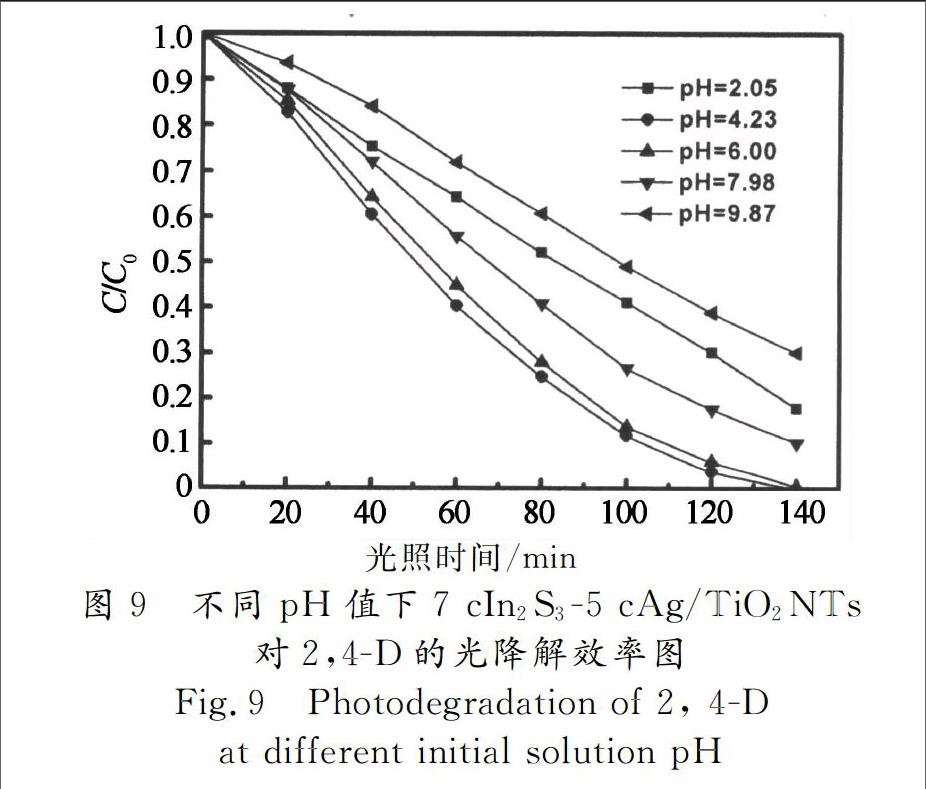
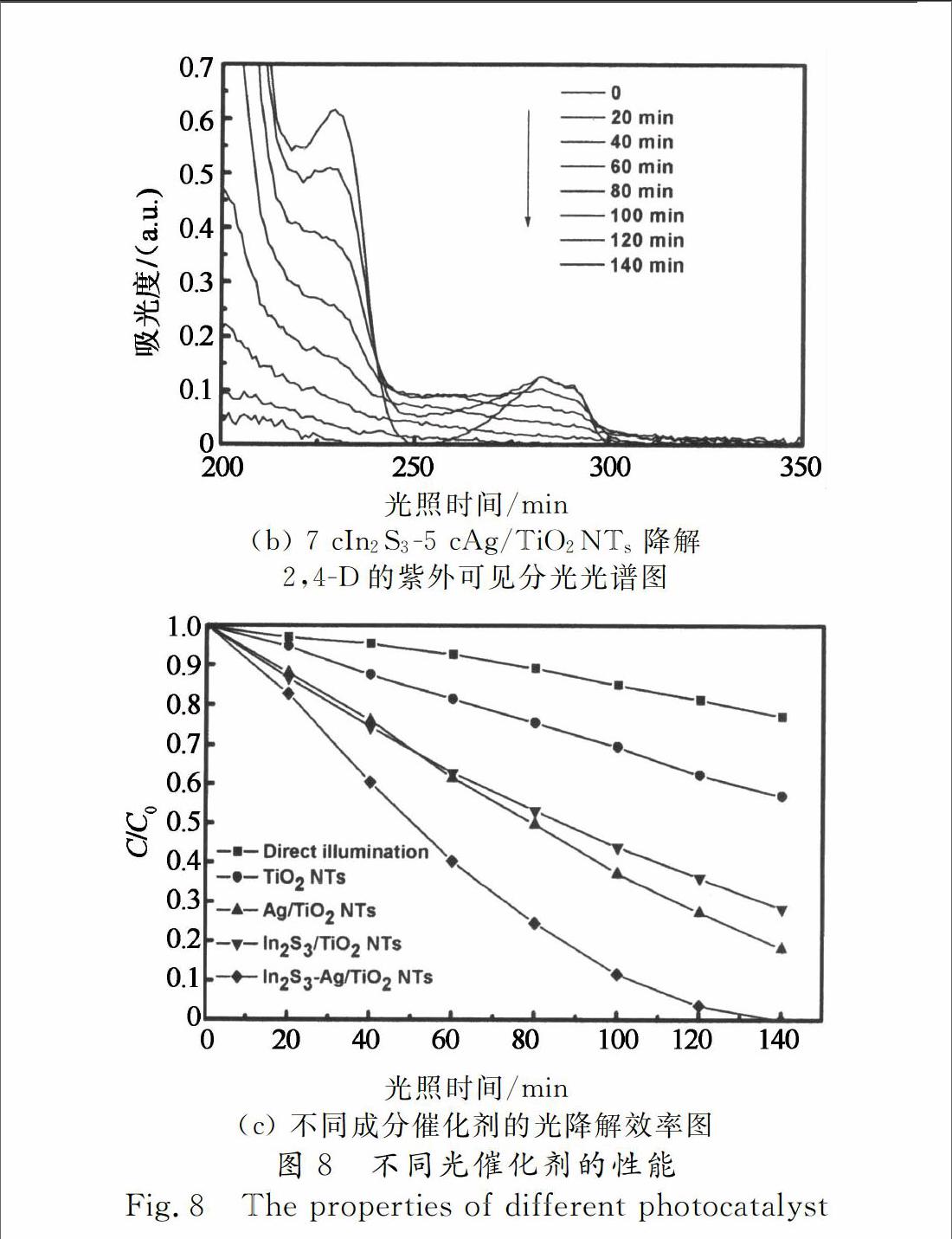
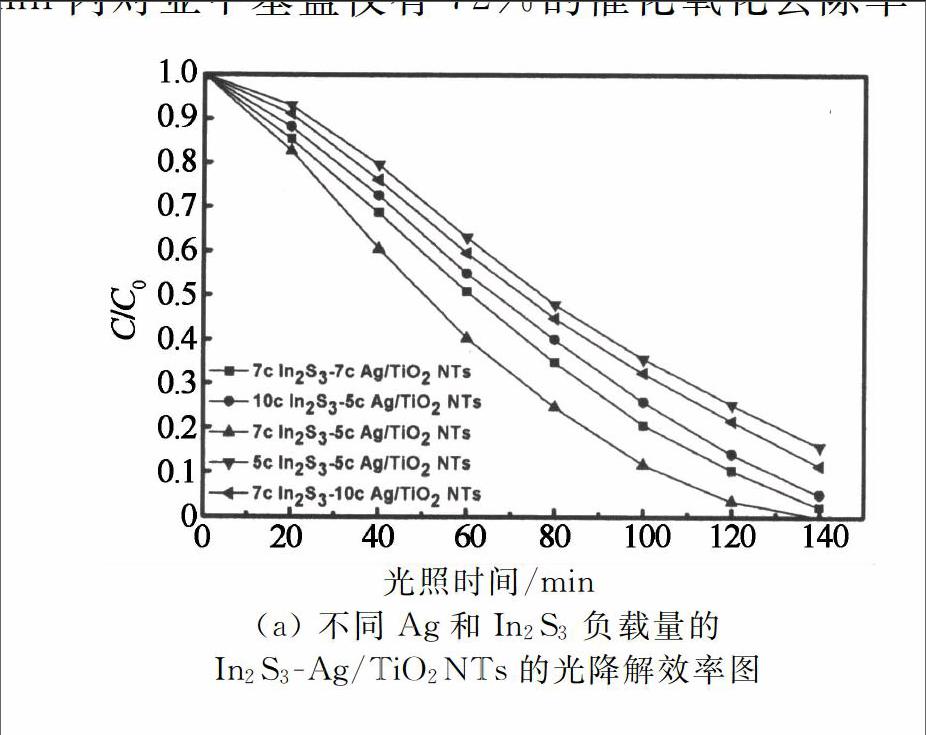
摘 要:采用两步沉积法首次合成出新三元纳米材料-In2S3-Ag/TiO2纳米管阵列,并用电子扫描显微镜(SEM)、光致发光光谱仪(PL)等仪器对该三元催化剂进行形貌、元素、晶体结构的表征与光电性能的测试,并将该三元催化体系应用于2,4-二氯苯氧乙酸(2,4-D)的光降解实验.结果表明,In2S3-Ag/TiO2三元纳米材料所特有的两步光激发体系使它的催化降解能力显著提高,在溶液pH为4.23时,140 min内可实现对2,4-D 100%的去除;强酸和强碱的环境都不利于三元催化剂In2S3-Ag/TiO2对 2,4-D的催化降解.最后对三元催化剂的光催化降解机理进行了探讨.
关键词:光催化;In2S3-Ag/TiO2;两步沉积法;两步光激发
中图分类号:X5 文献标识码:A
The Investigation of Photodegradation of 2,4-D by the
Three-component System In2S3-Ag/TiO2 Nanotube Arrays
YU Jian1, ZHAO Ling-hui1, TANG Hao1, LIU Cheng-bin2, LI Yue2
(1. College of Civil Engineering, Hunan Univ, Changsha,Hunan 410082, China;
2. College of Chemistry and Chemical Engineering, Hunan Univ, Changsha,Hunan 410082,China)
Abstract:A new kind of three-component nanomaterials-In2S3-Ag/TiO2 nanotube arrays was first synthesized in two-step deposition method. In this study, the morphology, elements, crystal structure and photoelectric property testing of the three-component photocatalyst were characterized by scanning electron microscope (SEM) and fluorescence photoluminescence spectra (PL), etc. The three-component photocatalyst was applied to the photodegradation 2,4-dichlorophenoxyacetic acetic acid (2,4-D). The photocatalytic degradation experiment results of 2,4-D have shown that its 100% removal rate can be achieved within 140 minutes. The unique two-step excitation process in the three-component In2S3-Ag/TiO2NTs system leads to the significant improvement of photocatalytic ability. The experiments indicate that different values of pH and the concentration of 2,4-D have significant effect on degradation. The preliminary results show that the photocatalytic reactions are optimized at pH 4.23, higher or lower pH levels will reduce the removal rate due to the phase change of 2,4-D molecules. The photocatalytic degradation mechanism was also analyzed with equations and model diagrams.
Key words:photocatalysis; In2S3-Ag/TiO2; the two-step deposition method; the two-step excitation process
2,4-二氯苯氧乙酸(2,4-D)是一种植物生长调节剂和除草剂,在常温条件下性质稳定,微溶于水,使用后残留的大部分2,4-D进入土壤与水环境中. 虽然2,4-D遇紫外线照射会引起部分分解,但自然分解速率缓慢,在黑土中的降解半衰期为27.3 d,红土中为301.4 d.2,4-D属于低毒类有机物,能经口、皮肤吸附进入人体造成损害,对眼睛、皮肤均有刺激作用,其急性毒性主要表现为神经毒性[ 1].目前对存在于环境中的2,4-D的去除方法主要有生物降解、臭氧氧化以及光降解等.其中,光催化降解是一种新兴的绿色水处理技术,它具有高效、无二次污染、适用范围广等优点,在环境污染治理领域已初步显示出其明显的优越性[ 2].
光催化作用是光催化剂(多数指半导体材料)在光照条件下,通过在空间内不同类型纳米分子之间的联动……
登录APP查看全文
