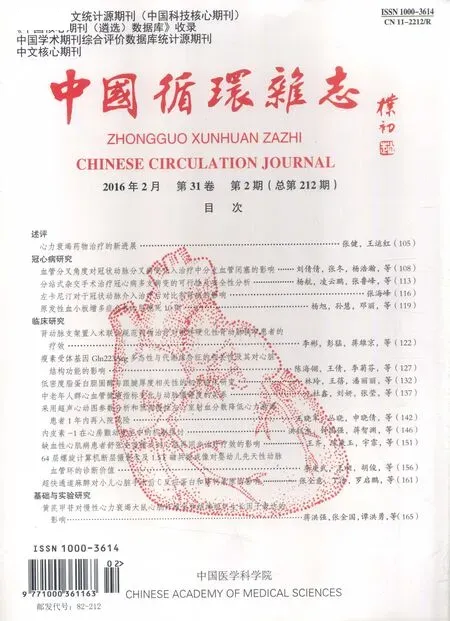
缺血性心肌病患者舒张充盈模式对心脏再同步治疗疗效的影响
2016-04-01 09:35:05王齐陈康玉宇霏苏浩安春生胡杨杨冬妹徐健严激
中国循环杂志
2016年2期
关键词:心力衰竭
王齐, 陈康玉, 宇霏, 苏浩,安春生, 胡杨, 杨冬妹, 徐健, 严激
缺血性心肌病患者舒张充盈模式对心脏再同步治疗疗效的影响
王齐, 陈康玉, 宇霏, 苏浩,安春生, 胡杨, 杨冬妹, 徐健, 严激
摘要
关键词心力衰竭 ;心脏再同步治疗;超声心动描记术,多普勒
作者单位:230001 安徽省合肥市,安徽医科大学附属省立医院 心血管内科
Influence of Diastolic Filling Pattern on Cardiac Resynchronization Therapy in Patients With Ischemic Cardiomyopathy
WANG Qi, CHEN Kang-yu, YU Fei, SU Hao, AN Chun-sheng, HU Yang, YANG Dong-mei, XU Jian, YAN Ji.
Department of Cardiology, Provincial Hospital Affiliated to Anhui Medical University, Hefei (230001), Anhui, China Corresponding Author: YAN Ji, Email: yanji111111@ 126.com
Abstract
Objective: To explore the influence of diastolic filling pattern on cardiac resynchronization therapy (CRT) in patients with ischemic cardiomyopathy.
Methods: A total of 61 patients with ischemic cardiomyopathy received CRT in our hospital from 2012-03 to 2014-03 were studied.According to pre-CRT diastolic filling pattern, the patients were divided into 2 groups: Non-restrictive filling (NRF) group, n=36 and RF group, n=25.All patients were followed-up for 12 months, based on NYHA classification, CRT efficacy was assessed by echocardiography; the endpoints included re-hospitalization for heart failure or cardiac death.Kaplan-Meier survival curve was used to assess the prognosis.
Results: ①NRF group had CRT response rate at 66.7% (24/36) which was higher than RF group 28.0% (7/25), (χ²=8.826, P=0.003); the post-operative NYHA classification, LVEF, FS, LVEDV and LVESV were significantly improved, all P<0.01.②RF group showed the improved post-operative NYHA classification, P<0.01, while no obvious changes of LVEF, FS, LVEDV at 6 months after operation, and LVESV increased than it was before, P<0.05.Significant differences were observed between 2 groups at 6 months after operation, P<0.01.Logistic regression analysis indicated that diastolic filling pattern was the independent impact factor for CRT response.There were 2 patients died during 12 months of follow-up period; the endpoints in RF group was 76.0% (19/25) which was higher than NRF group 44.4% (16/36), (χ²=5.213, P=0.022).
Conclusion: Diastolic filling pattern affected CRT efficacy in patients with ischemic cardiomyopathy; NRF patients were more beneficiary for CRT, while RF patients had lower response to CRT which associated to poor prognosis.
Key words Heart failure; Cardiac resynchronization therapy; Echocardiography, Doppler
(Chinese Circulation Journal, 2016,31:151.)
缺血性心肌病是冠心病的一种特殊类型和终末期阶段。美国现有心力衰竭(心衰)患者中,至少70%的左心室收缩功能不全系缺血性心肌病所致[1],随着国内人口老龄化程度增加,冠心病尤其是急性心肌梗死患者存活率的提高,缺血性心肌病的发生率将不断增加。缺血性心肌病的药物治疗效果及预后很差,大量循证医学资料表明心脏再同步治疗(CRT)能改善缺血性心肌病患者的心衰症状,提高生活质量,并能降低心衰再住院风险及死亡率[2,3],但约30%的患者表现为CRT无反应,且缺血性心肌病较原发性心肌病的疗效差。舒张功能作为心脏整体功能的重要组成部分,长期以来,其受重视程度远低于收缩功能。异常的舒张功能对心衰症状和体征的产生具有重要意义,即使在收缩性心衰中,升高的左心室充盈压与运动受限密切相关,独立于收缩功能不全的程度[4, 5]。冠心病是舒张功能不全的主要病因之一,其舒张功能损害甚至早于收缩功能[6-8]。异常的舒张功能是否对CRT疗效产生影响,目前尚不明确。本研究旨在探究缺血性心肌病患者舒张充盈模式对CRT疗效的影响,为CRT患者的筛选及疗效预测提供依据。……
登录APP查看全文
猜你喜欢
现代养生·下半月(2016年5期)2017-01-09 12:06:24
中国当代医药(2016年29期)2017-01-03 23:58:04
中国实用医药(2016年30期)2016-12-28 22:44:13
中国实用医药(2016年23期)2016-12-26 14:20:38
中国实用医药(2016年27期)2016-11-30 10:41:01
中外医学研究(2016年28期)2016-11-28 12:35:34
中国现代医生(2016年23期)2016-11-15 03:43:35
中国实用医药(2016年24期)2016-10-17 04:51:36
上海医药(2016年17期)2016-10-12 01:43:07