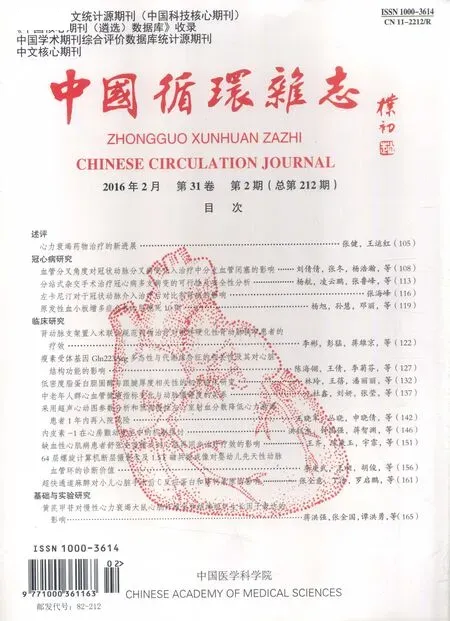
超快通道麻醉对小儿心脏手术后C反应蛋白和降钙素原的影响
2016-04-01 09:34:27张全意丁洁罗启鹏张浩晏馥霞李立环
中国循环杂志
2016年2期
关键词:降钙素原
张全意,丁洁,罗启鹏,张浩,晏馥霞,李立环
超快通道麻醉对小儿心脏手术后C反应蛋白和降钙素原的影响
张全意,丁洁,罗启鹏,张浩,晏馥霞,李立环
摘要
关键词麻醉; C反应蛋白质;降钙素原
作者单位:100037 北京市,北京协和医学院 中国医学科学院 国家心血管病中心 阜外医院 麻醉科(张全意、丁洁、罗启鹏、晏馥霞、李立环),小儿心脏外科中心(张浩)
Effects of Ultra-fast Track Anesthesia on Blood Levels of C-reactive Protein and Procalcitonin in Patients After Pediatric Cardiac Surgery
ZHANG Quan-yi, DING Jie, LUO Qi-peng, ZHANG-hao, YAN Fu-xia, LI Li-huan.
Department of Anesthesiology, Cardiovascular Institute and Fu Wai Hospital, CAMS and PUMC, Beijing (100037), China
Corresponding Author: YAN Fu-xia, Email: yanfuxiafw@163.com
Abstract
Objective: To compare the effects of ultra-fast track anesthesia and traditional anesthesia on blood levels of high sensitivity C-reactive protein (Hs-CRP), C-reactive protein (CRP) and procalcitonin (PCT) in patients after pediatric cardiac surgery.
Methods: A total of 101 patients received pediatric cardiovascular surgery by a same anesthesiologist in our hospital from 2013-09 to 2014-05 were retrospectively reviewed.The patients were studied in 2 anesthesia groups: Ultra-fast track group, in which the extubation was conducted in operating room, n=40 and Traditional group, n=44.Blood levels of Hs-CRP, CRP and PCT at pre-operation (T0), 1stday post-operation (T1) and 2ndday post-operation (T2) were compared.
Results: ①Hs-CRP levels were higher at T1 and T2 than T0 in both groups, all P<0.05; Hs-CRP level in Ultra-fast track group was lower than Traditional group at T1 time point, P<0.05.②CRP levels were similar among 3 time points in Ultrafast track group; while in Traditional group, CRP level at T2 was higher than T1, P<0.05; CRP level was higher in Traditional group than Ultra-fast track group at T2, P<0.05.③PCT levels at 3 time points were similar in the same group; while PCT level in Ultra-fast track group was lower than Traditional group at T1 time point, P<0.05.
Conclusion: Compared With traditional anesthesia, ultra-fast track anesthesia could decrease the post-operative elevations of Hs-CRP, CRP and PCT in patients after pediatric cardiac surgery.
Key words Anesthesia; C-reactive protein; Procalcitonin
(Chinese Circulation Journal, 2016,31:161.)
超快通道麻醉是指心脏手术后即刻在手术室内气管拔管的麻醉技术。一项系统回顾性Meta分析研究表明心脏手术后早期拔管是安全的,可以减少重症监护病房(ICU)停留时间和住院时间[1]。
术后呼吸机相关性肺炎是小儿心脏手术后常见的并发症之一,但呼吸机相关性肺炎难以早期诊断。近年来研究发现C反应蛋白(CRP)、高敏CRP(hs-CRP)、降钙素原(PCT)可作为呼吸机相关性肺炎的预测指标,尤其是PCT对呼吸机相关性肺炎的诊断具有较高的敏感性与特异性[2, 3]。超快通道麻醉可以减少患儿术后使用呼吸机的时间,但是否能减轻呼吸机相关性肺损伤,目前尚少见相关文献报道。本研究通过比较小儿心脏手术中超快通道麻醉方法和传统麻醉方法术后CRP、hsCRP和PCT含量变化,探讨超快通道麻醉方法对术后呼吸机相关性肺炎的影响。
1 资料与方法
一般资料:通过麻醉临床信息系统,回顾分析了2013-09至2014-05由同一位麻醉医师实行心血管手术的101例患儿麻醉资料。排除标准为:术前肝、肾功能不全,术前检查hs-CRP增高(>3 mg/L),先天性心脏病手术风险分级评分 (RACH-1)>4,主动脉阻断时间>2 h,入室时已经行气管插管及麻醉记录不完整。最终8……
登录APP查看全文
猜你喜欢
中国当代医药(2016年30期)2017-01-07 13:19:35
中国实用医药(2016年29期)2016-12-26 10:04:59
中国实用医药(2016年23期)2016-12-26 09:51:08
中国实用医药(2016年29期)2016-12-26 08:16:34
中国当代医药(2016年28期)2016-12-20 15:43:56
华夏医学(2016年4期)2016-12-12 00:12:41
中外医学研究(2016年26期)2016-11-30 02:44:00
中国实用医药(2016年24期)2016-10-17 04:27:23
中国实用医药(2016年24期)2016-10-17 04:15:03
中国实用医药(2016年24期)2016-10-17 03:21:57