
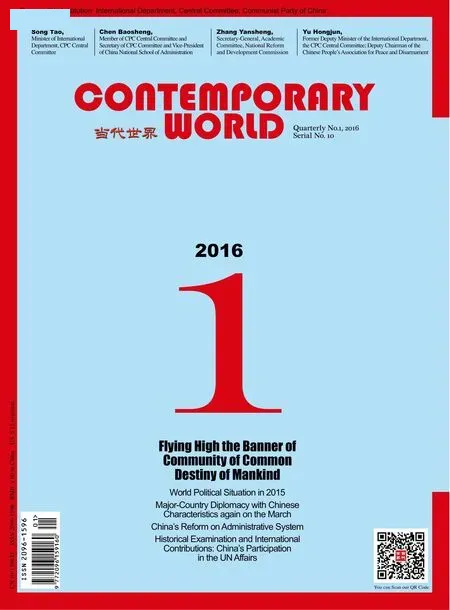
Historical Examination and International Contributions: China’s Participation in the UN Affairs
2016-04-18 04:00:24YUHONGJUNFormerDeputyMinisteroftheInternationalDepartmenttheCPCCentralCommitteeDeputyChairmanoftheChinesePeopleAssociationforPeaceandDisarmament
Contemporary World
2016年1期
YU HONGJUNFormer Deputy Minister of the International Department, the CPC Central Committee; Deputy Chairman of the Chinese People’s Association for Peace and Disarmament
Historical Examination and International Contributions: China’s Participation in the UN Affairs
YU HONGJUN
Former Deputy Minister of the International Department, the CPC Central Committee; Deputy Chairman of the Chinese People’s Association for Peace and Disarmament

THE UN AS THE WORLD’S LARGEST AND MOST REPRESENTATIVE INTER-GOVERNMENTAL ORGANIZATION, ASSUMES INDIS-putable authority in maintaining the international order, promoting common development and pushing for the establishment of a new just and equitable international political and economic order.China is a founding member of the UN and a permanent member of its Security Council.But for quite a long time, the Chiang Kai-shek clique overturned in the civil war unduly seized China’s seat in the UN.In October 1971, New China won the struggle to regain its legitimate seat and rights in the UN.Thereupon the socialist CPC-led New China began to engage in the UN affairs and stride with pride and confidence into the center of the world stage.

The 26th session of the UN General Assembly was held on October 25, 1971.The lawful seat and rights of the People’s Republic of China in the United Nations were restored.
STRUGGLES TO RESTORE ITS LEGITIMATE RIGHTS IN THE UN, FIRMLY PROJECTS AN IMAGE OF A RESPONSIBLE BIG COUNTRY
Upon its founding, New China, at the suggestion of the USSR, began to ponder entry into the UN.On November 15, 1949, Chinese prime minister and foreign minister Zhou Enlai sent telegrams to Rayy and Romulo, respectively UN secretary-general and president of the Fourth Session of UN General Assembly, requesting to outright disqualify Chiang Kai-shek clique from engaging in the UN affairs in the name of China.The USSR and other eastern European countries vigorously supported China in its efforts to enter the UN.The Polish representative to the UN even presented a protest against the UN as the UN secretary-general Rayy showed a passive attitude towards the matter.
On January 8, 1950, when Chairman Mao Zedong was visiting the USSR, instructed (at the USSR‘s suggestion) primer minister Zhou Enlai to send telegrams in the name of Chinese foreign minister to the president of the UN General Assembly, UN secretarygeneral and members of UN Security Council, entreating again the UN to kick the Chiang Kai-shek clique out of the UN Security Council.The USSR, in accordance with the China-USSR plan, submitted to the UN a proposal in support of China and released a statement that it would avoid work at the Security Council unless the UN kicked out the Chiang Kai-shek clique.But due to the US manipulation, the UN General Assembly vetoed the proposal of the USSR.The USSR tried to support China’s entry into the UN even at the expense of splitting the Security Council, but the strategy went in vain.
Though New China’s struggle to regain its legitimate seat in the UN failed to get off to a good start, the country never slacked diplomatic efforts to that end.In a gesture of supporting China, the USSR and some other eastern European countries exited those organizations, suspending cooperation with them.
Under the pressure from China and the USSR-led eastern European countries, the UN secretary-general had talks regarding China’s delegacy with representatives of various countries and held formal consultations with Wang Jiaxiang, Chinese ambassador to the USSR.In June of that year, the Korean War broke out, which put New China at an even more disadvantageous position to regain its legitimate rights in the UN.Despite that, prior to the opening of the Fifth Session of the UN General Assembly, the Chinese government appointed Zhang Wentian as Chinese chief representative to the session, and sent to Rayy a telegram, requesting him to facilitate the entry of Zhang Wentian and his fellow Chinese representatives into the UN, and showing firm opposition against the UN keeping members of the Chiang Kai-shek clique.But all these endeavors went down the drain due to the obstinate obstruction of the US-led western powers.
Following the ceasefire on the Korean peninsula in 1953, the international political landscape underwent new changes.But the US, in order to keep China out of the UN, made a proposal in November of that year to the effect that the CPC can participate in the UN General Assembly while the KMT remains in the UN Security Council, trying to create two Chinas and thus eroding China’s diplomatic efforts.On the big issues concerning sovereignty and dignity, China upholds principles and shows no compromise, resolutely averting the US diplomatic traps.China always stresses and believes that People’s Republic of China is the sole legitimate representative of Chinese people, which will win universal recognition one day in the future.
REGAINS UN SEAT THANKS TO FORCES OF JUSTICE, MAKES A GIANT STRIDE TO THE WORLD STAGE
Throughout the 1950s, the US kept the UN under stringent control.It always employed the “no discussion for the moment” tactics to oppose China’s delegacy in the UN.In the 1960s, the UN General Committee passed theproposal on discussing China’s representation.Then the US used the new sleight of hand and pushed for the adoption of the Important Question Resolution by the UN General Assembly, which stated that China shall gain a seat when the majority (two thirds) of the representatives vote for it.Still, China was kept outside the UN.
In July 1971, representatives of 17 countries including Albania and Algeria sent a message to the UN secretarygeneral, demanding to restore the legitimate seat of the People’s Republic of China and to put the proposal of expelling the Chiang Kai-shek clique’s representatives into the UN General Assembly’s agenda of the year, which was accepted by the UN General Assembly.
Centering on China’s representation, the 26th Session of the UN General Assembly in 1971 put three resolutions to the vote: first, it was the “Albanian Resolution” co-sponsored by Albania and Algeria among other countries which stated the UN should restore all lawful rights of the People’s Republic of China and promptly oust the Chiang Kai-shek clique’s representatives; second, it was the “Important Question Resolution” of the US and Japan among other countries, which tried to make the ousting of the Republic of China Government an important question requiring a decision of a two-thirds majority; and third, it was the “Dual Representation Resolution” made by the US and Japan, a proposal that recognized that the People’s Republic of China is a member of the UN and a permanent member of the UN Security Council while the Republic of China retains representation in the UN.
When the UN General Assembly was convened on October 25, after the passage of the “Albanian Resolution”, the “Dual Representation Resolution”presented by the US and Japan was dismissed as void.The UN, based on the voting result on the “Albanian Resolution”, made the No.2758 Resolution, to restore all rights of the People’s Republic of China in the UN and kick Chiang Kai-shek’s representatives out of the UN and its subsidiary organizations right away.

China joined the Special Committee on Peacekeeping Operations of the United Nations in 1988 and has been actively involved in peacekeeping operations worldwide since then.The photo shows the third Chinese Formed Police Unit in Liberia practicing small unit tactics on February 9, 2015.
The restoration of China’ legal status in the UN should be attributable to the concerted efforts of the international forces of justice.Among the 23 countries which sponsored the “Albanian Resolution”, 12 were from Africa, 7 Asia, 3 Europe and 1 Latin America.Albania and Algeria’s friendliness to China played an important role.Though Yugoslavia and Cuba went estranged with China, but they both signed the “Albanian Resolution”.Though the relationship between the USSR-led eastern European countries and China severely worsened, they all showed a clear-cut supportive stance in the vote for the restoration of China’s representation.At that time, the USSR had three votes (as Ukraine and Byelorussia were members of theUN, either with one vote); its positive stance was vital to China.

CHINA HOLDS HIGH THE BANNER OF UNITY AND ANTI-HEGEMONY, TURNS INTO A MAJOR REPRESENTATIVE OF DEVELOPING COUNTRIES IN THE UN
Upon receiving the news that New China regained it legitimate seat in the UN, on October 29, 1971, the Chinese government released a statement in the UN No.2758 Resolution that the US policy aiming to deprive China of its legal rights and the plot to create “two China” had gone bankrupt, and declared that China will stand together with all the countries and peoples in the world that uphold peace and justice, to strive to safeguard the national independence and state sovereignty of all countries, to maintain the international peace, and to promote progressive causes of mankind.
When China regained its UN seat in 1971, the two super powers of the US and the USSR faced interlocking contradictions in scrambling for hegemony; the developing countries waged grim struggles against hegemony and power politics.As a matter of course, China, as a developing socialist country, is committed to efforts to safeguard the legitimate rights and interests of developing countries and promote the establishment of a new fair and equitable international political and economic order, which is the main task and goal for it to join the UN and carry out the UN work.
For example, regarding such issues as all-round disarmament, Middle East conflicts, Portuguese invasion into Africa and African racial discrimination, China always takes the initiative to speak for the developing countries, assume the mission of safeguarding the interests of developing countries and push for the passage of many resolutions opposing hegemony and curbing power politics, for which China enjoys huge popularity around the world.
In view of the new international situations, the new balance of power and China’s new demand for foreign strategy, Mao Zedong put forward the three-world theory which holds that the US and the USSR belong to the first world, the developing countries including China belong to the third world and the remainder the second.It is at the core of the international struggle for all people across the world to get united and oppose the two super powers.In 1974, then Chinese vice prime minister Deng Xiaoping led a delegation to attend the UN sixth special meeting where the Chinese representatives gave a well-rounded illustration of Mao Zedong’s threeworld theory, unequivocally proposed to establish a new fair and equitable international political and economic order, and solemnly pledged that China belongs to the third world, it never seeks to be a superpower and never seeks hegemony, which evoked extensive repercussions around the world.
Still, due to historical reasons, China had a very limited understanding about the UN when it just regained its lawful rights.For quite a long time, China regarded the UN as a tool of the US or a place for collusion between the US and the USSR.From 1972 to 1975, China successively regained its seat in the WHO, FAO, UPU and ICAO, and gradually engaged in activities of UNDP, UNCTAD, UNEP and ECOSOC.On the whole, as China had a smattering of knowledge about the functions of the organizations under the UN, its involvement in them was intended to know more about them, and its role in them couldn’t be spoken of at all.
EXTENSIVELY ENGAGES IN UN AFFAIRS, TAKES ON INCREASING INTERNATIONAL RESPONSIBILITIES AND OBLIGATIONS
From late 1970s to early 1980s, China launched the reform and opening up policy and pressed ahead with the modernization campaign.In this period China all-roundly adjusted its foreign strategy and tactics such that China went father away from an insular nation and major changes were seen in China’s attitude to and engagement in the UN affairs.
Since China embarked on cooperation with the UNDP in 1978, the Program provided assistance to China every five years.China’s cooperation with UNCTAD has become enriched over the passage of time, which concerns many fields like commerce, trade, foreign investment and regional arrangement of economic globalization.China’s cooperation with the WFP has gained momentum and its cooperation with the UN Population Fund and UNICEF has led China to feel for itself the significance of international cooperation.Over the past 30-plus years, the two funds respectively provided to China around USD220 million and USD495 million in gratuitous aid.
Since 1980s, China has been engaged in UN affairs across the board, from peaceful utilization of outer space to exploration of seabed resources, fromtechnological and cultural communication to children’s immunization and then to AIDS prevention and treatment of children, Chinese representatives are seen and Chinese voices are heard in various organizations and departments of the UN.In the economic and financial sector, the UN agencies and organizations, like the UNDP, World Food Program, World Bank and International Monetary Food all get high attention from China.
As for the UN peacekeeping, China thoroughly changed its old mindset that took the UN peace-keeping as interference in other countries’ internal affairs.China has made it clear that the UN peacekeeping operations conducted in light of the UN Charter’s purpose and principle to safeguard international peace and security and to maintain the state sovereignty and independence all deserve China’s serious treatment and research.With such a stance, China voted for the motion that the UN should prolong peacekeeping operations in Cyprus and in 1982 China began to accept the UN peacekeeping operation budget assessment.Since 1988 China has become a member of the UN Peacekeeping Special Committee and therefore actively engages in the global peacekeeping operations.
SAFEGUARDS THE UN STATUS AND AUTHORITY, PROMOTES AND SPEARHEADS REFORM OF THE INTERNATIONAL ORDER
At the beginning of the 21st century, China, in face of international balance of power and its own development need, came to have a better understanding about “the UN needs China and China needs the UN”.In 2000 Chinese president Jiang Zemin attended the UN Millennium Summit and delivered a speech, deeming that the UN plays an irreplaceable role in maintaining world peace, promoting development for all and pushing for establishment of a new fair and equitable international political and economic order.China as a permanent member of the UN Security Council will as always fulfill its duties and obligations to the UN.
The restoration of China’ legal status in the UN should be attributable to the concerted eforts of the international forces of justice.
As a result of the 14-year arduous negotiations, China joined the WTO closely related to the UN in 2001.The world’s influence upon China and China’s interaction with the world become more and more widespread, which means the UN organizations’influence and significance to China become more evident.In 2005 Chinese president Hu Jintao attended the commemoration meeting for the 60th founding anniversary of the UN and proposed at the meeting the notion of “Harmonious World”, indicating China is set to playing a role in international affairs as a more responsible big country.Indeed it is.In contributing to the fulfillment of the UN millennium development goal, China engages in discussion on all important issues ranging from Israeli-Palestinian conflict, anti-terror cooperation, African issue, Afghanistan issue, Korean nuclear issue, Iran nuclear issue, Georgia issue, war-torn Syria, Ukraine crisis, climate change and global governance.
More than a permanent member of the UN Security Council, China is a member of the Organizing Committee of the UN Peace-building Commission established in 2005.In support of the Commission, China donated USD3 million between 2010 and 2012 in addition to the previous donation of USD3 million.In 2006, the UN set the Internet Governance Forum and the UN secretary-general set the Forum on Migration and Development, both of which received active reaction from China.Towards the UN Alliance of Civilizations established after the September 11 Incident, China takes a constructive stance and has begun to engage in its dialogues as of 2007.
In recent years, the UN faces the increasingly pressing issue to reform itself, which has aroused more and more heated debate.On this issue, China supports the UN in keeping pace with the times and conducting necessary reforms to enhance its capability to cope with new challenges.But, the priority of the UN reform should be strengthening its authority, uplifting its efficiency, enhancing its functions through slimming down its agencies, laying off redundant staff and overcoming bureaucracy.With regard to the reform of the UN Security Council and especially the addition of permanent members to the Council, China advocates that all these must be preconditioned on the recognition, negotiation and consensus as well as unanimous support of all member states, otherwise it will split the UN and the international society, prone to trigger crisis in the current international system and world order.In a word, the indisputable guiding principle for the UN reform should be that the UN status should be heightened rather than lowered, its authority safeguarded rather than undermined, and its role strengthened rather than weakened.
On September 26, 2015, Chinese president Xi Jinping attended the UN Sustainable Development Summit at the UN headquarters where he delivered an important speech entitled “Seek Common and Sustainable Development and Forge a Partnership of Win-win Cooperation”.President Xi Jinping announced that China will establish the South-south Cooperation Assistance Fund in support of the UN post-2015 development agenda, with an initial contribution of USD2 billion, and indicated that China will continue to increase investment in the least developed countries and do its best to raise the investment to USD12 billion by 2030.
All these reveal the Chinese government attaches great importance and offers ready support to the UN and its agencies; meanwhile, they manifest that the UN has become and will continue to be an important stage for China to display its unique diplomacy.
登录APP查看全文
- Contemporary World的其它文章
- 黄福霆/作品欣赏
- China’s Belt and Road Initiative Helps to Promote Sri Lanka Economic Development: An Interview with Special Advisor to PM of Sri Lanka Mr.A Aala
- 10 Global News Figures in 2015
- 10 Global News Events in 2015
- The Rising Power of China in Africa and its Implications on African International Relations in the 21st Century
- Resumption of China-Japan-South Korea Trilateral Summit and the Future of Trilateral Cooperation