TTA1—Tat—PEG—GS NPs结合siRNA—EGFR转染C6细胞抑制EGFR基因表达的研究
2016-10-19 20:47:57胡洋张龙李旺魏峰丰伟田新华
中国医药导报
2016年6期
胡洋 张龙 李旺 魏峰 丰伟 田新华

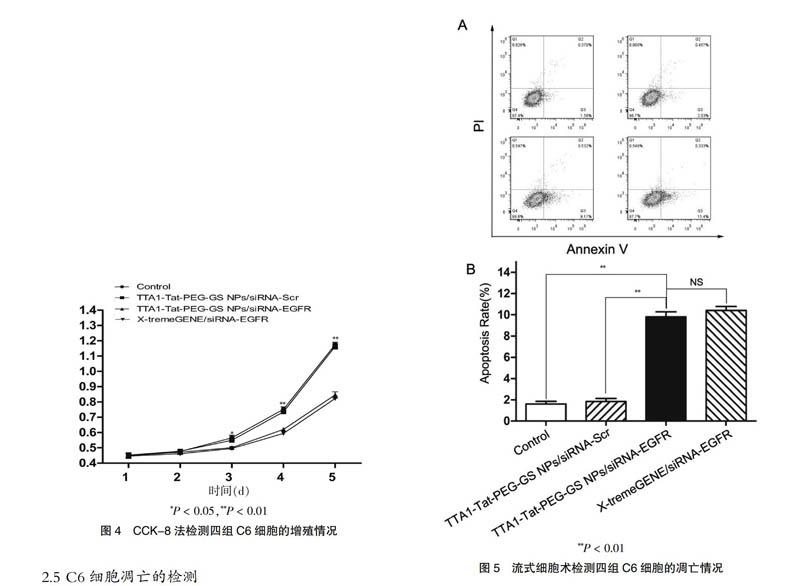
[摘要] 目的 探討TTA1、Tat、聚乙二醇(PEG)修饰的明胶硅氧烷纳米粒子(GS NPs)结合siRNA-EGFR转染C6细胞,抑制其表皮生长因子受体(EGFR)表达的影响。 方法 根据鼠EGFR的mRNA序列设计合成siRNA-EGFR以及阴性对照siRNA-Scr(无意义序列)。TTA1-Tat-PEG-GS NPs通过静电作用结合siRNA。实验分4组:Control组、TTA1-Tat-PEG-GS NPs/siRNA-Scr组、TTA1-Tat-PEG-GS NPs/siRNA-EGFR组及X-tremeGene/siRNA-EGFR组。除Control组外,其余三组均在体外对C6细胞进行转染。Real-time PCR、Western blot分别检测细胞EGFR mRNA及蛋白表达情况;CCK-8法、流式细胞仪分别检测细胞增殖和凋亡情况。 结果 与Control组及TTA1-Tat-PEG-GS NPs/siRNA-Scr组比较,TTA1-Tat-PEG-GS NPs/siRNA-EGFR组在体外细胞水平上能有效抑制C6细胞EGFR mRNA及蛋白的表达(P < 0.01),同时抑制C6细胞的增殖(P < 0.05或P < 0.01)并促进其凋亡(P < 0.01)。此外,X-tremeGene/siRNA-EGFR组和TTA1-Tat-PEG-GS NPs/siRNA-EGFR组在下调C6细胞EGFR水平、抑制细胞增殖及促进细胞凋亡方面差异无统计学意义(P > 0.05)。 结论 TTA1-Tat-PEG-GS NPs可能成为一种新型的基因治疗载体,为胶质瘤基因治疗的进一步研究提供理论依据。
[关键词] 胶质瘤;纳米粒子;基因载体;RNA干扰
[中图分类号] R739.41 [文献标识码] A [文章编号] 1673-7210(2016)02(c)-0004-05
Research of TTA1-Tat-PEG-GS NPs combined with siRNA-EGFR in transfection of C6 cells and inhibiting its EGFR gene expression
HU Yang1 ZHANG Long1 LI Wang1 WEI Feng2 FENG Wei2 TIAN Xinhua2
1.Medical College, Xiamen University, Fujian Province, Xiamen 361004, China; 2.Department of Neurosurgery, Zhongshan Hospital Affiliated to Xiamen University, Fujian Province, Xiamen 361004, China
[Abstract] Objective To investigate the property of TTA1-Tat-PEG modified gelatin-siloxane nanoparticles (GS NPs) combined with siRNA-EGFR in transfection of C6 cells and inhibiting its EGFR gene expression. Methods The siRNA-EGFR and negative control sequences (siRNA-Scr) were designed and synthesized according to the EGFR mRNA sequence of rats. TTA1-Tat-PEG-GS NPs bound to siRNA via electrostatic interaction. The composites of experiment included control group, TTA1-Tat-PEG-GS NPs/siRNA-Scr group, TTA1-Tat-PEG-GS NPs/siRNA-EGFR group and X-tremeGene/siRNA-EGFR group. C6 cells were transfected in all groups except for those in the control group. Real-time PCR and Western blot were used to detect EGFR mRNA and protein levels, respectively. The proliferation and apoptosis were detected with CCK-8 and flowcytometry, respectively. Results Compared with control group and TTA1-Tat-PEG-GS NPs/siRNA-Scr group, TTA1-Tat-PEG-GS NPs/siRNA-EGFR group could inhibit the expression of EGFR mRNA and protein of C6 cells (P < 0.01), restrain the proliferation of C6 cells (P < 0.05 or P < 0.01) and promote its apoptosis (P < 0.01). In addition, there were no statistically significant differences between X-tremeGene/siRNA-EGFR group and TTA1-Tat-PEG-GS NPs/siRNA-EGFR group in decreasing the EGFR levels of C6 cells, inhibiting the cell proliferation and promoting the cell apoptosis (P > 0.05). Conclusion TTA1-Tat-PEG-GS NPs may be a novel gene carrier and provide theoretical foundation for the further research of glioma gene therapy.
[Key words] Glioma; Nanoparticles; Genetic vector; RNA interference
胶质瘤是最常见的颅内恶性脑肿瘤之一,整体的预后及治疗效果不理想[1-2],寻找有效的治疗方法成为当务之急。近年来,基因治疗胶质瘤研究成为一大热点[3],RNA干扰(RNAi)就是基因治疗中极具前景的手段之一[4]。表皮生长因子受体(EGFR)在促进肿瘤细胞增殖及抑制凋亡等方面均发挥重要作用[5]。Wang等[6]认为,EGFR在恶性胶质瘤细胞中常出现扩增、突变以及过表达。应用RNAi降低胶质瘤细胞EGFR的表达,有望成为一个重要的治疗途径[7]。基因治疗的关键因素之一是基因载体,目前主要使用的载体为病毒载体[8],但由于其安全性差、靶向能力差等原因限制了其应用[9],因此非病毒基因载体成为一条新的研究途径[10],然而能具備跨血脑屏障及高效基因转染能力的非病毒基因载体仍不多见[11-12]。……
登录APP查看全文