用气相色谱—质谱联用法分析澳洲坚果幼叶的挥发性成分
2017-04-26 07:12:50朱泽燕黄雪松
热带农业科学
2017年3期
朱泽燕++黄雪松
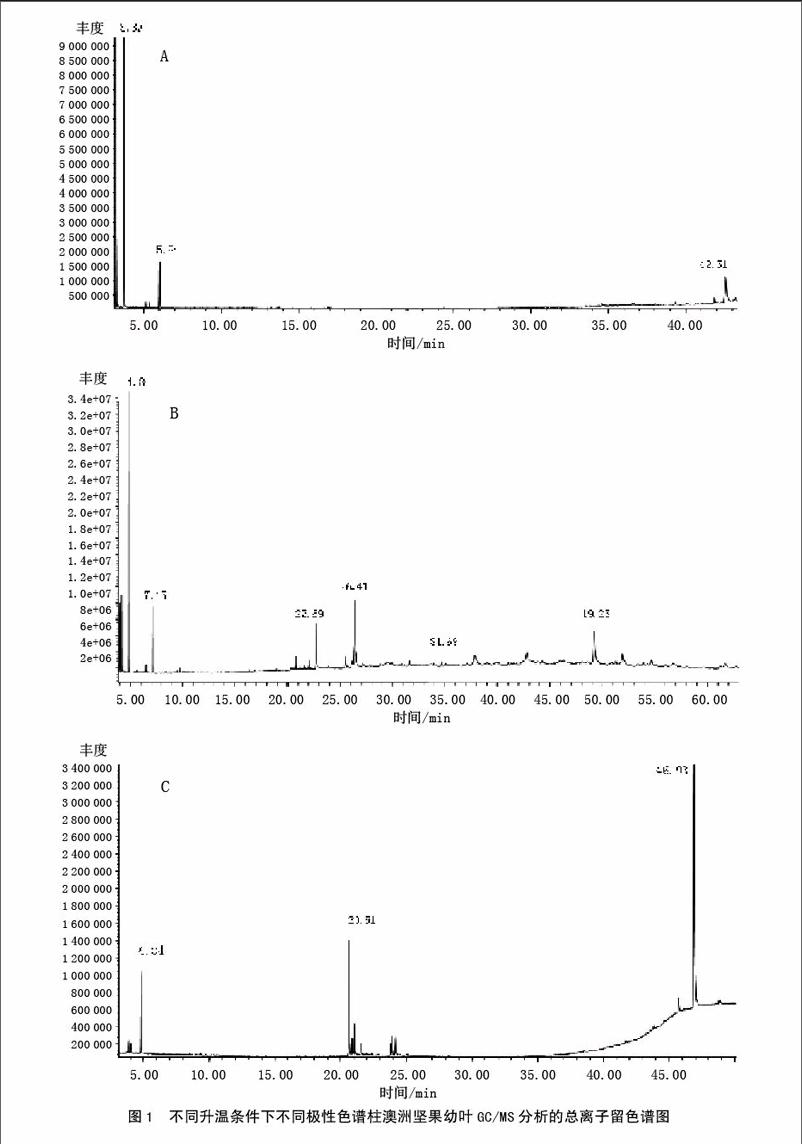
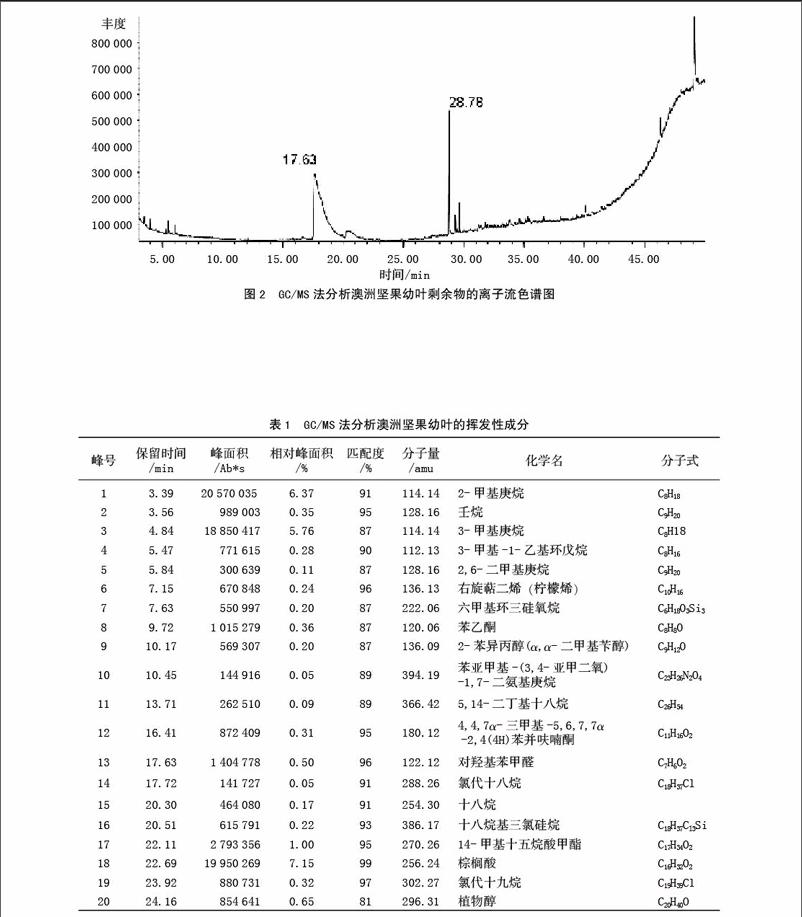
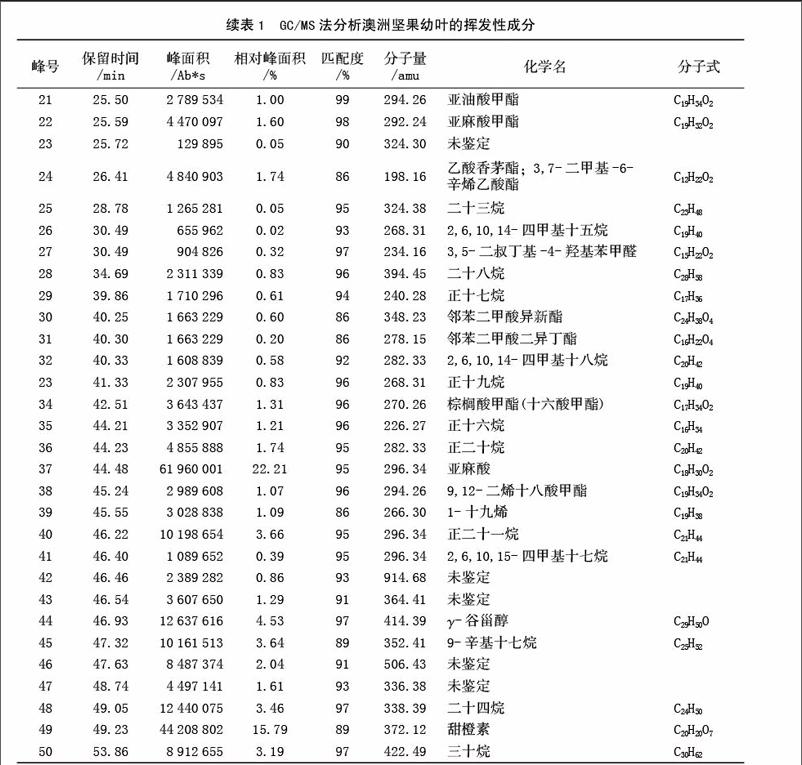
摘 要 利用气相色谱-质谱联用的方法(GC-MS)对澳洲坚果幼叶的挥发性成分进行了定性定量分析。在不同极性的色谱柱和不同程序性的升温条件下,采用正己烷和乙酸乙酯对澳洲坚果幼叶进行分步萃取,分离鉴定出45种挥发性成分,包括烃及其衍生物27种,酮3种,醛2种,醇3种,酸2种,酯8种共六大类物质。其中,不饱和脂肪酸(亚麻酸、棕榈酸)、植物甾醇、酚类等物质,不仅具有一定的营养价值,还具有降血压血脂、抗氧化抗癌等保健功能。
关键词 GC-MS ;挥发性成分 ;幼叶 ;澳洲坚果
中图分类号 O657.71 文献标识码 A Doi:10.12008/j.issn.1009-2196.2017.03.019
Volatile Compounds Determined by GC-MS in Young Leaves of
Macadamia integrifolia
ZHU Zeyan HUANG Xuesong
(Food Science and Engineering, Jinan University, Guangzhou, Guangdong 510632)
Abstract The qualitative and quantitative analysis for volatile components in young leaves of Macadamia integrifolia were discussed. Under the conditions of different polarities of columns and programmed temperatures, the young leaves of Macadamia integrifolia were extracted with n-hexane and ehtyl acetate, and 45 volatile components with 6 groups of substance were identified, i.e. 27 hybrocarbon and its derivatives, 3 ketones, 2 aldehydes, 3 alcohols, 2 organic acids, 8 esters. The unsaturated fatty acid (linolenic acid, palmitic acid), phytosterol and phenols had not only nutritional value, but also healthcare functions such as lowering blood pressure and lipid levels, resistance to oxidation and cancer, etc.
Keywords GC-MS ; volatile components ; young leaves ; Macadamia intergrifolia F. Muell.
澳洲堅果(Macadamia intergrifolia F. Muell.)又称为夏威夷果、澳洲核桃、巴布果、昆士兰栗等,原产于澳大利亚昆士兰与新南城威尔士的热带雨林,属于山龙眼科植物,因其具有可食的果实而被广泛种植。澳洲坚果是世界著名的坚果,被誉为“坚果之王”“干果之后”。目前,在我国的偏南部地区,如西南三省(云、贵、川),广东,广西,福建均可种植。目前,云南省种植最多,仅云南临沧区的栽培面积就已达到10.6万hm2[1]。目前,已有澳洲坚果种植的适宜条件、防治病虫理,果仁营养保健成分、贮存保鲜与加工等方面大量研究,也有少量利用果壳、青皮制作活性炭、抗氧化提取物的报道[2-12],但未见澳洲坚果叶资源利用的报道。澳洲坚果是利用实生苗经嫁接育苗而栽培的,育苗过程中产生大量幼叶。由于缺乏幼叶相应化学成分、加工特性方面的研究,这些幼叶都被弃掉了。为充分利用这些幼叶,采用气相色谱和质谱联用仪(GC-MS)、用不同的色谱柱等,分析澳洲坚果幼叶的挥发性成分,旨为澳洲坚果叶的实际开发利用提供成分依据,以更好地促进澳洲坚果产业的发展。……
登录APP查看全文