卡维地洛对非酒精性脂肪肝病大鼠脂联素表达的影响
2017-06-15 23:10:37刘娜梁传栋刘英姣
中国实用医药
2017年13期
刘娜+梁传栋+刘英姣
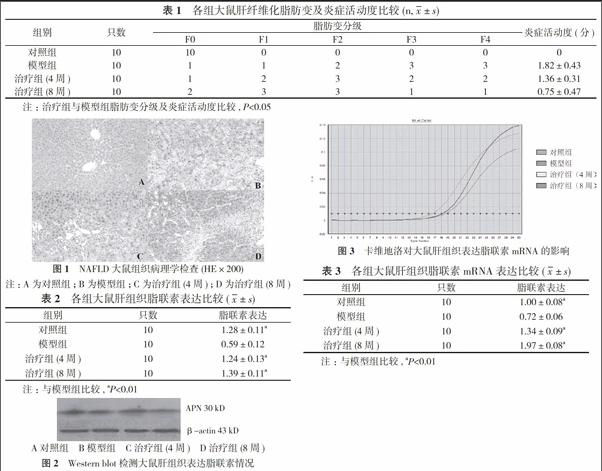
【摘要】 目的 探討卡维地洛对非酒精性脂肪肝病(NAFLD)大鼠脂联素表达的影响。方法 40只雄性SD大鼠随机分为对照组(10只)、模型组(10只)和治疗组(20只)。采用高脂饮食建立非酒精性脂肪肝病大鼠模型, HE染色观察大鼠肝脏病理学变化;应用蛋白质印迹法(Western blot法)检测卡维地洛对非酒精性脂肪肝病大鼠模型肝组织脂联素蛋白表达的影响;应用实时荧光定量PCR技术检测对其mRNA表达的作用。结果 三组病理学检查:①大体形态:对照组肝脏呈鲜红色, 表面光滑有光泽, 边缘规则锐利, 质地软;模型组肝脏体积增大, 边缘变钝, 切面油腻状;治疗组肝脏与模型组相比油腻状减轻, 边缘较清晰, 指压有弹性。②组织学变化:对照组大鼠肝组织切片HE染色肝索排列整齐, 肝细胞无变性坏死, 结构完整;模型组大鼠肝组织切片可见弥漫性肝细胞脂肪变性, 脂质沉积, 空泡变性, 排列紊乱, 局部见纤维组织增生, 汇管区炎症明显;治疗组肝脏病理有不同程度的改善, 轻度至中度脂肪变为主, 肝细胞形态大致正常, 肝内脂肪滴减少。治疗组4周与8周的脂肪变及炎症活动度与模型组相比, 差异具有统计学意义(P<0.05)。模型组大鼠肝组织脂联素表达与对照组相比明显降低, 差异具有统计学意义[(0.59±0.12) VS (1.28±0.11), t=-13.404, P<0.01];卡维地洛治疗4周组和8周组脂联素表达明显升高, 与模型组相比差异有统计学意义[(1.24±0.13) VS (0.59±0.12), t=11.618, P<0.01;(1.39±0.11) VS (0.59±0.12), t=15.541, P<0.01]。模型组脂联素mRNA表达水平明显低于对照组, 差异具有统计学意义[(0.72±0.06) VS (1.00±0.08), t=-8.854, P<0.01];卡维地洛治疗4周组和8周组脂联素mRNA表达明显高于模型组, 差异具有统计学意义[(1.34±0.09) VS (0.72±0.06), t=18.126, P<0.01;(1.97±0.08) VS (0.72±0.06), t=39.528, P<0.01]。结论 卡维地洛能明显改善NAFLD大鼠肝脏病变程度, 同时使肝脏表达脂联素升高, 从而为非酒精性脂肪肝病的治疗提供了新的途径。
【关键词】 非酒精性脂肪肝病;卡维地洛;脂联素;大鼠
DOI:10.14163/j.cnki.11-5547/r.2017.13.109
【Abstract】 Objective To investigate influence by carvedilol on expression of adiponectin in rats with nonalcoholic fatty liver disease (NAFLD). Methods A total of 40 male SD rats were randomly divided into control group (10 rats), model group (10 rats) and treatment group (20 rats). Nonalcoholic fatty liver disease rat model was built by high fat diet, and HE staining was applied to observe pathological changes in liver of rats. Western blot method was applied to detect influence by carvedilol on expression of adiponectin in rats with nonalcoholic fatty liver disease. Real-time fluorescence quantification polymerase chain reaction (PCR) was applied to detect effect for mRNA. Results Pathological examination in the three groups: ① Gross morphology: the control group had bright red liver with smooth and glossy surface, regular and sharp edge and soft texture. The model group had enlarged liver, with blunt edge and oleaginous section. The treatment group had slighter oleaginous section and clearer edge, with elasticity. ② Histological change: the control group had regular hepatic cords in HE staining of liver tissue slice with no degenerative necrosis in liver cell and complete structure. The model group had diffuse hepatic cell fatty degeneration in liver tissue slice, with lipidosis, vacuolar degeneration, disorder arrangement, local proliferation of fibrous tissue, and obvious portal area inflammation. The treatment group had different degree of improvement in liver pathology, with mainly mild and moderate fatty change, normal liver cellular morphology, and reduction of intrahepatic fat granule. Comparison of fatty change and inflammation grade between the treatment group and the model group showed statistically significant difference (P<0.05). The model group had obviously lower expression of adiponectin in liver tissue than the control group in 4 weeks and 8 weeks of treatment, and their difference had statistical significance [(0.59±0.12) VS (1.28±0.11), t=-13.404, P<0.01]. In 4 weeks and 8 weeks of treatment by carvedilol, the treatment group had obviously higher expression of adiponectin. Comparing with the model group, their difference had statistical significance [(1.24±0.13) VS (0.59±0.12), t=11.618, P<0.01; (1.39±0.11) VS (0.59±0.12), t=15.541, P<0.01]. The model group had much lower expression of adiponectin mRNA than the control group, and the difference had statistical significance [(0.72±0.06) VS (1.00±0.08), t=-8.854, P<0.01]. In 4 weeks and 8 weeks of treatment by carvedilol, the treatment group had obviously higher expression of adiponectin mRNA than the model group, and the difference had statistical significance [(1.34±0.09) VS (0.72±0.06), t=18.126, P<0.01; (1.97±0.08) VS (0.72±0.06), t=39.528, P<0.01]. Conclusion Carvedilol can remarkably improve liver lesion degree in NAFLD rats, along with increased expression of adiponectin in liver. It provides a new pathway in treating nonalcoholic fatty liver disease.
【Key words】 Nonalcoholic fatty liver disease; Carvedilol; Adiponectin; Rats
非酒精性脂肪肝病(nonalcoholic fatty liver disease, NAFLD) 是指除外酒精和其他明确的损肝因素所致的肝细胞内脂肪过度沉积为主要特征的临床病理综合征, 目前尚缺乏防治NAFLD的有效措施。非酒精性脂肪肝病患者血清脂联素水平降低, 并且有可能受交感神经递质的参与调节[1]。……
登录APP查看全文