基于DEA—Malmquist模型的省际经济全要素生产力分析
2017-07-07 00:05:47秦春艳
商业经济
2017年7期
秦春艳
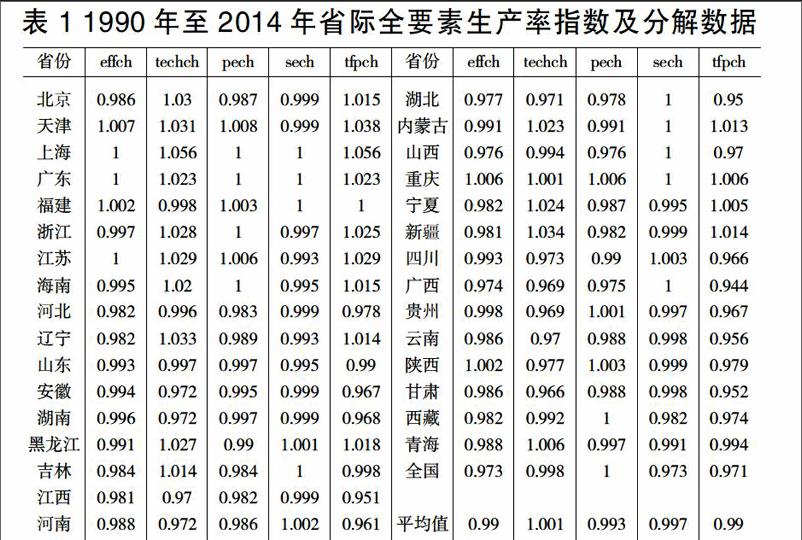

[摘 要] 选取1990-2014年全国和各省份面板数据,首先利用柯布道格拉斯生产函数模型和索罗经济增长方程测算资本、劳动力和科技进步对经济增长的贡献率,再利用DEA-Malmquist指数方法,测算各省份全要素生产力数值,结果表明样本期间内,科学技术贡献率EA=40.5%,资本贡献率EK=53.87%,劳动力贡献率EL=5.62%,资本投入仍然是经济发展最主要动力,东部地区明显高于西部地区,全要素生产力地区发展不平衡,并且呈下降趋势。
[关键词] TFP;DEA-Malmquist模型;索罗经济增长方程;经济增长贡献率
[中图分类号] F062.1 [文献标识码] A
Abstract: Selecting 1990-2014 panel data of the whole country and every province in China, the study calculating the contribution rates of capital, labor force, technological progress of economic growth with Cobb-Douglas production function and Solow' economic growth equation. Then the DEA-Malquist method is used to figure out the numerical value of total factor productivity of every province. The result proves that during the sample period, the contribution rates of science and technology, capital, and labor force are respectively EA= 40, 5%, EK=53.87%,and EL=5.62%. Capital investment is still the major driving power of economic growth. It is more obvious in the east region than in the west region of China. The growth of total factor productivity is not even among regions and is declining.
Key words: TFP, DEA-Malmquist model, Solow' economic growth equation, contribution rate to economic growth
一、引言
亚当·斯密的古典经济增长理论和哈罗德—多马模型,分别分析了资本和劳动力对经济增长的贡献,索洛模型将技术进步引入到经济模型中,发现当资金投入增长率等于劳动力投入的增长率时,工业产出增长率大于资金与劳动力增长率。也就是说,还有存在于资金和劳动力资本以外的其他资本存在,索洛认为,一是企业的技术进步产品创新因素;二是企业管理因素。在本文中,全要素生产率是指由索洛提出的,表示除了资本和劳动力以外的其他因素投入对产出的影响。全要素生产率可以解释经济增长中要素使用效率对增长的贡献,反映经济增长的质量,判断经济增长方式的变化。本文旨在利用全要素生产力变动模型(DEA-Malmquist)研究各省份TFP变动情况,分析1990-2014年中国经济增长因素。
目前对省际全要素生产力的估算已经有了很多研究,Fleisher and Chen(1997)运用经济增长核算方法计算中国25个省份TFP数值,发现沿海省份的TFP是内地的两倍,主要由教育和外商投资造成的。……
登录APP查看全文