
优质护理以及风险规避对计划性再次开胸手术患者的护理满意度的影响
2017-08-22 11:32:55张平孙海春傅晓玲
中国医药科学
2017年13期
张平+孙海春+傅晓玲
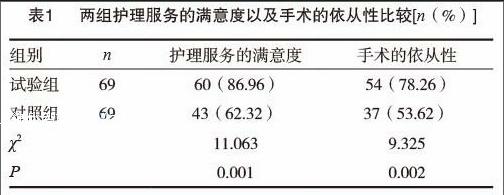
[摘要] 目的 探究优质护理以及风险规避对计划性再次开胸手术患者的护理满意度的影响。方法 收集我院收治的择期进行再次开胸手术患者138例,参考电脑随机生成的随机数字表分为对照组和试验组,每组各69例,对照组入院后予以常规常规计划性再次手术和常规护理,试验组予以再次手术的风险规避策略及优质护理干预,干预结束后比较两组患者护理服务的满意度以及手术的依从性。结果 与对照组相比,试验组患者对护理服务的满意度以及手术的依从性较高(P<0.05)。结论 优质护理及风险规避对计划性再次开胸手术能够有效提高患者满意程度及手术的依从性,改善开胸手术整体治疗效果,适宜临床推广应用。
[关键词] 优质护理;计划性再次开胸手术;风险规避策略
[中图分类号] R473.6 [文献标识码] A [文章编号] 2095-0616(2017)13-75-04
[Abstract] Objective To explore the impact of high quality nursing and risk aversion on nursing satisfaction of patients undergoing planned re-thoracotomy. Methods 138 patients undergoing elective thoracotomy in our hospital were selected and divided into control group and experimental group with 69 cases in each, according to random number table generated by reference computer. Patients in control group were treated with routine planned reoperation and routine care after admission. Patients in experimental group were treated with risk aversion strategy and high quality nursing intervention for reoperation. After the intervention, the satisfaction of nursing service and the compliance of the two groups were compared. Results Compared with the control group, the patients in the experimental group were satisfied with the nursing service and the compliance of the operation(P<0.05). Conclusion The high quality nursing and risk aversion on patients undergoing planned re thoracotomycan effectively improve the satisfaction degree of patients and the compliance of the operation, and improve the overall treatment effect. It is suitable for clinical application.
[Key words] High quality nursing; Planned thoracotomy; Risk aversion strategy
计划性再次开胸手术即为在初次手术时已经计划施行的再次开胸手术[1]。临床上出现较多的情况包括功能性单心室的外科治疗、肺动脉重度发育不良、拟行双心室手术、法乐氏四联症、复杂先天性心脏病的早产儿、极低出生体重儿或因病情严重以及存在体外循环手术禁忌征等[2-3]。开胸是计划性再次开胸手术所面临的重点难题,如若外科医生处理不得当,会造成灾难性心脏、大血管破裂等严重结局,尤其是部分复杂先天性心脏病患者,由于其主动脉位置前移,常出现与胸骨完全贴合、粘连的情况,更易出现上述不良结局[4]。我院对过去数年经验教训进行总结,制定了手术风险规避策略及优质护理,本就实验就优质护理及风险规避对计划性再次开胸手术患者的护理满意度的影响进行探究。……
登录APP查看全文
