
品管圈活动在提高泌尿系结石患者对宣教知晓率中的应用
2017-08-22 11:36:46曹涧敏吴凡宇邓金彩
中国医药科学
2017年13期
曹涧敏+吴凡宇+邓金彩
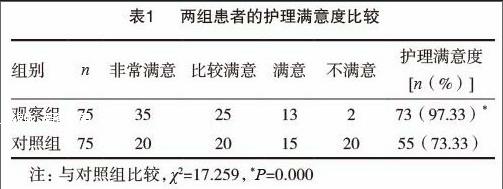
[摘要] 目的 探讨品管圈活动在提高泌尿系结石患者对宣教知晓率中的应用效果。方法 于2015年3月~2016年12月,选取泌尿系统结石患者150例,随机分组,对照组给予常规护理干预,观察组基于常规护理,给予品管圈活动管理,比较两组患者的宣教知晓率及护理满意度。结果 (1)和对照组(79%)比较,观察组宣教知晓率(92%)明显更高,数据比较差异有统计学意义(P<0.05)。(2)护理满意度方面比较,观察组护理满意度(97.33%)明显比对照组(73.33%)要高,且差异具有统计学意义(P<0.05)。结论 品管圈活动在提高泌尿系结石患者对宣教知晓率中的应用效果显著,有利于增加患者对泌尿系统结石的认识,提高护理的满意度,具有较高的临床应用价值。
[关键词]品管圈 ;泌尿系结石;宣教
[中图分类号] R473.6 [文献标识码] A [文章编号] 2095-0616(2017)13-78-03
[Abstract] Objective To explore the application effect of quality control circle activities in improving the awareness rate of education in patients with urinary calculi. Methods From March 2015 to December 2016, selected 150 cases with urinary calculi were randomly divided into two groups. The control group was given routine nursing intervention, and the observation group was given the QCC management based on routine nursing. Health education awareness rate and the nursing satisfaction of two groups were compared. Results (1)Compared with the control group(79%), the healthy education awareness rate of observation group(92%) was significantly higher, and the difference was statistically significant(P<0.05). (2)Comparision of the nursing satisfaction: the nursing satisfaction of observation group(97.33%) was significantly higher than that of the control group(73.33%), and the difference was statistically significant(P<0.05). Conclusion The effects of quality control circle activities on improving the awareness rate of education in patients with urinary calculi is remarkable. It is helpful to increase the understanding of urinary calculi, improve nursing satisfaction, with high clinical value.
[Key words] Quality control circle; Urinary calculi; Education
泌尿系統结石是临床常见的泌尿外科疾病,由于患者对疾病知识、微创手术的治疗缺乏正确的认识,感到害怕、恐惧、不安,给治疗的开展带来一定的影响[1]。同时,患者对预防结石措施缺乏全面的知识,导致结石复发,因此必须采取有效的措施加强患者对结石疾病与预防措施的认识[2]。本研究采取品管圈活动对泌尿系统结石患者进行干预,效果显著,提高了患者的宣教知晓率,现报道如下。
1 资料与方法
1.1 一般资料
于2015年3月~2016年12月,选取泌尿系统结石患者150例,其中80例为男性患者,70例为女性患者,年龄50~80岁,平均(60.3±3.5)岁,随机分组,观察组75例,其中45例为男性患者,30例为女性患者,年龄50~80岁,平均(60.3±3.0)岁;对照组75例,其中35例为男性患者,40例为女性患者,年龄50~80岁,平均(60.0±3.5)岁。两组临床资料比较差异无统计学意义(P>0.05),本研究已通过医院医学伦理委员会批准。
纳入标准[3]:参与研究者知情同意;均为泌尿系统结石患者;均可正常沟通听从医嘱。排除标准:不符合上述标准;……
登录APP查看全文
