前列地尔治疗糖尿病肾病蛋白尿的效果评价
2017-09-07 19:11:22王淑伟
糖尿病新世界
2017年9期
关键词:效果
王淑伟

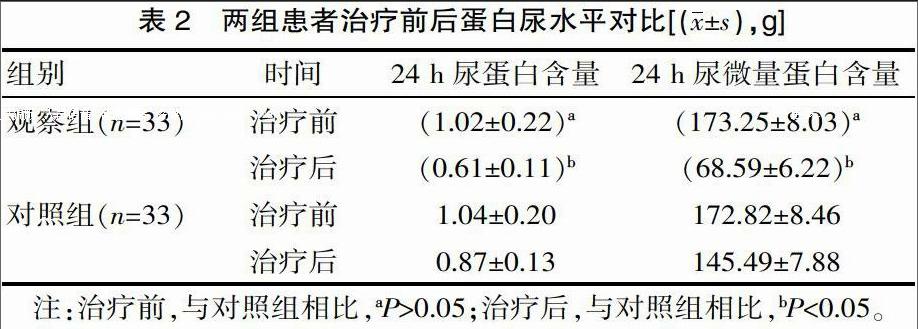
[摘要] 目的 观察前列地尔治疗糖尿病肾病蛋白尿的效果。 方法 选择该院2015年8月—2016年8月收治的糖尿病肾病患者66例,随机将其分为两组,即对照组(33例)和觀察组(33例),两组患者均给予常规治疗和贝那普利治疗,观察组在此基础上给予前列地尔治疗,对比两组患者疗效及治疗前后蛋白尿水平。结果 治疗后,相较于对照组,观察组患者治疗总有效率明显升高,差异有统计学意义(P<0.05),两组患者24 h尿蛋白含量和尿微量白蛋白较治疗前均有所降低,且观察组降低程度明显优于对照组,差异有统计学意义(P<0.05)。结论 前列地尔治疗糖尿病肾病蛋白尿疗效显著,建议在临床上推广应用。
[关键词] 前列地尔;糖尿病肾病;蛋白尿;效果
[中图分类号] R587 [文献标识码] A [文章编号] 1672-4062(2017)05(a)-0003-02
Evaluation of the Effect of Alprostadil on Proteinuria in Diabetic Nephropathy
WANG Shu-wei
Department of Endocrinology, Peixian Peoples Hospital, Xuzhou, Jiangsu Province, 221600 China
[Abstract] Objective This paper tries to evaluate the effect of alprostadil on proteinuria in diabetic nephropathy. Methods 66 cases of patients with diabetic nephropathy from August 2015 to August 2016 were chosen and randomly divided into the control group and the observation group, with 33 cases in each group. Both groups were given routine treatment and benazepril treatment, the observation group added alprostadil treatment, and the curative efficacy and proteinuria levels of both groups before and after treatment were compared. Results Compared with the control group, the total effective rate of the observation group significantly increased(P<0.05). The 24 h urinary protein content and urinary albumin after treatment in the two groups were lower than those before, and that of the observation group was significantly better than the control group (P<0.05). Conclusion Curative effect of alprostadil treatment on proteinuria in diabetic nephropathy is remarkable, so it is worth clinical application.
[Key words] Alprostadil; Diabetic nephropathy; Proteinuria; Effect
糖尿病肾病蛋白尿属于糖尿病比较常见的一种并发症,数据调查结果显示,其中约30%糖尿病患者会随着疾病进展为肾病,并出现蛋白尿[1]。糖尿病肾病蛋白尿是发展为终末期肾衰竭的重要原因,临床治疗难度较大,不仅大大降低了患者生活质量,同时也带来沉重的经济负担。该文特选择该院于2015年8月—2016年8月期间收治的糖尿病肾病蛋白尿患者66例,对其施以前列地尔治疗,获得了较为满意的疗效,现报道如下。
1 资料与方法
1.1 一般资料
选取在该院进行治疗的糖尿病肾病蛋白尿患者66例。纳入标准:患者均同时并发糖尿病肾病;持续性蛋白尿≥0.5 g/d;均了解该次研究,自愿参与,并签署知情同意书。排除标准:其它原因导致的蛋白尿异常;合并有原发性泌尿系统疾病、严重高血压者;存在药物过敏史者。采用双色球法随机将其分为两组,即对照组33例和观察组33例,对照组:21例为男性,12例为女性,年龄最小为42岁,最大为69岁,平均年龄(58.5±3.1)岁,病程2~10年,平均病程(5.1±1.0)年。……
登录APP查看全文
猜你喜欢
中老年保健(2021年12期)2021-11-30 02:58:01
好日子(2021年8期)2021-11-04 09:02:46
小学生学习指导(爆笑校园)(2020年6期)2020-07-03 10:01:10
摄影之友(影像视觉)(2019年2期)2019-03-05 08:27:14
摄影之友(影像视觉)(2018年12期)2019-01-28 09:01:02
摄影之友(影像视觉)(2018年12期)2019-01-28 09:01:02
中华诗词(2018年11期)2018-03-26 06:41:34
小学生学习指导(低年级)(2017年11期)2017-10-23 01:32:36
Coco薇(2016年8期)2016-10-09 02:11:50
中国医药科学(2015年19期)2015-02-27 12:33:11