
上海某社区乳腺癌术后患者个性特点及心理状况调查
2018-01-18 18:15:24陈淑琴沈美吴建平
上海医药
2017年24期
陈淑琴+沈美+吴建平
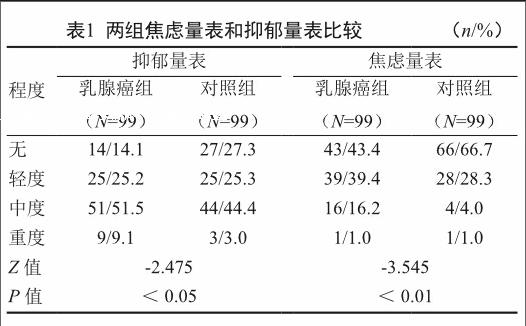
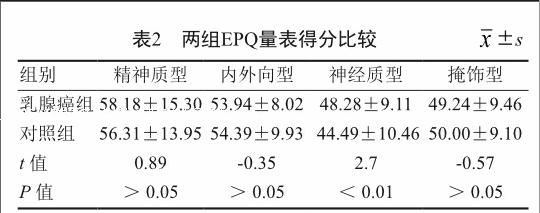
摘 要 目的:了解社區乳腺癌术后患者个性特征和心理健康状况,指导社区全科团队进行心理干预工作。方法:采用横断面研究设计,对99例社区建立肿瘤病卡的乳腺癌术后患者及99例对照人群进行艾森克人格问卷(EPQ)、焦虑自评量表(SAS)和抑郁自评量(SDS)问卷调查,评估两组对象的个性特点、焦虑、抑郁状况。结果:乳腺癌患者的个性神经质维度评分、焦虑和抑郁自评量表分均明显高于对照组(P均<0.05)。结论:乳腺癌组患者存在较高的神经质个性及焦虑和抑郁症状,对乳腺癌患者实施有效的心理干预是必要的。
关键词 乳腺癌;术后;心理;个性特点
中图分类号:R737.9 文献标志码:A 文章编号:1006-1533(2017)24-0044-03
Survey of personality characteristics and psychological status of postoperative patients with breast cancer in a community of Shanghai
CHEN Shuqin, SHEN Mei, WU Jianpin
(Ouyang Community Health Service Center of Hongkou District, Shanghai 200081, China)
ABSTRACT Objective: To investigate the personality characteristics and mental health status of community postoperative patients with breast cancer to guide the community general practitioner team to carry out psychological intervention work. Methods: With cross sectional study design a total of 99 postoperative cases of breast cancer who had the files established in the community and 99 cases of the control group were investigated with Eysenck personality questionnaire (EPQ), self rating anxiety scale (SAS) and self rating depression scale (SDS). The personality characteristics, anxiety and depression status of the two groups were evaluated. Results: The scores of personality neuroticism score, anxiety and depression self rating scale in the breast cancer patients were significantly higher than those in the control group (P<0.05). Conclusion: Patients with breast cancer have higher neurotic personality, anxiety and depression symptoms, and it is necessary to carry out effective psychological intervention for breast cancer patients.
KEY WORDS breast cancer; postoperation; psychology; personality characteristics
近年来,随着生活水平提高和生活方式的改变,乳腺癌已在我国女性所患癌症中位居首位,且每年以3%~6%的速度递增,发病日趋年轻化[ 1 ]。它对女性造成的身心影响是不容忽视的现实。乳腺癌的确诊和治疗方法对患者造成沉重的心理压力,影响其生存质量。本研究试图通过对回归社区乳腺癌术后患者的心理个性特点及心理状况调查,了解其心理健康水平及个性特征,为以家庭医生为主的社区团队开展心理干预提供依据。
1 对象与方法
1.1 调查对象
调查对象来源于欧阳街道2012年至2016年建立恶性肿瘤登记卡的乳腺癌患者99例,年龄35~79岁,平均年龄(60.06±7.72)岁;文化程度:小学4人,初中40人,高中42人,大专及以上13人;对照人群来自同社区无乳腺癌病史的居民99例。年龄33~79岁,平均年龄(60.02±11.59)岁,文化程度:小学6人,初中41人,高中36人,大专及以上16人。两组患者基线资料比较,差异无统计学意义(P>0.05)。排除标准:(1)有精神病家族史;(……
登录APP查看全文
猜你喜欢
光明少年(2024年5期)2024-05-31 10:25:59
中老年保健(2022年6期)2022-08-19 01:41:48
当代陕西(2022年4期)2022-04-19 12:08:54
International Journal of Nursing Sciences(2022年1期)2022-02-08 03:23:58
娃娃画报(2019年11期)2019-12-20 08:39:45
中国生殖健康(2019年2期)2019-08-23 08:11:42
中国生殖健康(2019年6期)2019-01-06 09:20:12
中国生殖健康(2019年5期)2019-01-06 09:16:40
祝您健康(2018年5期)2018-05-16 17:10:16
母子健康(2015年1期)2015-02-28 11:22:02
