有机?金属钙钛矿太阳能电池微结构及载流子传输机制
2018-03-13 21:37:28邓建平方俊飞傅明星杨智
现代电子技术
2018年6期
邓建平+方俊飞+傅明星+杨智
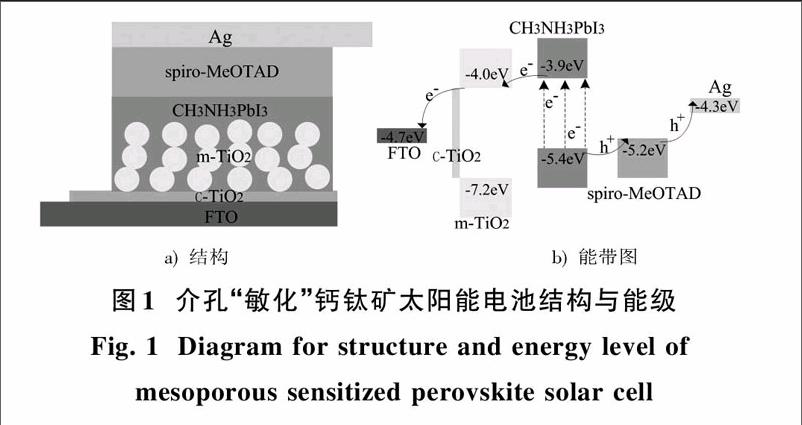
摘 要: 采用有机?金属卤化物钙钛矿作为光吸收材料的固态太阳能电池取得了巨大的突破与快速的发展,电池效率已超过20%。对固态钙钛矿太阳能电池的微结构和激发载流子在电池内的产生与传输机制做了详细的综述与分析,指出了电池结構从介孔“敏化”结构开始,经历介观?超结构、平面异质结结构、无空穴传输层结构及无电子传输层结构的发展阶段。分析表明电池结构的发展主要取决于对有机?金属卤化物钙钛矿材料中激发载流子分离与传输机制的深入认识,利用既可传输电子又可传输空穴的有机?金属卤化物钙钛矿材料制备的介孔结构和异质结结构的电池都可实现高效率转化。
关键词: 太阳能电池; 钙钛矿; 微结构; 载流子传输; 介孔结构; 异质结
中图分类号: TN36?34; TM914.4+2 文献标识码: A 文章编号: 1004?373X(2018)06?0087?05
Abstract: The solid?state solar cell in which organic?metal halide perovskite is used as the light absorption material has made a great breakthrough and rapid progress with its efficiency exceeding 20%. The microstructure of solid?state perovskite solar cells and generation and transport mechanism of excited charge carriers in cells are reviewed and analyzed in detail in this paper. Starting from mesoporous sensitized structure, the cell structure has experienced the development stages of meso?superstructure, planar heterojunction, hole?free transport layer and electron?free transport layer. The analysis result shows that the development of cell structure mainly depends on in?depth understanding of the separation and transport mechanism of excited charge carriers in the organic?metal halide perovskite material, and high effective transformation can be achieved by adopting the mesoporous structured cell and heterojunction structured cell which transport not only electrons but also holes, and are prepared by the organic?metal halide perovskite material.
Keywords: solar cell; perovskite; microstructure; charge carrier transport; mesoporous structure; heterojunction
0 引 言
基于敏化太阳能电池基础上发展起来的有机?金属卤化物钙钛矿太阳能电池,其基本结构类似于传统的敏化太阳能电池,通过卤化物钙钛矿替代传统敏化太阳电池中的有机染料或者无机半导体量子点作为吸光材料,形成最初的P?i?N型介孔异质结钙钛矿敏化太阳能电池。这一研究始于2009年,CH3NH3PbI3钙钛矿被用于液态的敏化太阳能电池,但是,由于CH3NH3PbI3在液态电解质中的溶解,导致电池性能的迅速下降。直到2012年,Chung等人在固态染料敏化电池中引入CsSnI3钙钛矿作为空穴传输材料,实现8.5%的效率[1]。同年,Kim等人采用spiro? MeOTAD (2,2′,7,7′?Tetrakis(N,N?p?dimethoxy?phenylamino)?9,9′?spirobifl uorene)与CH3NH3PbI3作为空穴传输材料与吸光材料,制作了9.7%高效率的全固态敏化电池[2],这种固态空穴传输层取代液态电解质就形成了如今的钙钛矿电池。……
登录APP查看全文