拉压超静定问题中变形协调方程的讨论
2018-07-25 11:37:10张晓艳陈燕唐亮
科教导刊
2018年14期
张晓艳 陈燕 唐亮
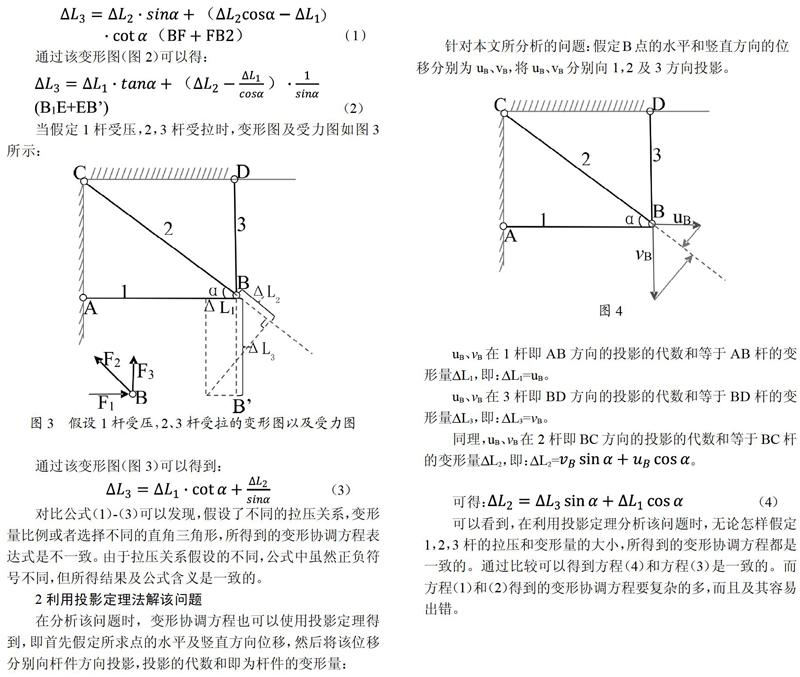
摘 要 在材料力学中利用小变形放大法得到变形协调方程是求解杆件拉压静不定问题的重难点。在教学实践中发现,学生往往对杆件拉压受力的定性判断不够准确,导致对杆件力的方向假定不一致以及假设变形长度不同,所得到的变形协调方程也是不同的。现就教科书上针对杆件拉压问题所讲授的变形协调方程的几种形式进行了探讨,在此基础上提出了利用投影法形成变形协调方程简单易于理解,特别是在不易进行拉压定性判断的复杂杆系中更显优势。
关键词 变形协调方程 小变形放大法 材料力学
中图分类号:O347 文献标识码:A DOI:10.16400/j.cnki.kjdkz.2018.05.020
Abstract In the mechanics of materials, the small deformation magnification method is used to obtain the deformation compatibility equation. In the teaching practice, it is found that the qualitative judgment of the tension and compression of the rod is not accurate, which leads to the difference of the assumption that the direction of the rod is not consistent and the length of the deformation is different. In this paper, several forms of the deformation coordination equation are discussed in the textbook for the tension and pressure problem of the rod. On this basis, it is proposed that the formation of the deformation coordination equation by using the projection method is simple and easy to understand, especially in the complex bar system which is not easy to conduct the qualitative judgment of the tension and pressure.
Keywords deformation coordination equation; small deformation amplification method; material mechanics
求解杆件拉压静不定问题一般的解题思路是:[1-4]先建立力学平衡方程,然后根据杆件的变形特点建立变形协调方程,再补充力与变形之间的关系得到补充方程,进而求解得出所有的未知量。为得到变形协调方程,现行材料力学教科书中一般使用都是小变形放大法。
1 现行教材中对小变形放大法的描述
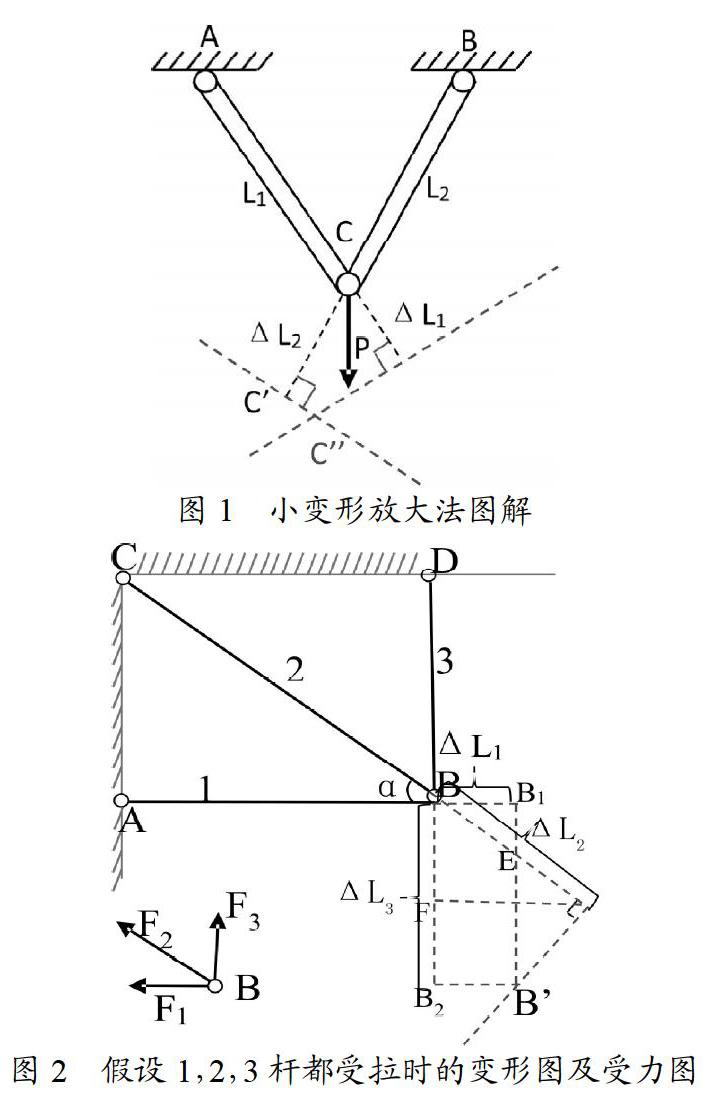
如图1所示,铰接杆件AC、BC在C点受力P的作用,求解C点变形后的位置。利用小变形放大法求解是通过杆件AC和BC伸长量 L1和 L2得到C点水平和竖直方向的位移。变形分析时严格的画法是分别以A点为圆心,(L1+ L1)为半径作圆弧,及以B点为圆心,(L2+ L2)为半径作圆弧,两圆弧的交点C'即为C点变形后的位置。实际操作时常采用的是“以直代曲”的近似畫法,即:分别过AC和BC变形延长线终点做AC和BC的垂线,两条垂线的交点C''就是C点变形后的位置。……
登录APP查看全文