护理敏感质量指标监测在降低住院失能老年患者非计划性拔管中的应用
2018-09-13 19:19:40薛斌
上海医药
2018年16期
薛斌
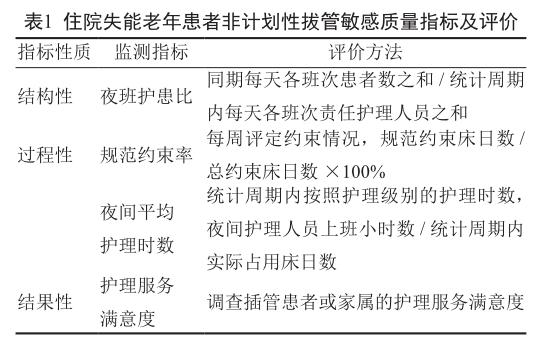


摘 要 目的:探讨护理敏感质量指标监测在降低住院失能老年患者非计划性拔管率中的作用。方法:选取松江区洞泾老年护理院2017年7—12月住院期间日常生活能力评定Barthel指数评分低于60分的失能插管老年患者38例作为研究组,选取实施护理敏感质量指标监测前Barthel指数评分低于60分的失能插管老年患者62例作为对照组。统计两组患者的非计划性拔管情况、夜班护患比、规范约束率、夜间平均护理时数及护理服务满意度。结果:住院失能老年患者非计划性拔管率从实施前的25.7%降低到实施后的3.4%;夜间护患比、规范约束率及夜间护理时数比的实施前后差异有统计学意义(P<0.05)。结论:应用护理敏感质量指标可有效降低住院失能老年患者非计划性拔管率的发生,确保护理质量和患者安全。
关键词 住院失能老年患者;非计划性拔管率;护理敏感质量指标
中图分类号:R473.5 文献标志码:A 文章编号:1006-1533(2018)16-0009-03
Application of nursing sensitive quality index in monitoring reduction of unplanned extubation in the hospitalized elderly patients with disability
XUE Bin
(Department of Geriatrics of Dongjing Community Health Service Center of Songjiang District, Shanghai 201619, China)
ABSTRACT Objective: To explore the role of nursing sensitive quality index in monitoring reduction of unplanned extubation rate in the hospitalized disabled elderly patients. Methods: A total of 38 elderly incapacitated intubated patients with the Barthel index scored less than 60 points during the period of hospitalization from July to December 2017 in Dongjing Community Elderly Nursing Home of Songjiang District were selected as a study group, and 62 elderly patients with incapacitated intubation whose Barthel index score was lower than 60 before implementation of the nursing sensitive quality index monitoring were selected as a control group. The unplanned extubation, night-shift nursing-patient ratio, standardized restraint rate, average night nursing hours and nursing service satisfaction in the patients of two groups were calculated. Results: The unplanned extubation rate of inpatients with disability was reduced from 25.7% before implementation to 3.4% after implementation; there were statistically significant differences between night nurse-patient ratio, standardized restraint rate and night nursing time ratio(P<0.05). Conclusion: Application of nursing sensitive quality index can effectively reduce the incidence of unplanned extubation in the hospitalized disabled elderly patients, and ensure the quality of nursing and patient safety.
KEY WORDS hospitalized disabled elderly patients; unplanned extubation rate; nursing sensitive quality index
喪失生活自理能力的老人称为“失能老人”。随着社会老年进程的加速、老年人身体机能的减退及体质降低,失能老人的数量持续升高。非计划性拔管(Unplanned extubation,UEX)是指未经医护人员同意、患者自行拔出管道或其他原因造成的导管脱落,又称意外拔管[1],是医院内发生率较高的护理不良事件。住院失能老年患者发生非计划性拔管将导致患者生理痛苦、增加感染几率及医疗资源的浪费等等问题。因此,降低住院失能老年患者非计划性拔管率对患者预后和预防并发症的发生具有重要意义。护理敏感质量指标是护理质量管理的重要抓手,也是用于定量评价和监测影响患者病情结果的护理管理、护理服务、组织促进等各项程序质量的标准[2]。……
登录APP查看全文