
维持性血液透析患者采用多模式组合透析对预后影响研究
2019-04-21 13:36:25陈晶
中外医学研究
2019年30期
陈晶
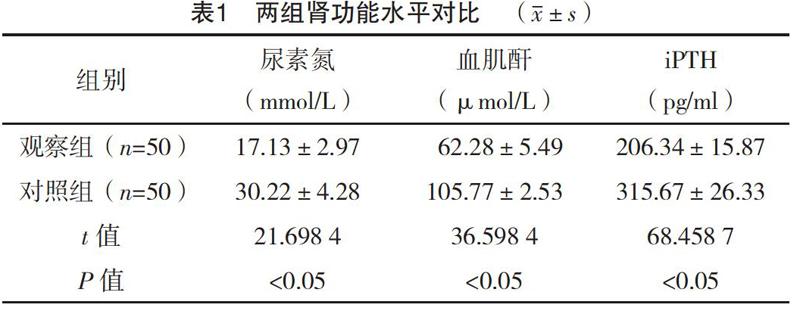

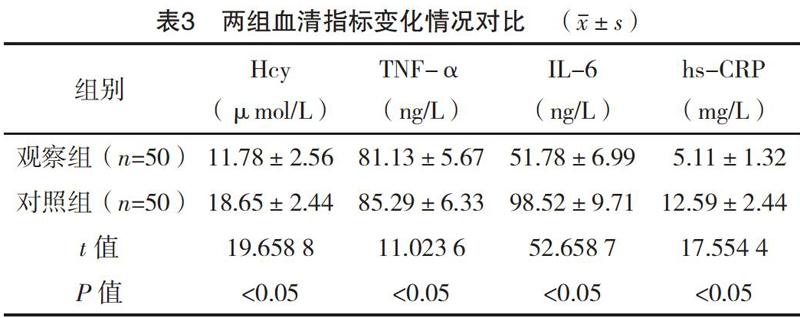
【摘要】 目的:探究维持性血液透析患者采用多模式组合透析对预后的影响。方法:选择2018年3月-2019年3月笔者所在医院100例实施维持性血液透析治疗患者为研究对象,根据患者住院号奇偶数分为两组,各50例。对照组进行血液透析(HD)治疗,观察组进行多模式组合透析治疗。比较两组治疗效果。结果:观察组血清转铁蛋白(151.96±15.75)mmol/L、血清前白蛋白(268.76±32.99)mg/L、Hb(105.86±10.36)g/L、ALB(65.79±5.87)g/L、尿素氮(17.13±2.97)mmol/L、血肌酐(62.28±5.49)μmol/L、iPTH(206.34±15.87)pg/ml、Hcy(11.78±2.56)μmol/L、TNF-α(81.13±5.67)ng/L、IL-6(51.78±6.99)ng/L、hs-CRP(5.11±1.32)mg/L,均优于对照组,差异有统计学意义(P<0.05)。结论:多模式组合透析在维持性血液透析患者中效果显著。
【关键词】 维持性血液透析 多模式组合透析 预后
doi:10.14033/j.cnki.cfmr.2019.30.005 文献标识码 A 文章编号 1674-6805(2019)30-00-03
[Abstract] Objective: To explore the prognostic impact of multimodal combination dialysis on maintenance hemodialysis patients. Method: A total of 100 patients with maintenance hemodialysis in our hospital from March 2018 to March 2019 were selected as the study subjects. According to the odd and even number of patients hospitalized, they were divided into two groups, with 50 cases in each group. The control group was treated with hemodialysis (HD), while the observation group was treated with multimodal combination dialysis. The therapeutic effects of the two groups were compared. Result: In the observation group, serum transferrin (151.96±15.75) mmol/L, serum prealbumin (268.76±32.99) mg/L, Hb (105.86±10.36) g/L, ALB (65.79±5.87) g/L, urea nitrogen (17.13±2.97) mmol/L, serum creatinine (62.28±5.49) μmol/L, iPTH (206.34±15.87) pg/ml, Hcy (11.78±2.56) μmol/L, TNF-α (81.13±5.67) ng/L, IL-6 (51.78±6.99) ng/L and hs-CRP (5.11±1.32) mg/L were all better than those in the control group, the differences were statistically significant (P<0.05). Conclusion: Multimodal combined dialysis is effective in maintenance hemodialysis patients.
[Key words] Maintenance hemodialysis Multimodal combined dialysis Prognostic
First-authors address: Ningde Hospital Affiliated to Fujian Medical University, Ningde 352100, China
血液透析(HD)常用于終末期肾功能衰竭患者中,是目前肾衰竭患者主要治疗措施,能够在一定程度上改善相关症状,替代肾脏排泄功能,延长生存时间。近年来随着相关研究深入和血液透析技术的发展,临床开始进入肾脏替代治疗时代[1]。在相关研究深入过程中可发现,常规血液透析能够有效将肌酐、尿素中小分子水溶性毒素清除,但无法清除中大分子毒素和蛋白结合毒素,容易影响患者生存期和生存质量,甚至导致肾性骨病、顽固性皮肤瘙痒、顽固性高血压等疾病发生[2]。对此部分学者提议采用多模式组合透析治疗,其更能够缓解当前皮肤瘙痒感,改善神经传导速度,提高中大分子毒素清除能力,弥补传统血液净化不足之处,对钙、磷均具有促进作用[3]。而本研究对实施维持性血液透析治疗的患者,采用不同透析措施,现报道如下。
1 资料与方法
1.1 一般资料
选择2018年3月-2019年3月笔者所在医院100例实施维持性血液透析治疗的患者为研究对象,入选标准:(1)患者存在固定的透析方案,近30 d内未采用常规血液透析外血液净化治疗;(2)透析龄>3个月;(3)年龄<70岁;(4)患者各项资料齐全。排除标准:(1)严重全身性感染;(2)近1个月内存在手术史或外伤史;(3)合并血管炎、急性感染、活动性肝炎;(4)近3个月内接受过免疫抑制剂、输血、激素治疗。根据患者住院号奇偶数将其分为两组,每组50例。观察组:男29例,女21例;平均年龄(58.98±4.77)岁;疾病类型:肾小管间质病11例,良性小动脉肾硬化症10例,糖尿病肾病14例,原发性肾小球肾炎15例。对照组:男28例,女22例;平均年龄(58.73±4.55)岁;疾病类型:肾小管间质病10例,良性小动脉肾硬化症9例,糖尿病肾病15例,原发性肾小球肾炎16例。两组一般资料比较,差异无统计学意义(P>0.05),有可比性。
登录APP查看全文
