
右美托咪定与臂丛麻醉应用于上肢骨折手术的麻醉效果分析
2019-04-21 13:36:25刘海萍韦薇
中外医学研究
2019年30期
刘海萍 韦薇

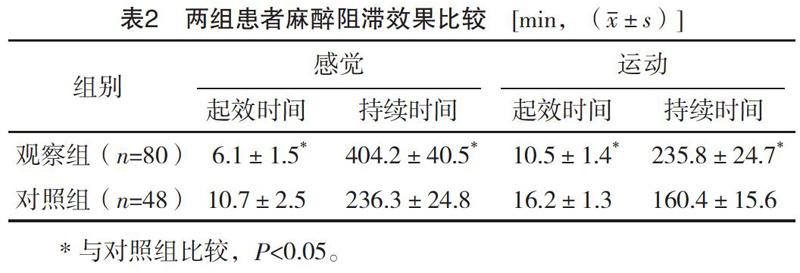

【摘要】 目的:探討右美托咪定与臂丛麻醉应用于上肢骨折手术的麻醉效果。方法:将2018年4月-2019年4月在笔者所在医院骨科行上肢骨折手术的128例患者作为研究对象,按麻醉方法的不同将其分为对照组(48例)和观察组(80例)。对照组行臂丛麻醉联合咪达唑仑,观察组行臂丛麻醉联合右美托咪定。比较两组血流动力学变化、臂丛神经阻滞效果、不良反应、术后追加止痛药物率。结果:观察组手术开始时(T2)、手术30 min后(T3)时心率均明显低于对照组,差异有统计学意义(P<0.05)。观察组T2、T3、手术结束时(T4)平均动脉压均明显低于对照组,差异有统计学意义(P<0.05)。两组T1~T4血氧饱和度比较差异均无统计学意义(P>0.05)。观察组运动及感觉阻滞起效时间均明显早于对照组,运动及感觉阻滞持续时间均明显长于对照组(P<0.05)。两组呼吸抑制、血压升高、心率过缓等不良反应发生率比较,差异均无统计学意义(P>0.05)。观察组在术后3、4、5、6 h追加止痛药物率均明显低于对照组,差异有统计学意义(P<0.05)。结论:右美托咪定与臂丛麻醉应用于上肢骨折手术的麻醉效果显著,能产生良好的镇痛效果,缩短起效时间,延长维持时间,稳定血流动力学,不良反应发生率低,具有积极的临床意义。
【关键词】 上肢骨折手术 右美托咪定 臂丛麻醉 麻醉效果
doi:10.14033/j.cnki.cfmr.2019.30.022 文献标识码 B 文章编号 1674-6805(2019)30-00-03
[Abstract] Objective: To investigate the anesthetic effect of Dexmedetomidine and brachial plexus anesthesia in upper limb fracture surgery. Method: A total of 128 patients who underwent upper limb fracture surgery in the department of orthopedic of our hospital from April 2018 to April 2019 were selected as the study objects. They were divided into the control group (48 cases) and the observation group (80 cases) according to different anesthesia methods. The control group was treated with brachial plexus anesthesia combined with Midazolam, while the observation group was treated with brachial plexus anesthesia combined with Dexmedetomidine. The hemodynamic changes, brachial plexus block effect, adverse reactions and the rate of additional painkillers were compared between the two groups. Result: The heart rate in the observation group were significantly lower than those in the control group at the beginning of operation (T2) and 30 min after operation (T3), the differences were statistically significant (P<0.05). The mean arterial pressure at T2, T3 and the end of operation (T4) in the observation group were significantly lower than those in the control group, the differences were statistically significant (P>0.05). There was no significant difference in blood oxygen saturation between the two groups from T1 to T4 (P>0.05). The onset time of motor and sensory block in the observation group were significantly earlier than those in the control group, and the duration of motor and sensory block were significantly longer than those in the control group, the differences were statistically significant (P<0.05). There was no significant difference in the incidence of adverse reactions such as respiratory suppression, elevated blood pressure and bradycardia between the two groups (P>0.05). The rate of additional painkillers in the observation group were significantly lower than those in the control group at 3, 4, 5 h and 6 h after operation, the differences were statistically significant (P<0.05). Conclusion: The application of Dexmedetomidine and brachial plexus anesthesia in upper limb fracture surgery has remarkable anesthetic effect, which can produce good analgesic effect, shorten the onset time, prolong the maintenance time, stabilize the hemodynamics, and the incidence of adverse reactions is low. It has positive clinical significance.
[Key words] Upper limb fracture surgery Dexmedetomidine Brachial plexus anesthesia Anaesthesia effect
First-authors address: Orthopaedic Hospital of the Chinese and Western Medicine of Guigang City, Guigang 537100, China
臂丛神经阻滞麻醉是上肢骨折手术常用麻醉方式,如何增加麻醉阻滞效果、减少麻醉及手术风险是临床一直以来研究的重点。臂丛神经阻滞麻醉虽然避免了全身麻醉对机体功能的影响,但患者可因惧怕手术、骨折的疼痛等出现明显的恐惧心理,导致情绪不稳定,进而出现阻滞不全的现象[1]。右美托咪定是麻醉镇静辅助用药,具有起效时间短、药效持续时间长等优点,具备镇静镇痛抗交感作用,有利于稳定患者情绪,提升麻醉效果[2]。本研究进一步分析右美托咪定与臂丛麻醉应用于上肢骨折手术的麻醉效果,现具体汇报如下。
1 资料与方法
登录APP查看全文
