基于载波相位差分的形变监测高精度定位算法
2019-08-01 01:54:12陈凯孙希延纪元法王守华陈紫强
计算机应用
2019年4期
陈凯 孙希延 纪元法 王守华 陈紫强
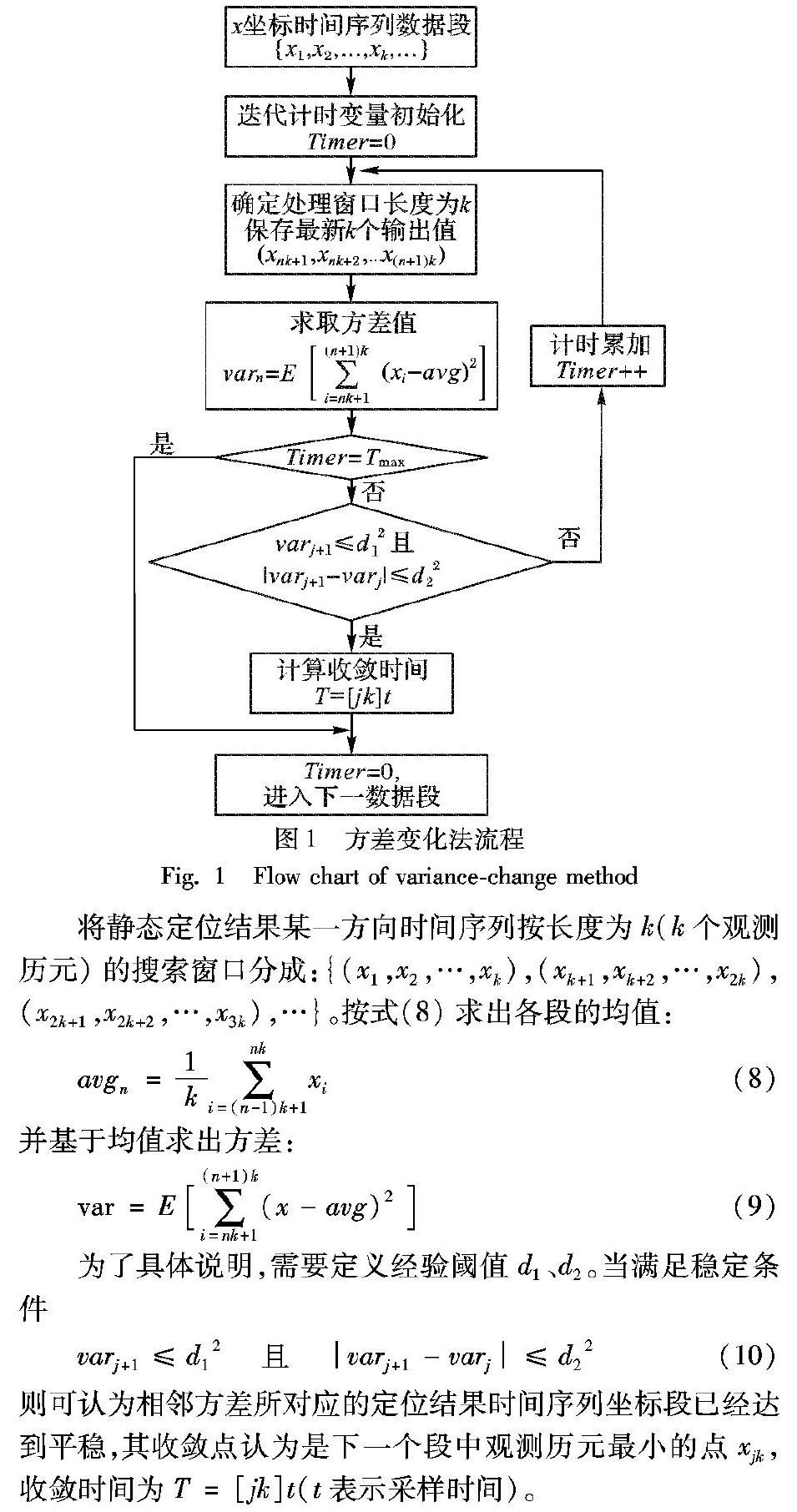

摘 要:传统载波相位差分算法在形变监测领域适用性不足,实时动态定位(RTK)精度难以满足要求,而载波双差静态相对定位连续解算时形变跟踪性能较低等。针对这些问题,在对动静态算法深入研究的基础上,提出一种基于载波相位差分的动静态自适应融合算法。通过方差变化法实时判断定位结果是否收敛,自适应调节扩展卡尔曼滤波(EKF)状态先验估计过程。在收敛时刻增大位置参数的先验估计误差的协方差值,使EKF后验估计过程倾向于信赖测量值;未收敛时刻通过EKF迭代,使EKF后验估计过程倾向于信赖状态预测值。实验结果表明:相比传统RTK新算法精度有明显提高,水平达±2mm内,高程达到±4mm内;相比静态定位则缩减了观测周期,提高了微小形变跟踪性能。
关键词:形变监测;实时动态定位;静态定位;方差变化;定位精度
中图分类号:TN967.1
文献标志码:A
文章编号:1001-9081(2019)04-1234-06
Abstract: Traditional carrier phase difference algorithm is not suitable for deformation monitoring, the accuracy of Real-Time Kinematic (RTK) positioning cannot meet requirements and static relative positioning based on carrier double-differential phase has poor deformation tracking performance with continuous calculations. To solve these problems, based on the deep research of dynamic and static algorithms, a dynamic and static adaptive fusion algorithm based on carrier phase difference was proposed. The convergence of positioning results was judged by variance-change method in real time, then the state priori estimation process of Extended Kalman Filter (EKF) was adaptively adjusted. In the process, the covariance value of priori estimation error of position parameters was increased at the convergence time, so that the posteriori process of EKF tended to trust measured value. EKF iteration was used at the non-convergence time, so that the posteriori process of EKF tended to trust state predicted value. The experimental results show that compared with traditional RTK, the accuracy of the new algorithm is improved, with horizontal accuracy of ±2mm, and altitudinal accuracy of ±4mm. Compared with static positioning, the observation period is reduced, and the tracking performance of micro-deformation is improved.
Key words: deformation monitoring; Real-Time Kinematic (RTK) positioning; static positioning; variance-change; positioning accuracy
0 引言
全球衛星导航系统(Global Navigation Satellite System, GNSS)定位技术在形变监测领域具备自动化程度高、可同时测定三维位移及全天候等优势,已经广泛应用在如建筑物、桥梁、大坝和滑坡等监测领域。在实际工程应用中,当形变监测精度要求较高时(例如大坝、船闸监测的精度要求毫米级),或者在沉降监测领域,传统定位算法很难满足监测需要[1]。
目前,形变监测常用的GNSS定位算法有实时动态定位(Real-Time Kinematic positioning, RTK)[2]和载波双差静态相对定位(简称静态定位)[3]两种。传统RTK算法实时性和形变跟踪性能较高,但……
登录APP查看全文