
不同入路下微创钻孔引流术治疗中等量基底节区高血压性脑出血的效果
2020-06-08 15:23:53张亮亮张景利曾雯倩
中外医学研究
2020年11期
张亮亮 张景利 曾雯倩
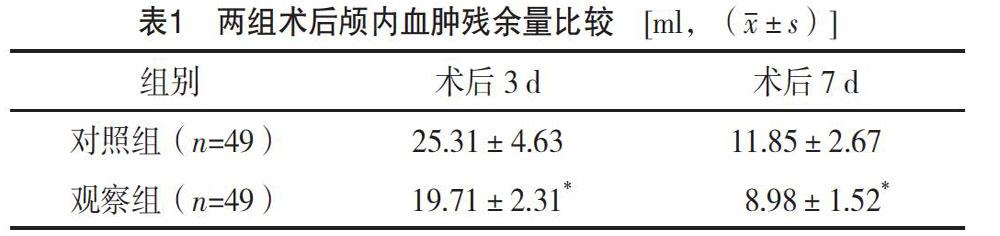

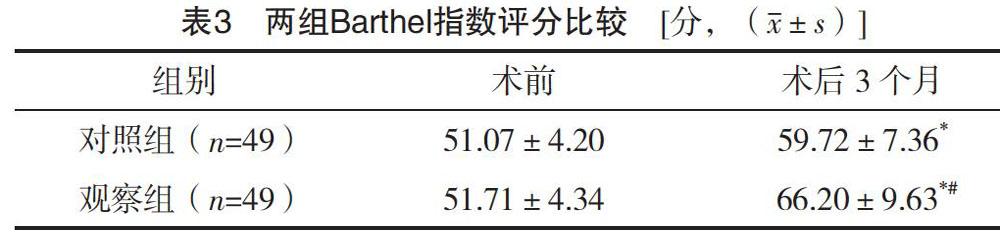
【摘要】 目的:探討不同入路下微创钻孔引流术治疗中等量基底节区高血压性脑出血的效果。方法:选取2017年1月-2019年8月笔者所在医院收治的中等量基底节区高血压性脑出血患者98例,根据随机数字表法分为对照组和观察组,每组49例。对照组采用经颞部入路微创钻孔引流术,观察组采用经额部入路微创钻孔引流术。观察两组术后3、7 d颅内血肿残余量、术前和术后3个月神经功能损伤情况、日常生活能力及并发症情况。结果:观察组术后3、7 d颅内血肿残余量均显著少于对照组(P<0.05);术后3个月,两组CSS评分和NIHSS评分均较术前显著下降,且观察组下降幅度显著优于对照组(P<0.05);术后3个月,两组Barthel指数评分均较术前显著升高,且观察组升高幅度显著优于对照组(P<0.05);两组术后并发症发生率比较,差异无统计学意义(P>0.05)。结论:相比经颞部入路微创钻孔引流术,对中等量基底节区高血压性脑出血患者应用经额部入路微创钻孔引流术能更好地清除血肿,促进神经功能和日常生活能力恢复,值得临床推广应用。
【关键词】 微创钻孔引流 颞部入路 额部入路 高血压性脑出血
[Abstract] Objective: To explore the effect of minimally invasive drilling and drainage under different approaches in the treatment of hypertensive cerebral hemorrhage with moderate amount of basal ganglia. Method: A total of 98 cases with hypertensive cerebral hemorrhage with moderate amount of basal ganglia admitted to our hospital from January 2017 to August 2019 were selected. According to the random number table method, they were divided into the control group and the observation group, with 49 cases in each group. The control group was treated with minimally invasive drilling and drainage through temporal approach, and the observation group was treated with minimally invasive drilling and drainage through frontal approach. The residual volume of intracranial hematoma at 3 and 7 days after operation, neurological impairment, daily living ability before and 3 months after operation, and complications of the two groups were observed. Result: The residual volume of intracranial hematoma at 3 and 7 days after operation in the observation group were significantly less than those of the control group (P<0.05). Three months after operation, the CSS scores and NIHSS scores in the two groups decreased significantly compared with those before operation, and the decrease range in the observation group was significantly better than that of the control group (P<0.05). Three months after operation, Barthel index score in the two groups increased significantly compared with those before operation, and the increase range in the observation group was significantly better than that of the control group (P<0.05). The incidence of postoperative complications was compared between the two groups, and the difference was not statistically significant (P>0.05). Conclusion: Compared with the minimally invasive drilling and drainage through temporal approach, the minimally invasive drilling and drainage through frontal approach in the treatment of hypertensive cerebral hemorrhage with moderate amount of basal ganglia can clear the hematoma better and promote the recovery of nerve function and daily living ability, which is worthy of clinical application.
高血压性脑出血是最常见的脑出血类型,脑血管破裂后,血液进入脑实质或脑室而影响中枢神经功能[1]。本病起病急,病情进展迅速,致死率高,出血位置常见于基底节区,需要进行紧急处理[2]。通过手术清除脑血肿为最有效的治疗方式,其中以微创钻孔引流术应用最广泛[3]。但目前关于微创钻孔引流术的入路方式尚无明确共识,常用入路方式为经额部和颞部两种[4]。现阶段,对于经额部和颞部微创钻孔引流术的手术效果的直接对比研究较少。为此,本研究选取笔者所在医院收治的98例患者,主要探讨不同入路下微创钻孔引流术治疗中等量基底节区高血压性脑出血的效果。……
登录APP查看全文
