
IGF-1对6-OHDA诱导人神经母细胞瘤细胞损伤作用
2020-06-08 10:18:56王晓雯晏振陈夙袁良杰陈文芳
青岛大学学报(医学版)
2020年2期
王晓雯 晏振 陈夙 袁良杰 陈文芳
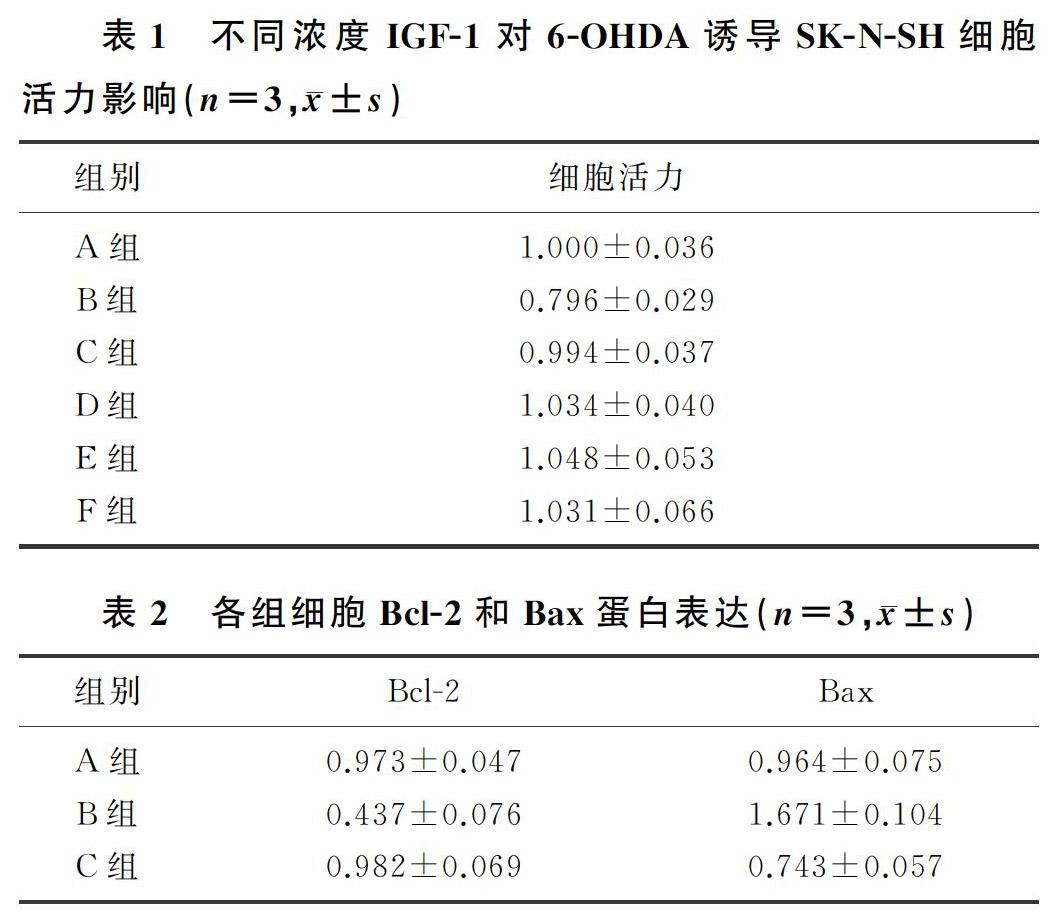
[摘要] 目的 探讨胰岛素样生长因子-1(IGF-1)对6-羟基多巴胺(6-OHDA)诱导的人神经母细胞瘤细胞(SK-N-SH细胞)神经毒性反应的抑制作用。方法 将SK-N-SH细胞种于96孔板,首先用不同浓度的IGF-1(6.25、12.50、25.00、50.00 μg/L)预处理细胞24 h,然后与6-OHDA(100 μmol/L)共同孵育细胞24 h,采用MTT法检测细胞活力。再将SK-N-SH细胞分为对照组(细胞不处理)、6-OHDA组(用100 μmol/L 6-OHDA处理细胞24 h)、6-OHDA+IGF-1组(细胞先用6.25 μg/L IGF-1预处理24 h,再与100 μmol/L 6-OHDA共同作用24 h),应用Western blot方法检测Bcl-2及Bax蛋白表达。结果 6.25~50.00 μg/L IGF-1均能够明显对抗6-OHDA诱导的神经毒性作用,提高细胞的存活率(F=11.53,q=4.795~5.556,P<0.05)。与对照组相比较,6-OHDA组Bcl-2蛋白的表达水平明显降低,而Bax蛋白的表达水平明显升高,差异有显著性(F=22.92、35.80,q=8.223、8.727,P<0.01);6.25 μg/L IGF-1能够明显对抗6-OHDA诱导的Bcl-2蛋白表达的下调和Bax蛋白表达的上调(q=8.361、11.450,P<0.01)。结论 IGF-1可对抗神经毒素6-OHDA诱导的SK-N-SH细胞凋亡相关蛋白Bcl-2及Bax的蛋白表达变化,发挥神经保护作用。
[关键词] 胰岛素样生长因子1;细胞凋亡;帕金森病;神经母细胞瘤
[中图分类号] R742.5;R338 [文献标志码] A [文章编号] 2096-5532(2020)02-0161-04
doi:10.11712/jms.2096-5532.2020.56.090 [開放科学(资源服务)标识码(OSID)]
[网络出版] http://kns.cnki.net/kcms/detail/37.1517.R.20200519.1433.007.html;2020-05-19 17:24
[ABSTRACT] Objective To investigate the inhibitory effect of insulin-like growth factor-1 (IGF-1) on the neurotoxic response of SK-N-SH human neuroblastoma cells induced by 6-hydroxydopamine (6-OHDA). Methods SK-N-SH cells were ino-culated into 96-well plates and pretreated with different concentrations of IGF-1 (6.25,12.50,25.00, and 50.00 μg/L) for 24 h. After that, the cells were co-incubated with 6-OHDA (100 μmol/L) for another 24 h. MTT assay was performed to determine the cell viability. In order to explore the protective mechanisms of IGF-1 on dopaminergic neurons, SK-N-SH cells were divided into control group (cells were left untreated), 6-OHDA group (cells were treated with 100 μmol/L 6-OHDA for 24 h), and 6-OHDA+IGF-1 group (cells were pre-treated with 6.25 μg/L IGF-1 for 24 h and then co-incubated with 100 μmol/L 6-OHDA for 24 h). Western blot was used to measure the expression of anti-apoptotic protein Bcl-2 and pro-apoptotic protein Bax in the SK-N-SH cells. Results Compared with the 6-OHDA group, 6.25-50.00 μg/L IGF-1 could significantly protect against the neurotoxic effects of 6-OHDA and improve the survival rate of SK-N-SH cells (F=11.53,q=4.795-5.556,P<0.05). Compared with the control group, the 6-OHDA group had significantly down-regulated protein expression of Bcl-2 and significantly up-regulated protein expression of Bax (F=22.92,35.80;q=8.223,8.727;P<0.01); 6.25 μg/L IGF-1 could significantly protect against 6-OHDA-induced down-regulation of Bcl-2 protein expression and up-regulation of Bax protein expression (q=8.361,11.450;P<0.01). Conclusion IGF-1 can protect against the neurotoxin 6-OHDA-induced apoptosis-related Bcl-2 and Bax protein expression changes in SK-N-SH cells, and exert a neuroprotective effect.
[KEY WORDS] insulin-like growth factorⅠ; apoptosis; Parkinson disease; neuroblastoma
帕金森病(PD)又名震颤麻痹,是一种中枢神经系统退行性疾病[1]。PD的主要临床表现为运动症状,如静止性震颤、肌强直、运动迟缓和姿势不稳等;其次为非运动症状,比如嗅觉功能异常、睡眠异常、肠道功能障碍等[2]。PD的主要病理表现是中脑黑质多巴胺(DA)能神经元的渐进性缺失,纹状体投射神经纤维的丢失以及嗜酸性包涵体路易小体(LBs)沉积[3-4]。导致PD病理改变的原因极其复杂,主要有环境因素、免疫炎症反应、遗传因素、线粒体功能异常、自噬功能的紊乱等[5-7]。一些神经毒素,如1-甲基-4-苯基-1,2,3,6-四氢吡啶(MPTP)、6-羟基多巴胺(6-OHDA)、百草枯和鱼藤酮等被用于PD模型的制备,这些药物大多与增强细胞凋亡有关[8]。6-OHDA属于DA与去甲肾上腺素类似物,其结构与儿茶酚胺相似,有研究显示其可以损毁神经末梢,导致递质减少,被广泛用于制备PD的细胞和动物模型[9]。……
登录APP查看全文
猜你喜欢
保健医苑(2022年6期)2022-07-08 01:25:28
中国民间疗法(2021年10期)2021-07-22 02:32:40
成都医学院学报(2021年2期)2021-07-19 08:35:14
活力(2019年22期)2019-03-16 12:47:04
中国中药杂志(2016年22期)2017-02-13 17:28:52
科技视界(2016年15期)2016-06-30 12:27:37
中国实用医药(2016年11期)2016-05-04 21:56:32
山东体育学院学报(2015年3期)2015-08-14 20:30:25
中国当代医药(2015年18期)2015-08-06 18:09:34
中国现代医生(2015年13期)2015-06-17 10:19:05
