
低频重复经颅磁刺激与持续θ暴发刺激治疗失眠症疗效的对比研究
2020-08-04 11:11:35瞿砚舟吴泓蔚陈洁
中国现代医生
2020年15期
瞿砚舟 吴泓蔚 陈洁
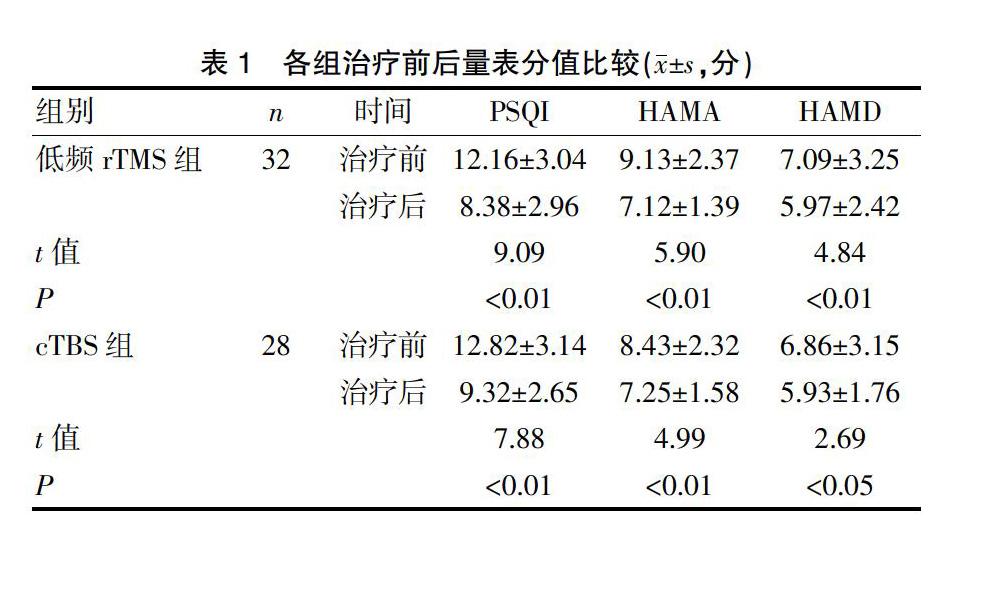

[摘要] 目的 比较低频重复经颅磁刺激(rTMS)与持续θ暴发刺激(cTBS)治疗失眠症的疗效差异。 方法 选取2018年1~12月丽水市人民医院神经内科收治的60例失眠症患者,随机分为低频rTMS组(32例)和cTBS组(28例),低频rTMS组以1 Hz低频rTMS刺激右侧背外侧前额叶(r-DLPFC)和顶枕区域,cTBS组以cTBS模式刺激相同位点,疗程2周。治疗前后评估匹兹堡睡眠质量指数(PSQI)、汉密尔顿焦虑量表(HAMA)、汉密尔顿抑郁量表(HAMD)。结果 低频rTMS组及cTBS组治疗前后PSQI、HAMA、HAMD均下降,差异有统计学意义(P<0.01);低频rTMS组各量表减分率略高于cTBS组,但差异无统计学意义(P>0.05)。 结论 持续θ暴发刺激治疗失眠症疗效不低于低频重复经颅磁刺激。
[关键词] 失眠症;重复经颅磁刺激;θ暴发刺激;右侧背外侧前额叶;顶枕区域
[中图分类号] R454.1 [文献标识码] A [文章编号] 1673-9701(2020)15-0007-04
Comparative study on the effects of low frequency repetitive transcranial magnetic stimulation and continuous θ burst stimulation in the treatment of insomnia
QU Yanzhou WU Hongwei CHEN Jie LAN Likang
Department of Neurology, Lishui People's Hospital in Zhejiang Province, Lishui 323000, China
[Abstract] Objective To compare the differences in the curative effect of low frequency repetitive transcranial magnetic stimulation(rTMS) and continuous θ burst stimulation(cTBS) in the treatment of insomnia. Methods 60 patients with insomnia who were treated in our hospital from January to December 2018 were selected and randomly divided into low-frequency rTMS group(32 cases) and cTBS group(28 cases). The low frequency rTMS group was given the stimulation on the right dorsal lateral prefrontal cortex(r-DLPFC) and parietal occipital region with low frequency rTMS at 1 Hz. The cTBS group was given the stimulation at the same site with cTBS mode; the course of treatment was 2 weeks. The Pittsburgh Sleep Quality Index(PSQI), Hamilton Anxiety Scale(HAMA), and Hamilton Depression Scale(HAMD) were evaluated before and after treatment. Results The PSQI, HAMA, and HAMD in the low-frequency rTMS group and the cTBS group were decreased before and after treatment(P<0.01). The reduction rate of each scale in the low-frequency rTMS group was slightly higher than that in the cTBS group, but the difference was not statistically significant(P>0.05). Conclusion The curative effect of continuous θ burst stimulation on insomnia is not lower than that of low frequency repeated transcranial magnetic stimulation.
[Key words] Insomnia; Repetitive transcranial magnetic stimulation; θ burst stimulation; Right dorsal lateral prefrontal cortex; Parietal occipital region
失眠癥是以频繁而持续的入睡困难和(或)睡眠维持困难并导致睡眠不满感为特征的睡眠障碍,可孤立存在或与精神障碍、躯体疾病、物质滥用共病。随着社会节奏加快和社会压力增大,失眠症发生率进一步增高,在成人中,符合失眠症标准者约10%~15%,且呈慢性化病程,近半数严重失眠症患者症状可持续10年以上,严重影响患者的生活质量和工作效率,甚至诱发交通事故等意外而危及个人和公共安全,对个人和社会都造成严重负担[1]。经颅磁刺激(Transcranial magnetic stimulation,TMS)技术,由Barker等[2]于1985年创立,是利用时变磁场在大脑皮层中产生感应电流,进而改变神经细胞的动作电位,以此来影响脑内代谢和神经电活动的生物刺激过程,是一项无创、操作简单、安全性好,可治疗多种神经、精神疾病的治疗技术。……
登录APP查看全文
