右美托咪定在无痛胃镜中的麻醉治疗疗效分析
2020-08-09 08:56:59范红帅
中外医疗
2020年15期
范红帅
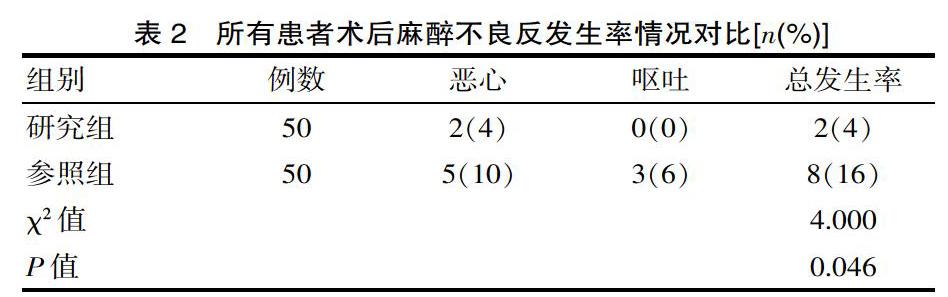
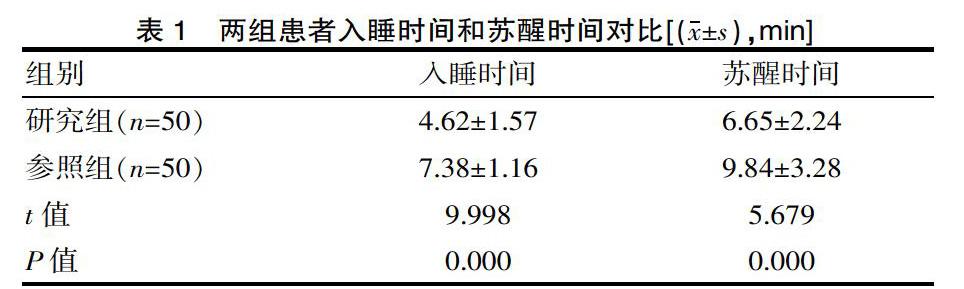
[摘要] 目的 分析应用右美托咪定应用于无痛胃镜中的麻醉效果,并对其用药安全性进行分析。方法 方便选取2018年3月—2019年3月期间在该院进行治疗的患者纳入研究,所有患者均有接受无痛胃肠镜进行治检查的需求,共计100例患者,按照随机数字表法的方式将所有患者区分成两组,分别为研究组和参照组,每组50例,参照组患者应用丙泊酚药物进行麻醉,研究组患者则应用右美托咪定药物进行麻醉,对两组患者的最终麻醉成效予以分析、对比。结果 研究组患者的入睡时间为(4.62±1.57)min、苏醒时间为(6.65±2.24)min,参照组患者的入睡时间为(7.38±1.16)min,苏醒时间为(9.84±3.28)min,研究组患者的入睡时间和苏醒时间均显著短于参照组,差异有统计学意义(t=9.998、5.679,P=0.000、0.000);研究組患者共计出现2例恶心症状的患者,不存在呕吐症状的患者,其不良反发生率为4%;参照组患者出现5例恶心症状的患者,3例呕吐情况的患者,其不良反发生率为16%,研究组患者不良反应发生率显著低于参照组,差异有统计学意义(χ2=4.000,P=0.046)。结论 应用右美托咪定麻醉药物对进行无痛胃镜治疗的患者予以麻醉,其麻醉效果较为理想,并且安全性较高,使用过后患者临床不良反应发生率较低,因而该种麻醉药物具有广泛应用的价值。
[关键词] 右美托咪定;无痛胃镜;麻醉效果;对比分析
[Abstract] Objective To analyze the anaesthetic effect of dexmedetomidine in painless gastroscopy and to analyze the safety of its administration. Methods The patients who were treated in the hospital from March 2018 to March 2019 were convenient selection included in the study. All patients had the need to undergo painless gastroscopy for treatment. A total of 100 patients were treated according to the random number table method. All patients were divided into two groups, a study group and a reference group. Each group received 50 patients. The patients in the reference group were anesthetized with propofol. The patients in the study group were anesthetized with dexmedetomidine. The final anesthesia effect of the two groups of patients was analyzed and compared. Results The sleep time of patients in the study group was (4.62 ± 1.57) min and the awake time was (6.65 ± 2.24) min. The sleep time of the reference group was (7.38 ± 1.16) min and the awake time was (9.84 ± 3.28) min. The sleep time and wake-up time of the patients in the group were significantly shorter than those in the reference group, the difference was statistically significant(t=9.998, 5.679, P=0.000, 0.000). The patients in the study group had 2 patients with nausea and no patients with vomiting symptoms. The adverse reaction rate was 4%; 5 patients with nausea in the reference group and 3 patients with vomiting had a 16% adverse reaction rate. The incidence of adverse reactions was significantly lower in the study group than in the reference group. The difference was statistically significant(χ2=4.000, P=0.046). Conclusion The application of dexmedetomidine anesthesia to anesthesia for patients undergoing painless gastroscopy has an ideal anesthesia effect and high safety. The incidence of clinical adverse reactions is low after use, so this anesthetic has a wide range of application value.
[Key words] Dexmedetomidine; Painless gastroscopy; Anesthetic effect; Comparative analysis
胃镜是一种临床用于消化道检查疾病常用的一种手段,该种检查方式能够帮助医生对消化道组织进行直观的观察,进而对疾病进行精准的诊断。因该种措施会给患者带来较大的痛苦,患者会出现强烈的恶心、呕吐等症状,使得检查效果受到影响,因而临床推出无痛胃镜[1]。……
登录APP查看全文