
不同喂养和分娩方式对婴儿巨细胞病毒感染的影响及其结局
2020-08-17 01:23:28马田君
中外女性健康研究
2020年12期
马田君


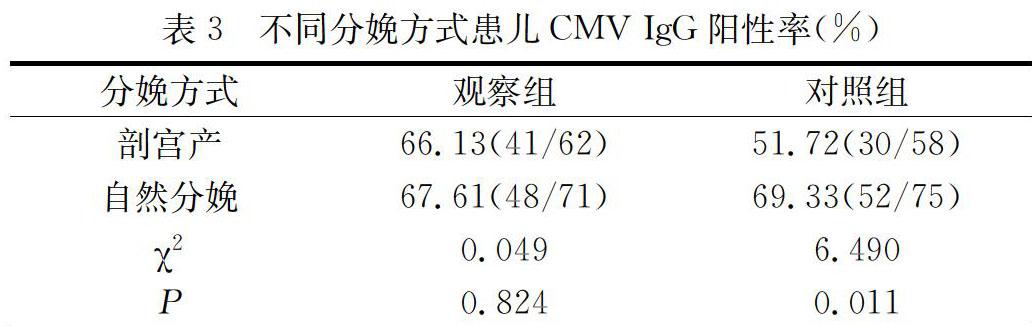
【摘 要】目的:探討不同喂养和分娩方式对婴儿巨细胞病毒感染(cytomegalovirus infection,CMV)的影响及其结局。方法:选择于2016年9月至2018年1月在本院进行孕检的310例孕妇,其中发现巨细胞病毒感染IgG阳性且IgM阴性的孕妇共266例,均在本院生产,新生儿出生孕周均≥32周,均为单胎,为所有新生儿检测母体与新生儿血清巨细胞病毒感染IgM、lgG抗体。按照是否母乳喂养将婴儿划分为观察组与对照组各133例,其中观察组采用母乳喂养,对照组采用人工喂养与混合喂养,评价两组新生儿出生后不同月龄CMV IgG阳性率、不同分娩方式CMV IgG阳性率、感染结局。结果:观察组患儿不同月龄时CMV IgG阳性率均高于对照组,P>0.05。观察组中不同月龄时CMV IgG阳性婴儿中IgM阳性率均高于对照组,但两组结果比较无统计学意义,P>0.05。观察组133例婴儿中经剖宫产分娩的共62例,其中CMV IgG阳性率41例(66.13%);71例婴儿经自然分娩,其中CMV IgG阳性率48例(67.61%),结果比较无统计学意义,P>0.05。对照组133例婴儿中经剖宫产分娩的共58例,其中CMV IgG阳性率30例(51.72%),75例婴儿经自然分娩,其中CMV IgG阳性率52例(69.33%),结果比较有统计学意义,P<0.05。观察组与对照组CMV IgG阳性、CMV IgG阴性婴儿9~10个月时身高、体质量值比较无统计学意义,P<0.05。结论:婴儿出生后CMV感染条件与阴道分娩与母乳喂养有关,但对于≥32周的新生儿,感染CMV后对新生儿生长发育未造成严重影响,可继续给予母乳喂养。
【关键词】 母乳喂养;分娩;婴儿;巨细胞病毒感染
Effect of different feeding and delivery methods on infant cytomegalovirusinfection and its outcomes
Ma Tianjun
Heze City Hospital, Heze, Shandong 274031
[Abstract] Objective:To investigate the effects of different feeding and delivery methods on cytomegalovirus infection (CMV) in infants and its outcomes. Methods: 310 pregnant women who were examined in our hospital from September 2016 to January 2018 were selected. 266 pregnant women with positive cytomegalovirus infection and negative IgM were found. All of them were delivered in our hospital. The gestational weeks of newborns were more than or equal to 32 weeks. All of them were single fetuses. The maternal and neonatal serum cytomegalovirus infection IgM and IgG antibody was detected for all newborns. According to whether breastfeeding or not,infants were divided into observation group and control group,133 cases in each. The observation group was breastfed,while the control group was fed by artificial feeding and mixed feeding. The positive rate of CMV IgG at different months after birth,the positive rate of CMV IgG at different modes of delivery and the infection outcomes of the two groups were evaluated. Results: The positive rate of CMV IgG in the observation group was higher than that in the control group(P>0.05). The IgM positive rate of CMV IgG positive infants in the observation group was higher than that in the control group at different months of age,but there was no significant difference between the two groups(P>0.05). Of the 133 infants in the observation group,62 cases were delivered by cesarean section,of which 41 cases were CMV IgG positive(66.13%). Of 71 infants delivered naturally,48 cases(67.61%) were CMV IgG positive,the results showed no statistical significance(P>0.05). Of the 133 infants in the control group,58 cases were delivered by cesarean section,of which 30 cases(51.72%) were CMV IgG positive and 75 cases(69.33%) were natural delivery,the results were statistically significant(P<0.05). There was no significant difference in height and body weight of CMV IgG positive and CMV IgG negative infants between the observation group and the control group at 9~10 months(P>0.05). Conclusion: The condition of CMV infection after birth is related to vaginal delivery and breastfeeding,but it has no serious effect on the growth and development of newborns who have been infected with CMV for more than 32 weeks,so breastfeeding can be continued.
[Key words]Breastfeeding;Delivery;Infants;Cytomegalovirus infection
巨细胞病毒感染症(cytomegalovirus infection,CMV)是婴幼儿多发病,病因指CMV引起的先天性、后天性感染,CMV是双链DNA病毒,具有传染性,传播途径包括母婴传播、母乳感染;属疱疹病毒群,CMV是一种细胞内感染,患儿年龄越小病毒易感性越高,感染伴随症状随之加重,且初次感染后CMV难以被完全清除[1-2]。按照临床表现不同可划分为先天性、获得性感染两种,其中先天性感染症状在患儿出生后随即出现,临床表现包括皮肤瘀点、黄疸、肝脾肿大等;症状可单独出现,部分患儿可同时伴随生长缓慢、烦躁表现,但因小部分患儿出生后未出现疾病症状,因此临床确诊难度较大。而获得性感染……
登录APP查看全文
