
GFAP联合cfDNA测定在复杂性热性惊厥脑损伤中的临床研究
2020-08-21 08:52:27凌寅杰朱焰施明杰路攀袁琛
中国现代医生
2020年17期
凌寅杰朱焰 施明杰 路攀 袁琛
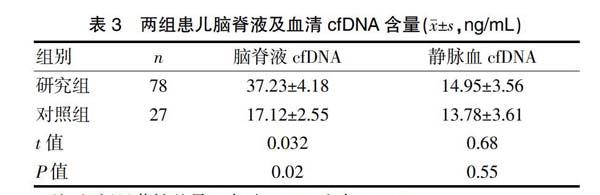

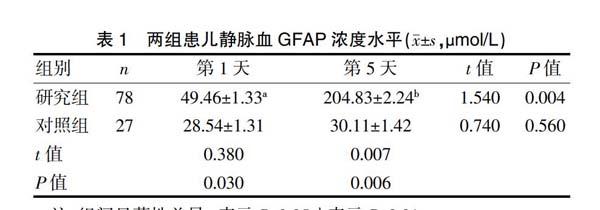
[摘要] 目的 研究復杂性热性惊厥患儿静脉血GFAP浓度、静脉血和脑脊液的cfDNA含量,并评价两者的相关性。方法 选择2019年1~12月在湖州市第一人民医院住院治疗的78例CFS患儿作为研究组,选择同期因发热疑似伴颅内感染,最终经脑脊液检查、脑电图、头颅MRI和病情观察排除颅内感染的住院患儿27例为对照组。分别测定两组患儿入院第1天和第5天的静脉血GFAP浓度,测定两组患儿入院当天的静脉血和脑脊液cfDNA含量。结果 研究组患儿静脉血GFAP水平(第1天和第5天)均较对照组水平升高,差异有统计学意义(P<0.05)。研究组患儿与对照组患儿之间的脑脊液cfDNA完整度具有显著性差异,且研究组患儿的脑脊液cfDNA含量较对照组显著增加,差异有统计学意义(P<0.05)。患儿静脉血GFAP水平与脑脊液cfDNA水平呈正相关关系。 结论 通过GFAP联合cfDNA含量测定,证实CFS患儿在分子和细胞层面存在惊厥后脑损伤。惊厥导致脑损伤的持续性,而非短暂消失,并可导致神经细胞死亡,引起脑脊液cfDNA浓度明显增加。
[关键词] GFAP;cfDNA;复杂性热性惊厥;脑脊液;相关关系
[中图分类号] R720.597 [文献标识码] A [文章编号] 1673-9701(2020)17-0029-04
Clinical study of GFAP combined with cfDNA determination in brain damage caused by complex febrile seizures
LING Yinjie ZHU Yan SHI Mingjie LU Pan YUAN Chen
Department of Pediatrics, Huzhou First Peoples Hospital in Zhejiang Province, Huzhou 313000, China
[Abstract] Objective To study the GFAP concentration of venous blood, cfDNA content in venous blood and cerebrospinal fluid in children patients with complex febrile seizures, and to evaluate the correlation between the two. Methods From January 2019 to December 2019, 78 children patients with CFS who were hospitalized for treatment in Huzhou First People's Hospital were selected as the study group. 27 hospitalized children patients suspected to be complicated with intracranial infection due to fever during the same period, who were excluded from intracranial infection through cerebrospinal fluid examination, electroencephalogram, skull MRI, and disease observation, were selected as the control group. The venous blood GFAP concentration in the two groups of children patients was determined on Day 1 and Day 5 of admission. The venous blood and cerebrospinal fluid(cfDNA) contents of the two groups of children patients were determined on the day of admission. Results The venous blood GFAP levels in the study group(Day 1 and Day 5) were higher than those in the control group, and the difference was statistically significant(P<0.05). There were significant differences in cerebrospinal fluid cfDNA integrity in children patients between the study group and the control group. The content of cfDNA in cerebrospinal fluid in the study group was increased significantly compared with that in the control group, and the difference was statistically significant(P<0.05). There was a positive correlation between venous blood GFAP levels and cerebrospinal fluid cfDNA levels in children patients. Conclusion GFAP combined with cfDNA determination confirms that children patients with CFS have brain damage after seizures at the molecular and cellular levels. Seizures cause persistent, not temporary disappearance of brain damage, and can lead to the death of nerve cells, causing a significant increase in cerebrospinal fluid cfDNA concentration.
[Key words] GFAP; cfDNA; Complex febrile seizures; Cerebrospinal fluid; Correlation
复杂性热性惊厥(complex febrile seizures,CFS),是儿童期常见的神经系统疾病。目前CFS的具体发病机制不清,如离子通道机制、脑脊液的酸碱平衡异常、神经递质失调等[1]。单纯性热性惊厥的患儿演变为癫痫的概率约2%~5%,而CFS则是其3.6倍[2]。除了增加罹患癫痫的风险外,CFS还可以造成不同程度的脑损伤。神经胶质纤维酸性蛋白(Glial fibrillary acidicprotein,GFAP)可作为惊厥后脑损伤的标志物[3],但不能评价是否存在神经细胞坏死。循环游离DNA(circulating cell-free DNA,cfDNA)是存在于人体中,在细胞外处于游离状态的DNA分子,其在人体血液和组织液等中均可检出。cfDNA的相关检测在产前诊断中已经取得了很多研究进展,另外通过对外伤、中风、颅内肿瘤和自身免疫性疾病患者的研究发现,其体内的cfDNA水平大大高于健康人[4-6]。而对于cfDNA在CFS患者中的研究报道较少。
本研究通过对78例……
登录APP查看全文
