咖啡渣低温燃尽条件及污染物排放特征
2020-08-24 12:56:26陈楠纬任杰孙水裕杨帆
当代化工
2020年6期
关键词:特征
陈楠纬 任杰 孙水裕 杨帆


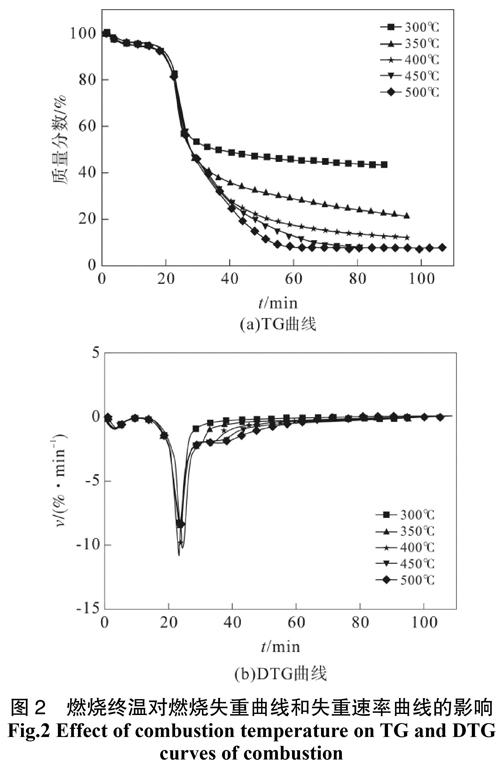
摘 要:先以热重分析法研究咖啡渣的低温燃尽条件,后使用“管式电炉+烟气分析仪”研究咖啡渣在燃尽条件下的污染物排放情况。结果表明,咖啡渣在空气气氛中以10 ℃·min-1的升温速率升至450 ℃保温40 min或升至500 ℃保温18 min,达到低温燃尽条件。在低温燃尽条件下,咖啡渣燃烧排放的污染物包括CO、CxHy、SO2和NO2,450 ℃的瞬时最大排放量分别为854、9、3、2 μg·g-1,500 ℃的瞬时最大排放量分别为1 399、33、8、2 μg·g-1。原料的不完全燃烧和管道的有机物残留是加剧污染的两大原因。
关 键 词:咖啡渣;燃尽条件;排放特征;CO;CxHy
中图分类号:X703 文獻标识码: A 文章编号: 1671-0460(2020)06-1064-05
Low Temperature Burnout Condition and Pollutant Emission
Characteristics of Coffee Industrial Residues
CHEN Nan-wei1, REN Jie1, SUN Shui-yu1,2, YAN Fang1
(1. Guangdong Polytechnic of Environmental Protection Engineering, Guangdong Engineering and Technology Research Center of Solid Waste Resource Recovery and Heavy Metal Pollution Control, Foshan Engineering and Technology Research Center of Heavy Metal Pollution Prevention and Resources Comprehensive Utilization, Foshan Guangdong 528216, China;
2. School of Environmental Science and Engineering, Guangdong University of Technology, Guangzhou Guangdong 510006, China)
Abstract: First, low temperature burnout condition of coffee industrial residues was researched by thermogravimetric analysis. Then, pollutant emission characteristics of coffee industrial residues were studied by “electric tube furnace + flue gas analyzer”. The results showed that, in order to meet low temperature burnout condition, coffee industrial residues should be heated up to 450 °C and kept the temperature for 40 min or 500 °C kept the temperature for 18 min with the heating rate of 10 °C·min-1 in air atmosphere. Under the low temperature burnout condition, pollutants in coffee industrial residues combustion emission include CO, CxHy, SO2 and NO2. At 450 °C, instantaneous maximum discharge amounts of four pollutants were 854, 9, 3 and 2 μg·g-1, respectively. At 500 °C, instantaneous maximum discharge amounts of four pollutants were 1 399, 33, 8 and 2 μg·g-1, respectively. Incomplete combustion of raw materials and organic residues in pipelines were the two major causes of pollution.
Key words: Coffee industrial residues; Burnout condition; Emission characteristics; CO; CxHy
咖啡渣是速溶咖啡生产过程的副产物,既是一种固体废弃物,又是一种生物质资源。据统计,全球咖啡平均年产量963.66万t[1],其中约20%用于生产速溶咖啡(每生产1 kg速溶咖啡就会排出0.9 kg咖啡渣)[2-3],即咖啡渣的年产量约91.29万t。既然咖啡渣的量如此之大,那么探究其转化利用途径和技术问题就显得十分必要。
生物质转化与利用技术分为直接燃烧技术、热解技术、化学技术和生物化学技术[4]。后三种技术对反应条件及设备要求较高,且须考虑产品的利用途径。相比之下,直接燃烧技术是最简单易行的,能最快实现减量化,广泛应用于生物质的处理处置。直接燃烧技术的关键在于控制燃烧的条件使生物质充分燃烧,减少污染气体的排放[5]。
国内外对咖啡渣的燃烧规律研究甚少,对其污染物排放特征也研究得不够全面。国内学者研究过咖啡渣燃烧特性及动力学[6]、咖啡渣与城市污泥的混燃特性[7]。……
登录APP查看全文
猜你喜欢
中学生数理化(高中版.高考数学)(2022年3期)2022-04-26 14:04:16
数学年刊A辑(中文版)(2020年1期)2020-05-19 00:30:36
空间科学学报(2020年2期)2020-04-01 03:50:40
疯狂英语·新策略(2019年10期)2019-12-13 08:43:28
当代陕西(2019年10期)2019-06-03 10:12:04
新闻传播(2018年11期)2018-08-29 08:15:24
广西科技大学学报(2016年1期)2016-06-22 13:10:38
河南科技(2014年23期)2014-02-27 14:19:15