基于ResNet和双向LSTM融合的物联网入侵检测分类模型构建与优化研究
2020-12-21 03:38:27陈红松陈京九
湖南大学学报·自然科学版
2020年8期
关键词:物联网
陈红松 陈京九
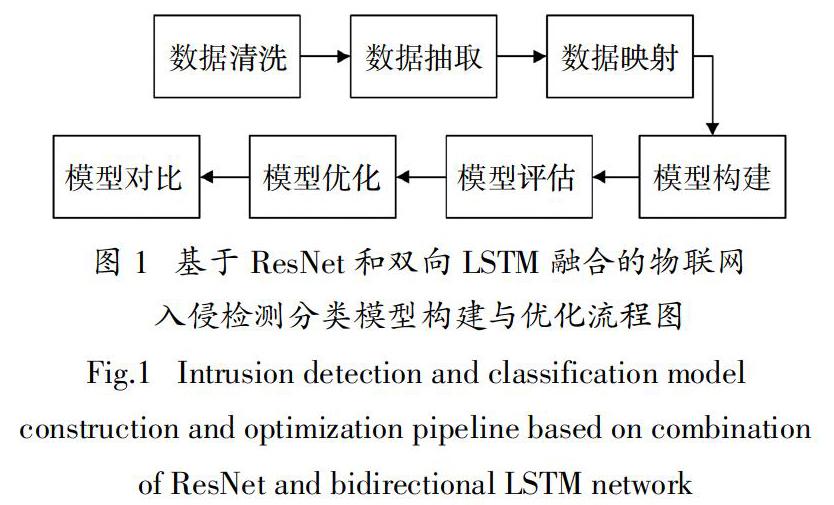
摘 要:为提高物联网入侵检测模型的综合性能,将残差神经网络(Residual Networks,ResNet)与双向长短时记忆(Long-Short Term Memory,LSTM)网络融合,构建物联网入侵检测分类模型.针对大规模物联网流量快速批量处理问题,在对原始数据进行清洗、转换等预处理基础上,提出将多条流量样本转换为灰度图,并利用基于ResNet和双向LSTM融合的深度学习方法构建物联网入侵检测分类模型.对分类模型的网络结构、可复用性进行综合优化实验,得到最终优化模型,分类准确率达到96.77%,综合优化后的模型构建时间为39.85 s.与其他机器学习算法结果相比,该优化方法在分类准确率和效率两个方面取得了很好的效果,综合性能优于传统的入侵检测分类模型.
关键词:入侵检测;残差网络;双向LSTM网络;图像分类;物联网
中图分类号:TP183 文献标志码:A 文章编号:1674—2974(2020)08—0001—08
Abstract:In order to improve the performance of the Internet of Things (IOT) network intrusion detection model, Residual Networks (ResNet) and bidirectional Long-Short Term Memory (LSTM) networks were combined,and an IOT intrusion detection classification model was constructed. For the rapid and batch processing problem of large-scale IOT traffic, multiple traffic samples were converted into grayscale images. Then,the grayscale images were used to construct IOT intrusion detection and classification model which combined with ResNet and bidirectional LSTM network. The network structure and re-usability of the classification model were optimized experimentally,so the optimization model was obtained finally. The classification accuracy of the optimization model is 96.77%, and the running time after the model reuse optimization is 39.85 s. Compared with other machine learning algorithms, the proposed approach achieves good results in both classification accuracy and efficiency. The performance of the proposed model is better than that of traditional intrusion detection model.
Key words:intrusion detection;Residual Networks(ResNet);bidirectional Long-Short Term Memory(LSTM) networks;image classification;IOT(Internet of Things)
随着网络的不断发展,人们对互联网的依赖也与日俱增.互联网为人们的生产生活提供方便的同時,也滋生了越来越多的安全问题.尤其是在当前物与物相连的物联网时代,如何快速识别物联网中的入侵,成为网络安全领域亟待解决的问题之一.入侵检测系统(Intrusion Detection System,IDS)可对流经网络中的流量进行判别,以检测是否有入侵情况的发生.入侵检测的实质是一个分类问题,即判定当前流量记录正常与否,或判定流量所属攻击类别.
Sharafaldin等[1]研发的CICIDS2017入侵检测数据集是一个公开数据集,该数据集基于真实环境采集得到.数据集包含正常流量和最新的常……
登录APP查看全文
猜你喜欢
软件导刊(2016年9期)2016-11-07 21:56:29
软件导刊(2016年9期)2016-11-07 21:32:45
中国科技博览(2016年22期)2016-11-01 15:02:01
中国科技博览(2016年22期)2016-11-01 13:21:09
中国科技博览(2016年19期)2016-10-19 14:58:22
电脑知识与技术(2016年21期)2016-10-18 22:33:02
科技视界(2016年22期)2016-10-18 17:23:30
中国新通信(2016年16期)2016-10-18 11:01:39
中国新通信(2016年16期)2016-10-18 11:00:54
科学与财富(2016年28期)2016-10-14 01:24:06