无模型自适应去噪控制及其应用
2020-12-21 03:38:27董娜朱硕
湖南大学学报·自然科学版
2020年8期
董娜 朱硕
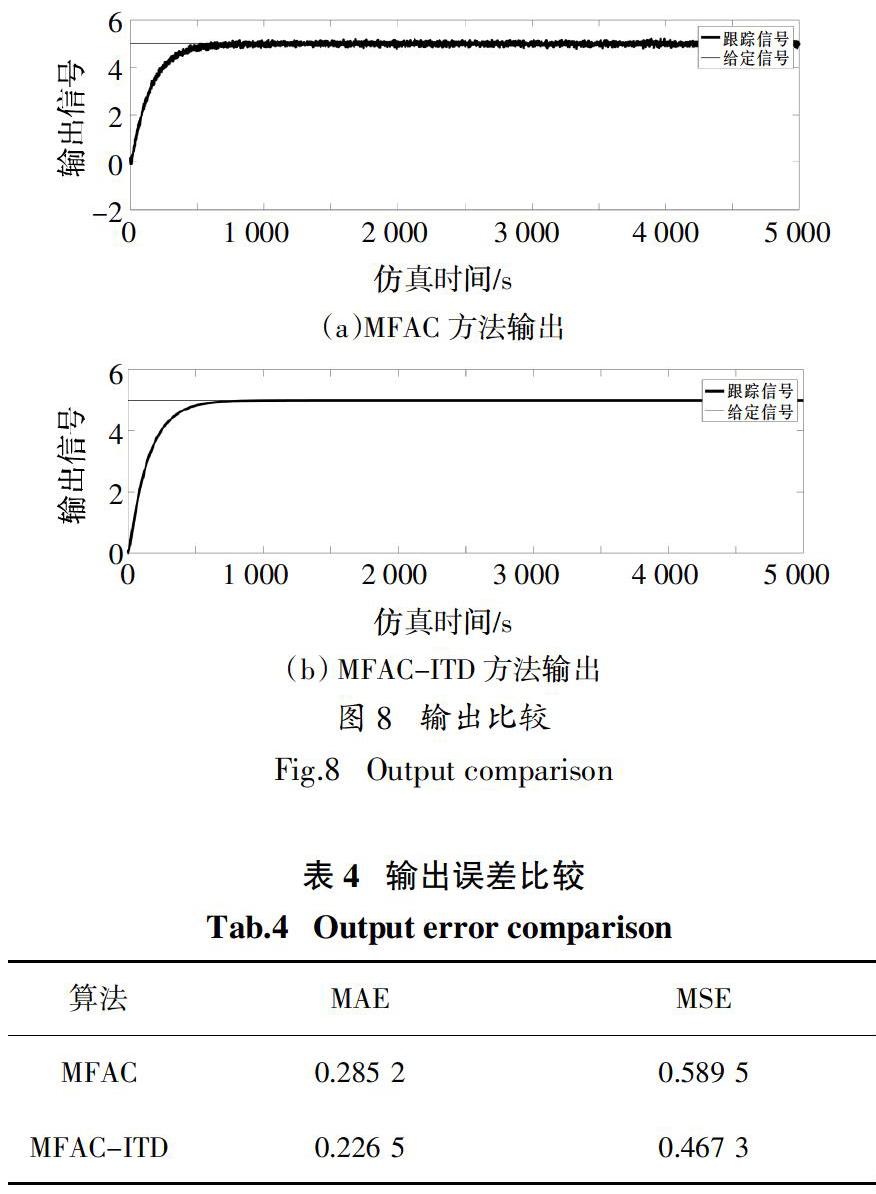
摘 要:为了使无模型自适应控制(Model-Free Adaptive Control,MFAC)更好地解决伴有噪声干扰系统的控制问题,在无模型自适应控制方法的基础上,针对伴随噪声干扰的系统进行分析研究,引入带有滤波作用的跟踪微分器,在反馈过程进行滤波操作,提出一种基于改进跟踪微分器(Improved Tracking Differentiator,ITD)的无模型自适应去噪控制方法,同时给出了该算法的收敛性证明. 并通过仿真证明了本文改进的控制方法可以快速跟踪给定信号并且具有良好的抵抗噪声干扰特性. 最后,将其应用在循环流化床锅炉汽包水位的控制中.
关键词:控制算法;工业锅炉的控制;无模型自适应控制;跟踪微分器;去噪;CFB锅炉
中图分类号:TP273 文献标志码:A 文章编号:1674—2974(2020)08—0074—08
Abstract:In order to make the model-free adaptive control(MFAC) better solve the control problem with noisy system, this paper examines the noise system and applies improved tracking differentiator in MFAC. Filtering is performed in the feedback process, and a MFAC method based on improved tracking differentiator(ITD) is proposed. The convergence of the algorithm is also proved. The simulation experiment proves that the improved control method can quickly track a given signal and has good resistance to noise interference. Finally, it is applied to the control of the drum water level of circulating fluidized bed (CFB) boiler.
Key words:control algorithm;control of industrial boilers;model-free adaptive control;tracking differentiator; de-noise;circulating fluidized bed(CFB) boiler
在工业生产过程中,尤其是复杂工业过程,数据量越来越大. 因此,很难建立精确的数学模型,由此导致基于模型的控制方法难以达到期望的控制结果. 无模型控制是解决此类问题的一种有效的选择. 典型的无模型控制方法当属PID(Proportional Integral Differential)[1]以及PID与其他算法相结合的方法[2]. 同时也有一些其他的无模型控制方法,如文献[3]基于同步扰动随机算法进行了聚表二元驱优化;文献[4]关于迭代学习控制的研究;以及虚拟参考反馈整定[5]等,经过众多科研人员的钻研与推广,这些方法取得了不同程度的发展,并且应用到了不同场景中.
侯忠生[6]于1994年提出了无模型自适应控制,相比前面提到的无模型方法,MFAC形式更加简单,参数调节更容易,并且有严格的理论证明……
登录APP查看全文