基于政策工具的我国中医药传承创新政策分析
2021-01-26 05:44:48邓月明聂海洋
中国药房
2021年1期
关键词:中医药
邓月明 聂海洋

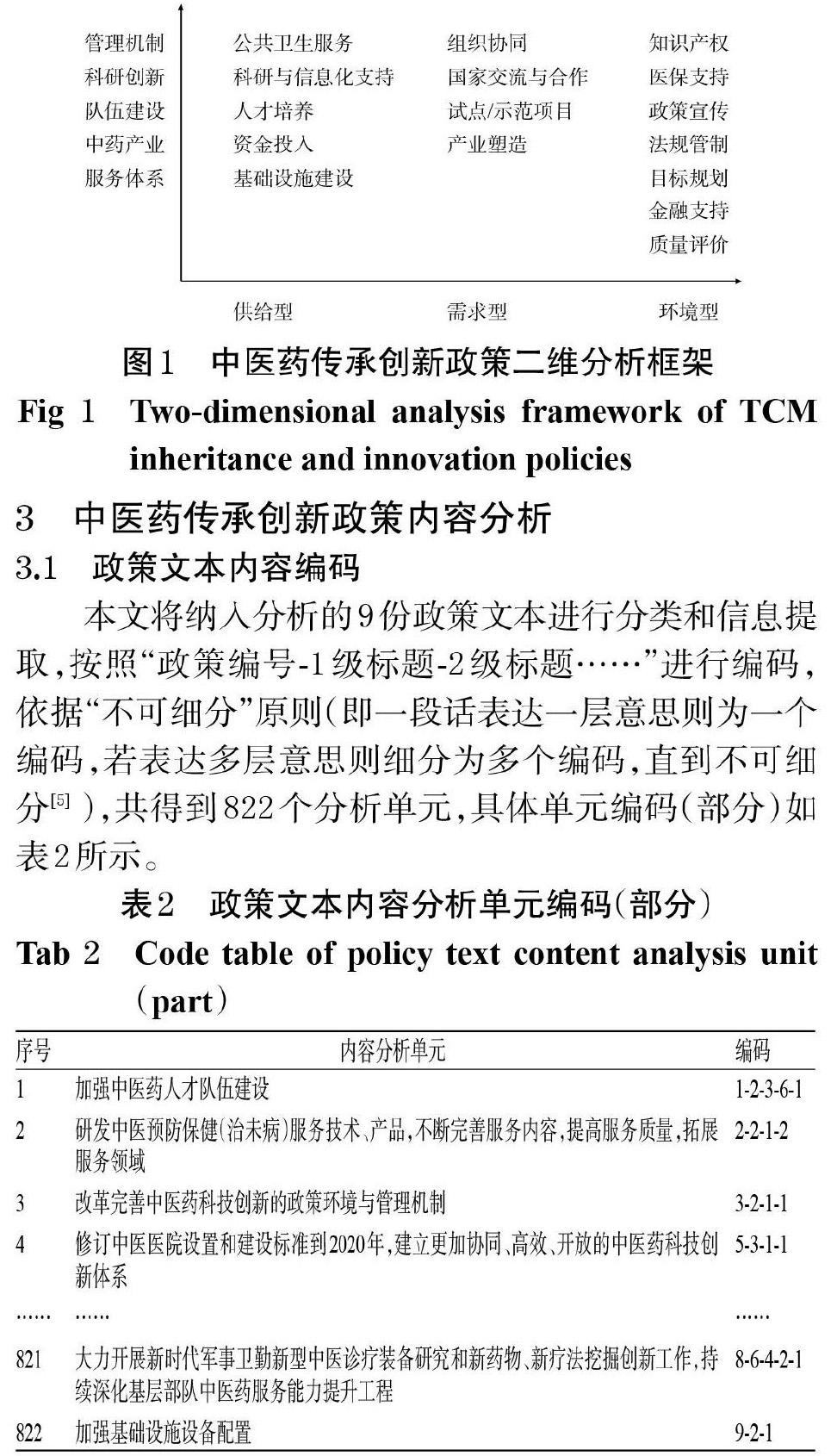

摘 要 目的:了解我國中医药传承创新政策的政策工具使用情况,为后续完善中医药传承创新政策提供借鉴。方法:采用内容分析法对2020年9月前国家层面发布的中医药传承创新相关政策文本进行编码分类,从基本政策工具和中医药传承创新体系两个维度进行统计分析,并提出相关完善建议。结果:共收集到相关政策文本9份,发布于2007-2020年。基本政策工具维度方面,环境型政策工具居多(占46.47%),其次是供给型政策工具(占41.36%),需求型政策工具最少(占12.17%)。供给型政策工具包含科研与信息化支持(占25.67%)、人才培养(占7.06%)、基础设施建设(占5.6%)、公共卫生服务(占2.07%)、资金投入(使用最少,占0.97%);需求型政策工具包含国际交流与合作(占5.11%)、组织协同(占3.77%)、产业塑造(占1.82%)、试点/示范项目(占1.46%),后2项内容使用较少;环境型政策工具中法规管制使用最多(24.94%),其次为目标规划(占9.73%)、知识产权(占6.57%)、金融支持(占2.43%)、政策宣传(占1.95%)、质量评价(占0.61%)、医保支持(占0.24%)。中医药传承创新体系维度方面包括科研创新(占34.67%)、管理机制(19.59%)、中药产业(占18.37%)、服务体系(占18.00%)、队伍建设(占9.37%)等5项内容,其中队伍建设相关内容较少。结论:为更好地完善落实我国中医药传承创新政策,建议优化供给型政策工具,突出政策推动功能;增加需求型政策工具,形成有效“拉动力”;调整环境型政策工具结构,改善传承创新外部环境;推进政策工具在传承创新体系全方位运用,实现规划目标。
关键词 中医药;传承创新;政策工具;内容分析法
ABSTRACT OBJECTIVE: To know about the use of policy tools for traditional Chinese medicine (TCM) inheritance and innovation policies in China, and to provide reference for subsequent improvement of TCM inheritance and innovation policies. METHODS: The content analysis method was used to classify and code the policy texts related to TCM inheritance and innovation policies at the national level before Sept. 2020. Statistical analysis was carried out from the two dimensions of basic policy tools and the TCM inheritance and innovation system, and related suggestions were put forward. RESULTS: Nine related policy texts were collected, which were published during 2007-2020. In terms of basic policy tool dimensions, environmental policy tools were the most (46.47%), followed by supplying policy tools (41.36%) and demanding policy tools (12.17%). The supply-based policy tools included scientific research and informatization support (25.67%), talent training (7.06%), infrastructure construction (5.6%), public health services (2.07%), and capital investment (used the least, 0.97%). The demand-based policy tools included international exchanges and cooperation (5.11%), organization coordination (3.77%), industry shaping (1.82%), pilot/demonstration projects (1.46%), the latter two contents were used less. Among the environmental policy tools, laws and regulations were used the most (24.94%), followed by target planning (9.73%), intellectual property (6.57%), financial support (2.43%), policy publicity (1.95%), quality evaluation (0.61%), and medical insurance support (0.24%). The dimensions of TCM inheritance and innovation system included scientific research and innovation (34.67%), management mechanism (19.59%), Chinese medicine industry (18.37%), service system(18.00%) and team building (9.37%), among which team building was related less. CONCLUSIONS: In order to better implement TCM inheritance and innovation policies in China, it is recommended to optimize supply-based policy tools and highlight policy promotion functions; increase demand-based policy tools to form an effective “pull force”; adjust the structure of environmental policy tools to improve the external environment for inheritance and innovation; promote the full use of policy tools in the inheritance and innovation system to achieve planning goals.
KEYWORDS Traditional Chinese medicine; Inheritance and innovation; Policy tools; Content analysis
中医药作为我国独特的卫生资源,应用于医疗、保健、康复等领域已有悠久的历史,早已作为优秀的中华传统文化深入人心[1]。……
登录APP查看全文
猜你喜欢
——中医药科研创新成果丰硕(一)
中国现代中药(2022年10期)2022-11-27 03:26:18
中国现代中药(2021年7期)2021-09-06 03:44:36
现代临床医学(2021年3期)2021-07-16 07:36:44
中国民间疗法(2021年5期)2021-06-09 09:21:42
实用中医药杂志(2021年2期)2021-04-01 03:05:20
公民与法治(2020年15期)2020-09-25 02:57:56
家庭医学(下半月)(2020年6期)2020-08-24 07:46:14
安徽医学(2020年6期)2020-07-17 12:16:44
中国卫生(2016年11期)2016-11-12 13:29:24
创业家(2015年10期)2015-02-27 07:55:16