在肺癌患者中联合应用IGRT和还原型谷胱甘肽的治疗效果
2021-03-25 22:29:12丁金泉李晓静温晓梅张群贵李为之黄立肖春晖曾莺婷
中国医学创新
2021年32期
关键词:肺癌
丁金泉 李晓静 温晓梅 张群贵 李为之 黄立 肖春晖 曾莺婷





【摘要】 目的:探討肺癌患者联合应用还原型谷胱甘肽和影像引导调强放射治疗(IGRT)的效果。方法:选取2019年1月-2020年12月本院60例肺癌患者,按照随机数字表法将其分为对照组和研究组,每组30例。对照组应用IGRT,研究组在对照组的基础上应用还原型谷胱甘肽。比较两组的近期临床疗效、炎症介质水平、生活质量评分、毒副反应发生情况。结果:研究组近期总有效率为80.00%高于对照组的46.67%,差异有统计学意义(P<0.05)。治疗前,两组各项生活质量评分比较,差异均无统计学意义(P>0.05);治疗后,两组各项生活质量评分均高于治疗前,且研究组均高于对照组,差异均有统计学意义(P<0.05)。治疗前,两组ACE、IL-6、TGF-β、IL-10、TNF-α水平比较,差异均无统计学意义(P>0.05);治疗后,研究组ACE、IL-10水平分别为(788.59±160.38)、(76.23±15.17)pg/mL,
均高于对照组的(581.89±140.18)、(65.06±14.81)pg/mL,IL-6、TGF-β、TNF-α水平分别为(58.36±20.61)、(4 067.26±278.24)、(51.62±20.72)pg/mL均低于对照组的(77.44±20.54)、
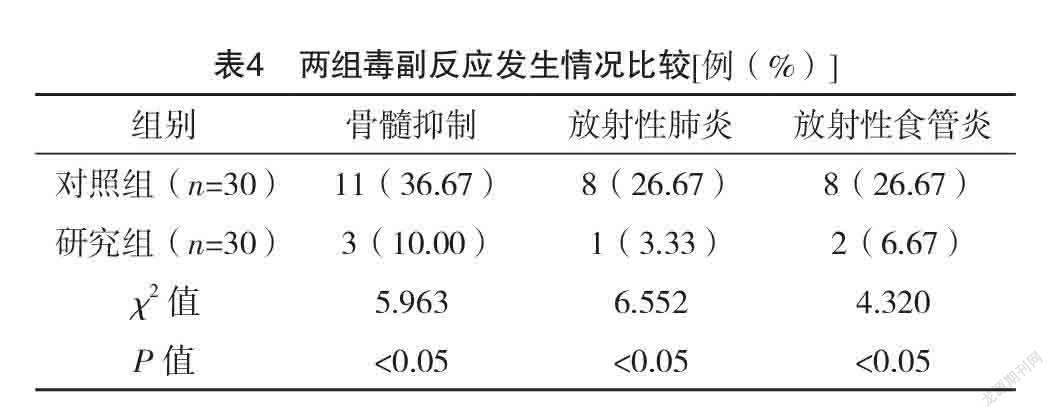
(4 987.39±304.17)、(87.05±22.01)pg/mL,差异均有统计学意义(P<0.05)。研究组骨髓抑制、放射性肺炎、放射性食管炎发生率分别为10.00%、3.33%、6.67%,均低于对照组的36.67%、26.67%、26.67%,差异均有统计学意义(P<0.05)。结论:相较于单独应用IGRT,联合应用IGRT+还原型谷胱甘肽治疗效果更佳,可以有效降低毒副反应的发生率以及患者机体中的炎症介质水平,提高治疗效果的同时提高患者的生活质量。
【关键词】 还原型谷胱甘肽 IGRT 肺癌 放疗 毒副反应
Therapeutic Effect of Combined Application of IGRT and Reduced Glutathione in Patients with Lung Cancer/DING Jinquan, LI Xiaojing, WEN Xiaomei, ZHANG Qungui, LI Weizhi, HUANG Li, XIAO Chunhui, ZENG Yingting. //Medical Innovation of China, 2021, 18(32): 0-014
[Abstract] Objective: To investigate the effect of combined reduced glutathione and IGRT in lung cancer patients. Method: A total of 60 lung cancer patients in our hospital from January 2019 to December 2020 were selected, and they were divided into control group and study group according to random number table method, 30 cases in each group. The control group was treated with IGRT, and the study group was treated with reduced glutathione on the basis of the control group. The recent clinical efficacy, changes in inflammatory mediators, quality of life scores, incidence of toxic reactions were compared between two groups. Result: The recent total effective rate in the study group was 80.00%, which was higher than 46.67% in the control group, the difference was statistically significant (P<0.05). Before treatment, there were no significant differences in all dimensions quality of life scores between two groups (P>0.05); after treatment, the all dimensions quality of life scores in both groups were higher than those before treatment, and those in the study group were higher than those in the control group, the differences were statistically significant (P<0.05). Before treatment, there were no significant differences in the levels of ACE, IL-6, TGF-β, IL-10 and TNF-α between two groups (P>0.05); after treatment, the levels of ACE and IL-10 in the study group were (788.59±160.38) pg/mL and
(76.23±15.17) pg/mL, which were higher than (581.89±140.18) pg/mL and (65.06±14.81) pg/mL in the control group, IL-6, TGF-β and TNF-α levels in the study group were (58.36±20.61) pg/mL, (4 067.26±278.24) pg/mL, and (51.62±20.72) pg/mL, which were lower than (77.44±20.54), (4 987.39±304.17), (87.05±22.01) pg/mL in the control group, the differences were statistically significant (P<0.05). The incidence of bone marrow suppression, radiation pneumonitis, and radiation esophagitis in the study group were 10.00%, 3.33%, and 6.67%, respectively, which were lower than 36.67%, 26.67%, 26.67% in the control group, the differences were statistically significant (P<0.05). Conclusion: Compared with IGRT alone, IGRT combined with reduced glutathione has a better therapeutic effect, which can effectively reduce the incidence of toxic reactions and the level of inflammatory mediators in the body of patients, improve the therapeutic effect and improve the quality of life of patients.
[Key words] Reduced glutathione IGRT Lung cancer Radiation therapy Toxic reaction
First-author’s address: Ganzhou Cancer Hospital, Ganzhou 341000, China
doi:10.3969/j.issn.1674-4985.2021.32.003
原发性支气管肺癌简称肺癌,是起源于气管、支气管黏膜或腺体的最常见的一种肺部原发性恶性肿瘤[1]。流行病学显示,全球范围内肺癌的死亡率、发病率均有升高趋势,目前临床中没有明确肺癌的病因,致病因素主要包括职业暴露、吸烟、遗传、肺部病史、空气污染、饮食、电离辐射等[2]。……
登录APP查看全文
猜你喜欢
保健医苑(2023年2期)2023-03-15 09:03:04
中国临床医学影像杂志(2022年2期)2022-05-25 13:24:34
中国药学药品知识仓库(2022年1期)2022-03-23 04:16:57
昆明医科大学学报(2021年4期)2021-07-23 01:21:44
天津医科大学学报(2021年2期)2021-03-29 05:30:38
天津医科大学学报(2019年6期)2019-08-13 07:04:26
癌变·畸变·突变(2016年3期)2016-02-27 06:15:34
医学研究杂志(2015年12期)2015-06-10 06:57:46
中国当代医药(2015年7期)2015-03-01 02:01:19
郑州大学学报(医学版)(2015年1期)2015-02-27 14:50:26