微生态制剂防治腹腔镜辅助巨结肠Soave根治术患儿围术期小肠结肠炎的临床效果
2021-03-25 22:28:36李伟坚李志雄陈锐源陈江谊冯燕琼陆金荣
中国医学创新
2021年23期
李伟坚 李志雄 陈锐源 陈江谊 冯燕琼 陆金荣
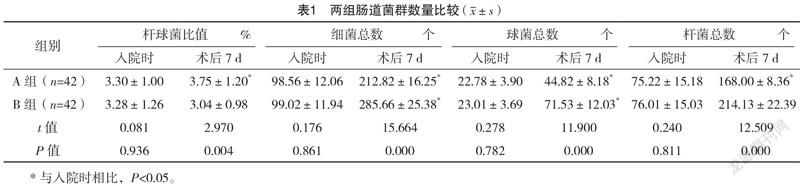
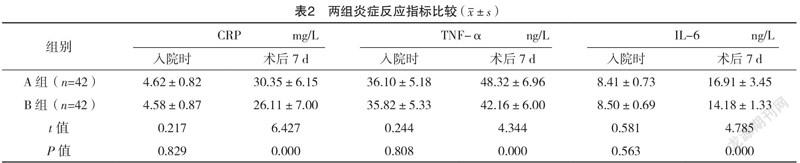
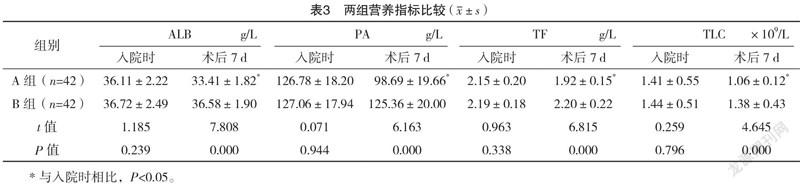

【摘要】 目的:探究微生態制剂防治腹腔镜辅助巨结肠Soave根治术围术期患儿小肠结肠炎的临床效果。方法:选取2017年1月-2019年12月在本院行腹腔镜辅助巨结肠Soave根治术的先天性巨结肠患儿84例,采用随机数表法将其分为A、B组,各42例。A组患儿术前准备按照传统方法(即术前口服肠道抗菌药),B组患儿于术前5 d开始口服肠道微生物制剂(枯草杆菌二联活菌颗粒)替代术前抗菌药,术后24 h起继续口服枯草杆菌二联活菌颗粒至术后第7天。对比两组患儿入院时、术后第7天肠道菌群数量、炎症反应指标以及营养指标,并统计两组术后小肠结肠炎的发生情况。结果:术后7 d,两组患儿的细菌、球菌及杆菌总数均明显高于入院时(P<0.05),且B组上述指标均明显高于A组(P<0.05);B组杆球菌比值与入院时比较,差异无统计学意义(P>0.05)。术后7 d,B组的血清C反应蛋白(CRP)、肿瘤坏死因子-α(TNF-α)以及白细胞介素-6(IL-6)均明显低于A组(P<0.05)。A组术后7 d各营养指标水平均明显低于入院时(P<0.05);B组术后7 d各营养指标水平与入院时相比,差异均无统计学意义(P>0.05),且B组术后7 d各指标水平均显著高于A组(P<0.05)。B组的小肠结肠炎发生率为7.14%,低于A组的23.81%(P<0.05)。结论:将微生态制剂应用于腹腔镜辅助巨结肠Soave根治术围术期患儿中,可有效纠正其肠道菌群失调现象,减少炎症反应并改善营养状况,降低小肠结肠炎的发生率。
【关键词】 微生态制剂 先天性巨结肠 Soave根治术 围术期 小肠结肠炎
Clinical Effect of Probiotics on Preventing Perioperative Enterocolitis in Children Undergoing Laparoscopic-assisted Soave Radical Resection of Megacolon/LI Weijian, LI Zhixiong, CHEN Ruiyuan, CHEN Jiangyi, FENG Yanqiong, LU Jinrong. //Medical Innovation of China, 2021, 18(23): 0-022
[Abstract] Objective: To explore the clinical effect of probiotics on preventing perioperative enterocolitis in children undergoing laparoscopic-assisted Soave radical resection of megacolon. Method: A total of 84 children with congenital megacolon who underwent laparoscopic-assisted Soave radical resection in the hospital from January 2017 to December 2019 were enrolled. They were divided into group A and B by random number table method, 42 cases in each group. The group A was treated with traditional method (oral intestinal antibacterial before surgery), while group B was treated with intestinal probiotics (Combined Bacillus Subtilis and Enterococcus Faecium Granules with Multivitamines, Live) at 5 d before surgery in place of preoperative antibacterial, and then treated with oral Combined Bacillus Subtilis and Enterococcus Faecium Granules with Multivitamines, Live at 24 h after surgery till the 7th day after surgery. The differences in number of intestinal floras, inflammatory response indexes and nutritional indexes at admission and 7 d after surgery were compared and analyzed between the two groups, the incidence of postoperative enterocolitis in both groups was statistically analyzed. Result: 7 d after surgery, the total number of bacteria, cocci and bacilli in the two groups were significantly higher than those at admission (P<0.05); and the above indicators in group B were significantly higher than those in group A (P<0.05); the ratio of bacillus in group B did not change significantly compared with that at admission (P>0.05). 7 d after surgery, concentrations of serum C-reactive protein (CRP), tumor necrosis factor-α (TNF-α) and interleukin-6 (IL-6) in group B were significantly lower than those in group A (P<0.05); 7 d after surgery, the levels of all nutrition indexes in group A were significantly lower than those at admission (P<0.05); 7 d after surgery, there was no statistical significance in the level of nutritional indexes in group B compared with at admission (P>0.05); 7 d after surgery, the levels of all nutrition indexes in group B were significantly higher than those in group A (P<0.05). The incidence of enterocolitis in group B was 7.14%, lower than 23.81% in group A (P<0.05). Conclusion: The application of probiotics in perioperative children undergoing laparoscopic-assisted Soave radical resection of megacolon can effectively correct intestinal flora imbalance, reduce inflammation response, improve nutritional status, and reduce the incidence of enterocolitis.
[Key words] Probiotics Congenital megacolon Soave radical resection Perioperative period Enterocolitis
First-author’s address: Jiangmen Central Hospital, Jiangmen 529000, China
doi:10.3969/j.issn.1674-4985.2021.23.005
先天性巨结肠是小儿临床中较为常见的消化道畸形疾病,其主要机制为肠神经节细胞减少或缺如,引起肠壁神经功能紊乱,当肠管痉挛和收缩时,近端肠管内容物无法继续向前推进,结肠扩张加剧,导致患儿出现或轻或重的腹胀[1]。……
登录APP查看全文