急性上消化道出血诱发心肌损伤患者最佳胃镜治疗时机的研究
2021-03-27 10:31:26穆天杰郝雨晴赵丽娟
中国医学创新
2021年21期
穆天杰 郝雨晴 赵丽娟
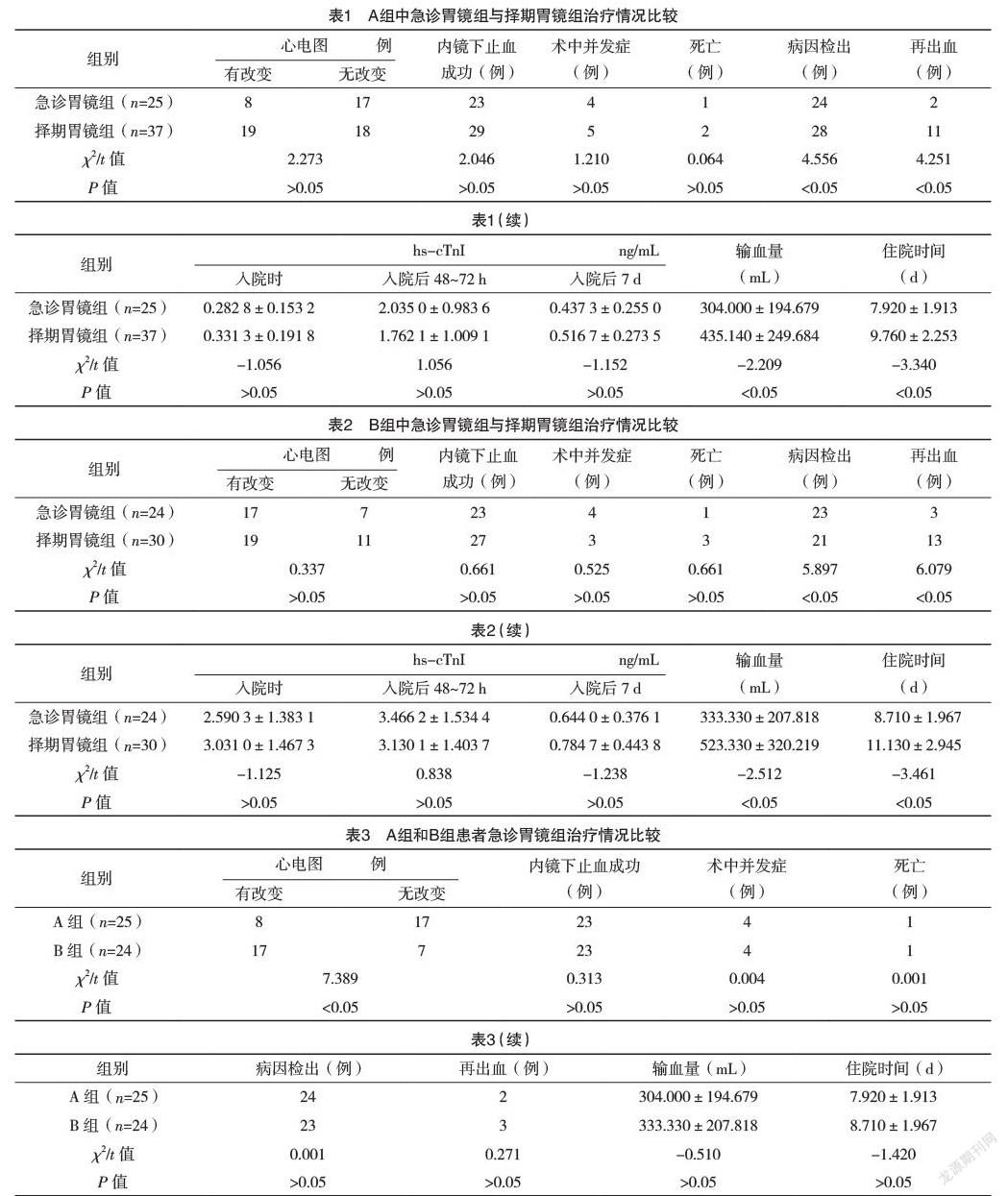
1月-2020年8月于本院治疗的116例急性上消化道出血诱发心肌损伤患者,将其分为两组,A组为0.068 4 ng/mL<hs-cTnI≤0.684 ng/mL者,B组为hs-cTnI>0.684 ng/mL者。A组行急诊胃镜(出血后24~48 h)者25例,择期胃镜(出血后48 h~7 d)37例,B组行急诊胃镜者24例,择期胃镜30例。分别比较A、B组急诊胃镜和择期胃镜的治疗情况,比较A组和B组急诊胃镜组治疗情况。结果:A组患者中急诊胃镜组和择期胃镜组病因检出率、术后复发出血率、输血量、住院时间比较,差异均有统计学意义(P<0.05)。B组患者中急诊胃镜组和择期胃镜组病因检出率、术后复发出血率、输血量、住院时间比较,差异均有统计学意义(P<0.05)。A组和B组中急诊胃镜组心电图情况比较,差异有统计学意义(P<0.05)。结论:急性上消化道出血诱发心肌损伤患者中,无论0.068 4 ng/mL<hs-cTnI≤0.684 ng/mL还是hs-cTnI>0.684 ng/mL者,与行择期胃镜相比,行急诊胃镜可减少输血量、缩短住院时间。
【关键词】 急性上消化道出血 心肌损伤 急诊胃镜 择期胃镜
[Abstract] Objective: To investigate the best time of gastroscopy in patients with myocardial injury induced by acute upper gastrointestinal hemorrhage. Method: A total of 116 patients with myocardial injury induced by acute upper gastrointestinal hemorrhage treated in our hospital from January 2018 to August 2020 were selected. They were divided into two groups, group A (0.068 4 ng/mL<hs-cTnI≤0.684 ng/mL) and group B (hs-cTnI > 0.684 ng/mL). Group A received emergency gastroscopy (24 to 48 h after bleeding) in 25 cases, and selective gastroscopy (48 h to 7 d after bleeding) in 37 cases. In group B, 24 patients received emergency gastroscopy, and 30 patients received elective gastroscopy. The treatment of emergency gastroscopy and elective gastroscopy in group A and B were compared, respectively. The treatment of emergency gastroscopy group was compared between group A and group B. Result: In group A, the etiology detection rate, postoperative recurrent bleeding rate, blood transfusion volume and length of stay of emergency gastroscopy group and selective gastroscopy group were compared, the differences were statistically significant (P<0.05). In group B, the etiology detection rate, postoperative recurrent bleeding rate, blood transfusion volume and length of stay of emergency gastroscopy group and selective gastroscopy group were compared, the differences were statistically significant (P<0.05). Comparison of ECG in emergency gastroscopy group between group A and group B, the difference was statistically significant (P<0.05). Conclusion: Among myocardial injury induced by acute upper gastrointestinal hemorrhage patients, whether 0.068 4 ng/mL<hs-cTnI≤0.684 ng/mL or hs-cTnI>0.684 ng/mL, emergency gastroscopy can reduce the amount of blood transfusion and shorten the length of hospital stay compared with elective gastroscopy.
[Key words] Acute upper gastrointestinal bleeding Myocardial injury Emergency gastroscope Elective gastroscope
First-author’s address: Third Affiliated Hospital of Jinzhou Medical University, Jinzhou 121000, China
doi:10.3969/j.issn.1674-4985.2021.21.037
急性上消化道出血是消化科急危重症疾病,可危及生命。随着治疗技术的不断进步,急性上消化道出血的病死率明显下降,但诱发急性心肌梗死时病死率仍较高,约12%的上消化道出血患者超敏肌钙蛋白(hs-cTnI)升高,表明一部分上消化道出血患者伴随着心肌损伤[1-2],因肌钙蛋白测定的阳性检出率显著高于心肌酶谱测定[3-5],故本研究选用hs-cTnI作为参考。在消化道出血的患者中,第一次出血量大、且以呕吐鲜血为主者,48 h内再出血的风险较大[6]。短期内失血量超过1 000 mL或循环血量20%的患者,在上消化道大出血第1天,大多会出现MB、hs-cTnI、CK-MB不同程度的升高[7],故对于失血量大、失血速度快的患者应密切监测心肌酶变化。……
登录APP查看全文