
基于CT肝癌3Dslicer人工智能建模精准辅助外科的应用研究
2021-03-27 10:31:47吴兆平彭浪金煜东陈伟力
中国医学创新
2021年18期
吴兆平 彭浪 金煜东 陈伟力
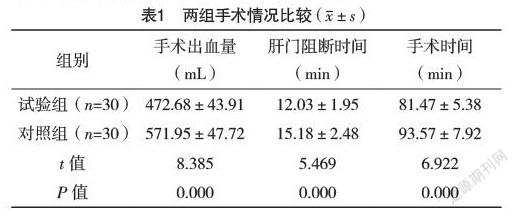
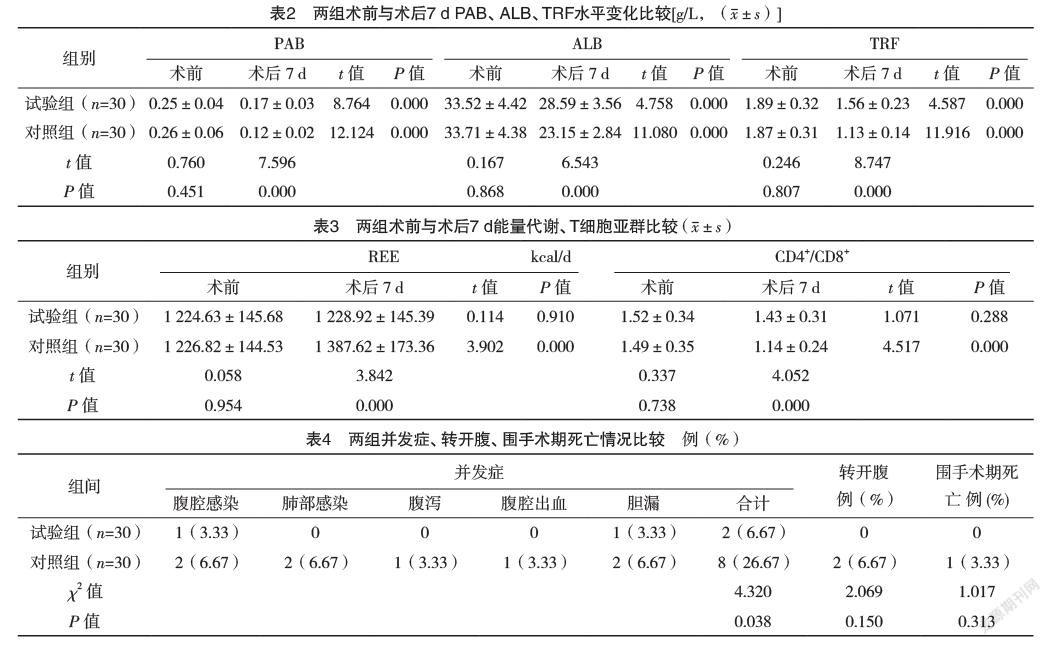
【摘要】 目的:探討基于电子计算机断层扫描(computed tomography,CT)肝癌三维切片(three dimensional slicer,3D slicer)人工智能(artificial intelligence,AI)建模精准辅助外科的应用效果。方法:选择2018年6月-2020年9月本院收诊的60例肝癌患者,均行腹腔镜肝切除术。按照有无辅助应用基于CT的3D slicer AI建模分为试验组(n=30,应用)与对照组(n=30,未应用)。观察两组手术出血量、肝门阻断时间、手术时间,分析两组术后7 d前白蛋白(prealbumin,PAB)、白蛋白(albumin,ALB)、转铁蛋白(transferrin,TRF)水平,比较其术后7 d静息能量消耗(resting energy expenditure,REE)水平、分化簇4(cluster of differentiation 4,CD4+)/分化簇8(cluster of differentiation 8,CD8+),且需统计其转开腹率、术后7 d并发症发生率及围手术期死亡率。结果:试验组手术出血量较对照组少,肝门阻断时间、手术时间均较对照组短,差异均有统计学意义(P<0.05)。两组术后7 d PAB、ALB、TRF、CD4+/CD8+水平均较术前降低,但试验组均较对照组高,差异均有统计学意义(P<0.05);而其术后7 d REE水平较术前升高,但试验组较对照组低,差异均有统计学意义(P<0.05)。试验组转开腹率、围手术期间死亡率与对照组相比,差异均无统计学意义(P>0.05)。试验组并发症发生率较对照组低,差异有统计学意义(P<0.05)。结论:基于CT的3D slicer AI建模辅助肝癌患者完成腹腔镜肝切除术,有助于减少患者的手术时间、手术出血量与并发症情况,可促使患者的血清内脏蛋白水平尽早恢复正常,且能够改善其能量代谢与免疫功能。
【关键词】 肝癌 CT 3D slicer 外科手术 人工智能建模
[Abstract] Objective: To explore the application effect of artificial intelligence (AI) modeling based on computed tomography (CT) three-dimensional slicer (3D slicer) of liver cancer in precision assisted surgery. Method: Sixty patients with liver cancer admitted to our hospital from June 2018 and September 2020 were selected for laparoscopic hepatectomy. According to whether the 3D slicer AI modeling based on CT was used as auxiliary application, the patients were divided into the experimental group (n=30, used) and the control group (n=30, not used). The surgical blood loss, hepatic portal occlusion time and surgical time were observed in two groups, and the levels of prealbumin (PAB), albumin (ALB) and transferrin (TRF) of two groups were analyzed at 7 d after surgery. The resting energy expenditure (REE) and cluster of differentiation 4 (CD4+)/cluster of differentiation 8 (CD8+) were compared at 7 d after surgery. The rate of conversion to laparotomy, total rate of complications at 7 d after surgery and perioperative mortality rate were statistically analyzed. Result: The surgical blood loss in the experimental group was less than that in the control group, and the hepatic portal occlusion time and surgical time were shorter than those in the control group (P<0.05). The levels of PAB, ALB, TRF and CD4+/CD8+ at 7 d after surgery in the two groups were decreased compared with those before surgery, and the levels in the experimental group were higher than those in the control group (P<0.05). The REE level at 7 d after surgery was increased compared to before surgery, and the level in the experimental group was lower than that in the control group (P<0.05). There were no significant differences in the rate of conversion to laparotomy and mortality rate during the perioperative period in the experimental group compared to the control group (P>0.05). The incidence rate of complications of the experimental group was lower than that of the control group (P<0.05). Conclusion: CT-based 3D slicer AI modeling assists patients with liver cancer to complete laparoscopic hepatectomy, which helps to reduce the surgical time, surgical blood loss and complications, and can promote the serum visceral protein level to return to normal as soon as possible, and can improve the energy metabolism and immune function.
[Key words] Liver cancer CT 3D slicer Surgery Artificial intelligence modeling
First-authors address: Jiujiang NO.1 Peoples Hospital, Jiujiang 332000, China
doi:10.3969/j.issn.1674-4985.2021.18.002
原发性肝癌是一种病死率极高的恶性肿瘤疾病[1],我国属该病高发国家,目前主要以腹腔镜肝切除术进行治疗。但由于肝内胆管、血管多变异且分支复杂,加之肝肿瘤和大血管存在密切关系,肝癌手术整体呈现出风险高、难度大等特点。……
登录APP查看全文
猜你喜欢
世界科学技术-中医药现代化(2022年3期)2022-08-22 00:32:50
腹腔镜外科杂志(2022年7期)2022-08-16 04:31:06
云南化工(2021年8期)2021-12-21 06:37:54
海洋信息技术与应用(2020年1期)2020-06-11 12:43:56
天津医科大学学报(2019年3期)2019-08-13 06:53:08
传媒评论(2019年4期)2019-07-13 05:49:14
中国内镜杂志(2017年2期)2017-03-20 16:18:12
腹腔镜外科杂志(2016年11期)2016-06-01 12:10:09
腹腔镜外科杂志(2016年9期)2016-06-01 12:10:07
肿瘤预防与治疗(2015年1期)2015-09-26 07:26:20
