丹参川芎嗪注射液对老年患者全膝关节置换术后谵妄的影响
2021-04-06 03:23:11胡亦玮曹寅
中国现代医生
2021年4期
胡亦玮 曹寅
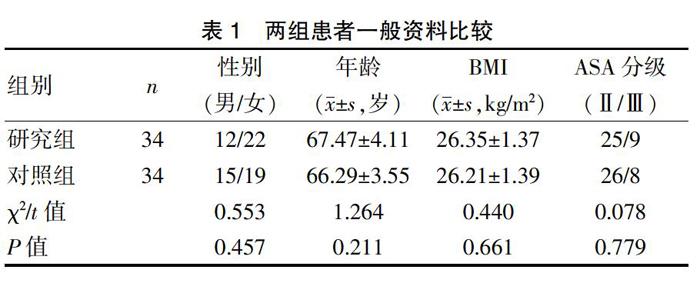
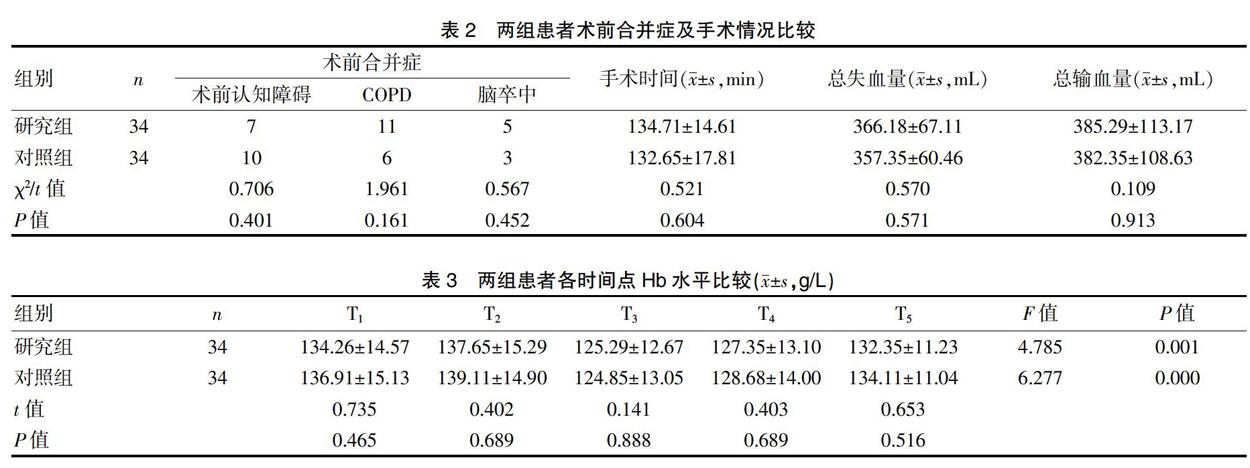
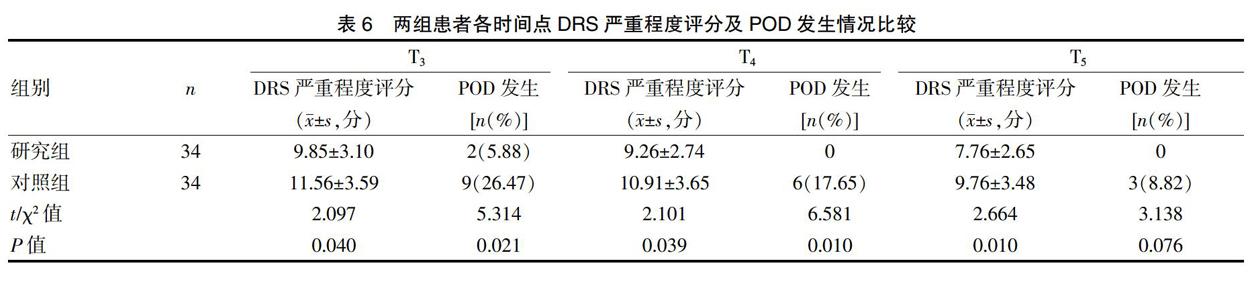
[摘要] 目的 觀察丹参川芎嗪注射液对老年患者全膝关节置换术后谵妄(POD)的影响。 方法 选取2019年2—10月宁波市第一医院接受单侧全膝关节置换术的老年患者68例,所有患者被分为研究组和对照组,每组各34例。研究组患者给予加入了10 mL丹参川芎嗪注射液的5%葡萄糖溶液250 mL;对照组患者给予250 mL 5%葡萄糖溶液。记录所有患者术前合并症、手术时间、总失血量、总输血量。术前第3天(T1)、手术当天(T2)、术后第1天(T3)、术后第2天(T4)、术后第3天(T5)检测患者脑氧饱和度(rSO2)、动脉血氧分压(PaO2)、血红蛋白(Hb)水平。T3、T4、T5时点采用谵妄分级量表(DRS)评估患者POD发生率及DRS严重程度。 结果 两组患者中合并术前认知障碍、COPD、脑卒中病史患者例数及手术时间、总失血量、总输血量比较,差异无统计学意义(P>0.05)。T1~T5时,两组患者PaO2及Hb水平比较,差异无统计学意义(P>0.05),T1、T2时两组患者rSO2水平比较,差异无统计学意义(P>0.05)。T3~T5时,研究组患者rSO2水平显著高于对照组,DRS严重程度评分均低于对照组(P<0.05)。T3、T4时,研究组POD发生率低于对照组(P<0.05)。 结论 在全膝关节置换术中,丹参川芎嗪注射液可提高老年患者术后rSO2,降低术后POD发生率,还能减轻其严重程度。
[关键词] 丹参川芎嗪注射液;脑氧饱和度;术后谵妄;血液高凝状态
[中图分类号] R687.4 [文献标识码] A [文章编号] 1673-9701(2021)04-0018-05
Effect of Salviae Miltiorrhizae and Ligustrazine Hydrochloride Injection on delirium after total knee arthroplasty in elderly patients
HU Yiwei CAO Yin
Department of Anesthesiology, Jiangbei Branch of Ningbo First Hospital(Ningbo Ninth Hospital), Ningbo 315000, China
[Abstract] Objective To observe the effect of Salviae Miltiorrhizae and Ligustrazine Hydrochloride Injection on postoperative delirium(POD) after total knee arthroplasty in elderly patients. Methods A total of 68 elderly patients who underwent unilateral total knee arthroplasty from February to October 2019 in Ningbo First Hospital were selected. All patients were divided into study group and control group, with 34 cases in each group. Patients in the study group were given 250 mL of 5% glucose solution with 10 mL of Salviae Miltiorrhizae and Ligustrazine Hydrochloride Injection. Patients in the control group were given 250 mL of 5% glucose solution. The preoperative complications, operation time, total blood loss, and total blood transfusion of all patients were recorded. On the 3rd day before the operation(T1), the day of the operation(T2), the first day after the operation(T3), the second day after the operation(T4), and the third day after the operation(T5), the cerebral regional oxygen saturation(rSO2), arterial partial pressure of oxygen(PaO2), and hemoglobin(Hb) levels were detected. At T3, T4 and T5, the delirium rating scale(DRS) was used to evaluate the incidence of POD and the severity of DRS. Results There was no significant difference in the number of patients with preoperative cognitive impairment, COPD, stroke history, and operation time, total blood loss and total blood transfusion between the two groups(P>0.05). From T1 to T5, there was no significant difference in PaO2 and Hb levels between the two groups(P>0.05). There was no significant difference in rSO2 levels between the two groups at T1 and T2(P>0.05). From T3 to T5, the rSO2 levels of the study group was significantly higher than that of the control group, and the DRS severity score was lower than that of the control group(P<0.05). At T3 and T4, the incidence of POD in the study group was lower than that in the control group(P<0.05). Conclusion In total knee arthroplasty, Salviae Miltiorrhizae and Ligustrazine Hydrochloride Injection can increase postoperative rSO2 in elderly patients, reduce the incidence of POD, and can reduce its severity.
[Key words] Salviae Miltiorrhizae and Ligustrazine Hydrochloride Injection; Cerebral oxygen saturation; Postoperative delirium; Blood hypercoagulability
术后谵妄(Postoperative delirium,POD)是指患者在接受外科手术之后出现的谵妄,一般发生于术后1~3 d,虽然不同的指南对POD的定义略有差异,但主要临床表现均为急性发病、病情存在波动性变化、注意力不集中、思维混乱无序及意识水平改变[1]。POD的病因仍不十分明确,目前绝大部分研究均支持高危因素有老年、术前认知障碍、睡眠障碍、低氧血症、术中失血量、脑梗后遗症等基础疾病[2]。围术期低流量吸氧是临床预防和治疗低氧血症的常规治疗手段,这虽然有助于提高动脉血氧分压,但未必可改善大脑氧供。研究者在以往……
登录APP查看全文