循证护理在预防手术患者文化休克中的应用
2021-04-06 03:23:11万梅胡蓉
中国现代医生
2021年4期
万梅 胡蓉

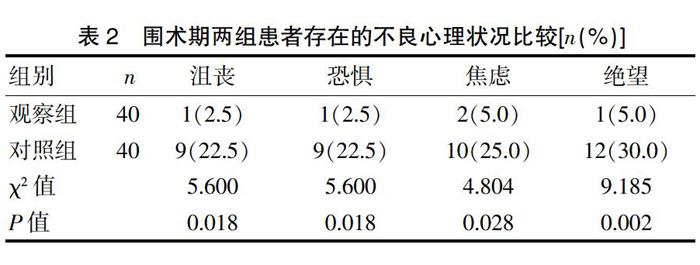
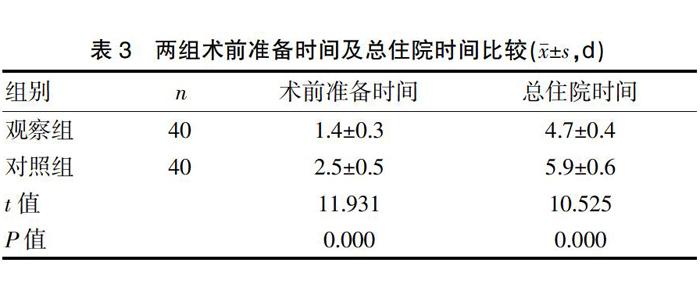
[摘要] 目的 探討循证护理在预防手术患者文化休克中的临床应用价值。 方法 选择2019年6—10月本院在手术室实施全身麻醉下手术患者80例,按照随机数字法分为两组,每组各40例。对照组实施常规护理,如一般护理、术前准备、术后护理常规等,观察组针对手术患者进行循证护理干预,对所有入组者住院期间及出院后1个月内情况进行电话随访,比较两组手术室相关文化休克指标,统计围术期观察组患者存在的不良心理状况,及两组术前准备时间及总住院时间。 结果 观察组手术室相关文化休克指标中文化环境的陌生、文化沟通障碍、文化适应能力障碍、个人支持系统、孤独感和态度改变的比例均显著低于对照组(P<0.05),围术期观察组患者存在的不良心理状况,如沮丧、恐惧、焦虑和绝望的比例均显著低于对照组(P<0.05),观察组术前准备时间短于对照组(P<0.05),总住院时间短于对照组(P<0.05)。 结论 针对手术室手术患者实施循证护理干预,能显著降低文化休克发生率,调整患者心态,缩短患者住院时间。
[关键词] 循证护理;手术患者;文化休克;负面心理
[中图分类号] R473 [文献标识码] B [文章编号] 1673-9701(2021)04-0162-03
Application of evidence-based nursing in preventing cultural shock of surgical patients
WAN Mei HU Rong
Hemodialysis Room, Ji′an Central People′s Hospital in Jiangxi Province, Ji′an 343000, China
[Abstract] Objective To explore the clinical application value of evidence-based nursing in the prevention of cultural shock in surgical patients. Methods A total of 80 patients undergoing surgery under general anesthesia in the operating room of our hospital from June to October 2019 were selected and divided into two groups according to the random number method, with 40 cases in each group. The control group received routine nursing care, such as general nursing, preoperative preparation, postoperative nursing routine, etc. The observation group carried out evidence-based nursing intervention for the surgical patients, and conducted telephone follow-ups on all the patients during their hospitalization and within 1 month after discharge. The related cultural shock indicators in the operating room of the two groups were compared. The adverse psychological conditions of the patients in the perioperative observation group were counted, as well as the preoperative preparation time and total hospital stay of the two groups. Results The proportion of unfamiliar cultural environment, cultural communication obstacles, cultural adaptation ability obstacles, personal support systems, loneliness and attitude changes of the operating room related cultural shock indicators in the observation group was significantly lower than that in the control group(P<0.05). The proportion of adverse psychological conditions in the observation group during the perioperative period, such as depression, fear, anxiety and despair, was significantly lower than that of the control group(P<0.05). The preoperative preparation time in the observation group was shorter than that in the control group(P<0.05), and the total length of hospital stay was shorter than that of the control group(P<0.05). Conclusion The implementation of evidence-based nursing intervention for patients undergoing surgery in the operating room can significantly reduce the incidence of cultural shock, adjust the mentality of patients, and shorten the length of hospital stay.
[Key words] Evidence-based nursing; Surgical patients; Cultural shock; Negative psychology
循证护理最先于上世纪末引入中国,具有慎重、准确且明智的特点,能有效的适用于当前医疗现状,且在临床应用中获得良好效果,实施上主要通过将护士的个人技能与临床经验有机结合,综合判断患者个体化病情[1],以价值观念、治疗愿望为基础,从实际出发制订的一套行之有效的护理干预方案[2]。医疗过程中的文化休克,主要是指患者对于不熟悉的文化环境时所产生的迷离、排斥、恐惧、焦虑及抑郁感觉[3]。该概念最先于美国人类学博士奥波哥在上世纪五十年代提出[4]。目前国内针对文化休克的相关研究甚少,本研究主要探讨循证护理在预防手术患者文化休克中的应用,现报道如下。……
登录APP查看全文