
水培条件下氮、CO2耦合对紫青菜叶片SPAD值、氮含量、温度及湿度的影响
2021-04-19 01:59:51李世龙陈丹艳张燕刘娅黄舒蕾吴思远杨智姜晓蕊马敬泽刘延飞沈岩颜立宇
福建农业科技
2021年11期
李世龙 陈丹艳 张燕 刘娅 黄舒蕾 吴思远 杨智 姜晓蕊 马敬泽 刘延飞 沈岩 颜立宇

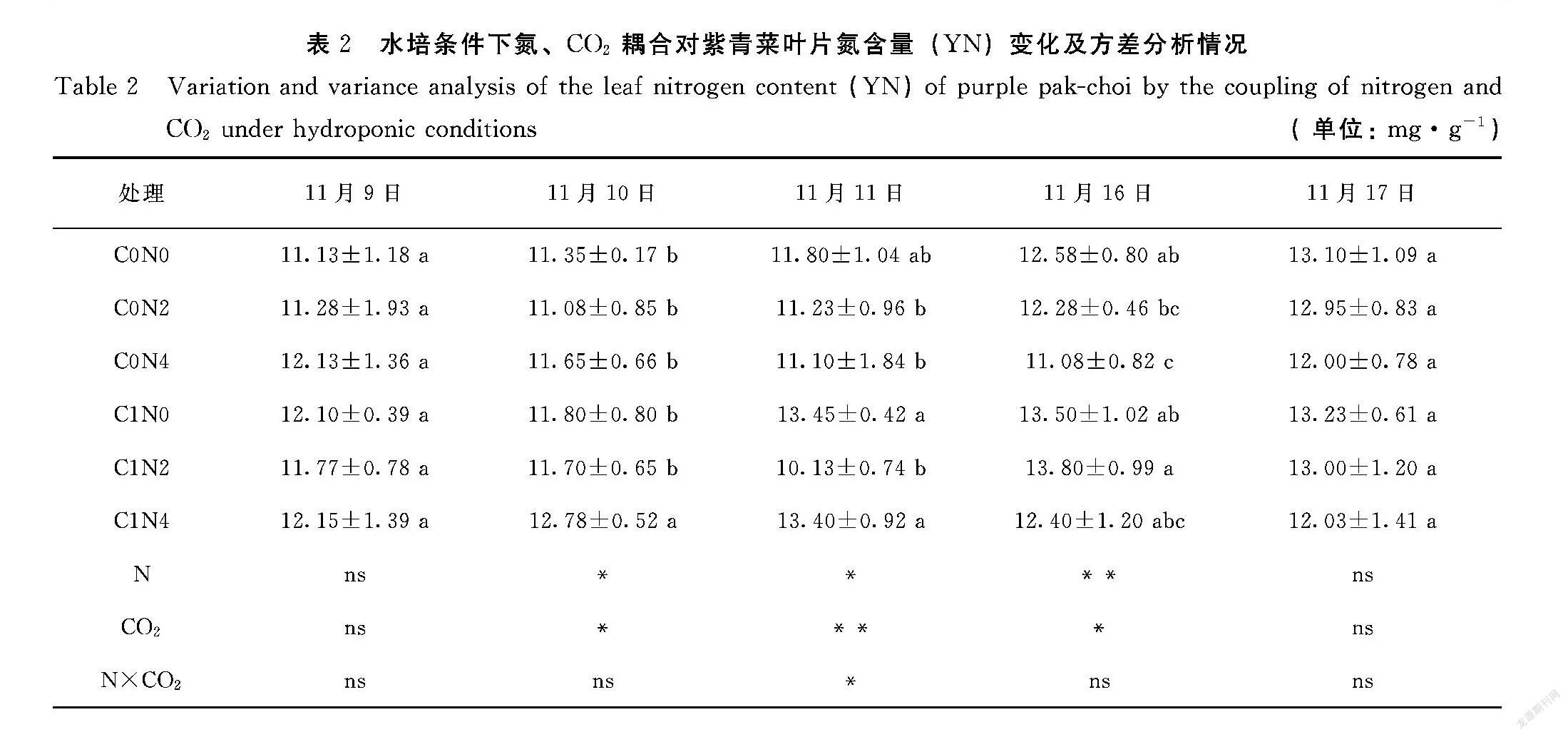
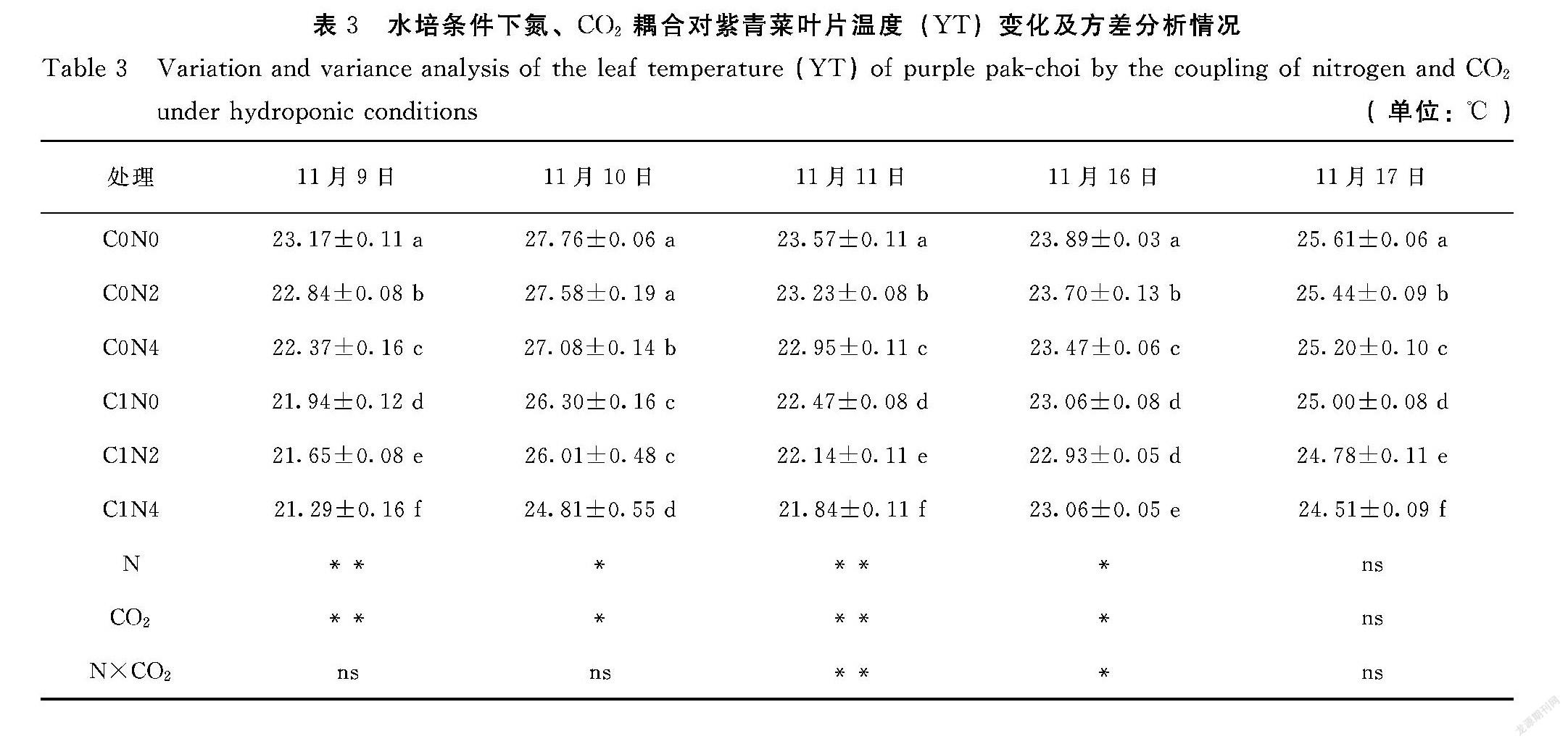
摘 要:為探讨水培条件下氮素营养(N)与二氧化碳(CO2)气体耦合对紫青菜叶片叶绿素荧光值(SPAD值)、氮含量(YN)、温度(YT)、湿度(YRH)的影响,以南京本地紫青菜为试验材料,设置了C0N0、C0N2、C0N4、C1N0、C1N2、C1N4等6个氮气耦合处理,其中水培液氮浓度设置为水培液稀释液中不添加外源氮(N0)、添加0.2 g·L-1外源氮(N2)、添加0.4 g·L-1外源氮(N4),每种氮素浓度下设置不施加CO2增长剂(C0)和施加CO2增长剂(C1)处理,研究了移栽后叶片SPAD值、YN、YT、YRH的变化情况。结果表明:施加CO2能够显著提高紫青菜叶片SPAD值(P<0.05),紫青菜移栽后,在11月16日之前C1N4处理下叶片SPAD值均较高,之后以C1N2处理下其值最大。在11月11日之前提高水培液N含量有助于增加叶片YN,但之后不利于叶片YN含量增加,以C1N0、C1N2处理下叶片YN较高。水培液N和CO2均能够显著降低叶片YT(P<0.05),且N和CO2耦合处理显著作用于叶片YRH(P<0.05),以高浓度N能够提高叶片YRH,11月11日后以增加CO2作用效果更明显。值得注意的是,同时间叶片各指标间具有显著相关性(P<0.05)。Pearson分析表明紫青菜生长前期YT增加直接降低了叶片SPAD值、YN、YRH,后期YT上升开始有利于SPAD值、YN、YRH提高。YN、YRH与叶绿素SPAD值呈极显著的正相关(P<0.01)。综上所述,合理的水培液氮素、CO2耦合能够增加水培紫青菜叶片叶绿素、氮含量,本结果可为水培紫青菜精准氮、CO2管理提供一定理论基础。
关键词:氮浓度;二氧化碳;紫青菜;叶绿素;花青素
中图分类号:S 634 文献标志码:A 文章编号:0253-2301(2021)11-0014-09
DOI: 10.13651/j.cnki.fjnykj.2021.11.003
Effects of the Coupling of Nitrogen and CO2 on Leaf SPAD, Nitrogen Content,Temperature and Humidity of Purple Pak-choi Under Hydroponic Conditions
LI Shi-long1, CHEN Dan-yan1*, ZHANG Yan2, LIU Ya2, HUANG Shu-lei1, WU Si-yuan1,
YANG Zhi1, JIANG Xiao-rui1, MA Jing-ze1, LIU Yan-fei1, SHEN Yan1, YAN Li-yu1
(1. College of Horticulture and Landscape Architecture, Jinling Institute of Technology, Nanjing, Jiangsu 210038,
China; 2. School of Software Engineering, Jinling Institute of Technology, Nanjing, Jiangsu 211169, China)
Abstract: In order to investigate the effects of the coupling of nitrogen nutrition (N) and carbon dioxide (CO2) on the leaf chlorophyll fluorescence value (SPAD) of purple pak-choi, nitrogen content (YN), temperature (YT) and humidity (YRH) under hydroponic conditions, six nitrogen coupling treatments including C0N0, C0N2, C0N4, C1N0, C1N2 and C1N4, were set with Nanjing local purple pak-choi as the experimental material, among which the nitrogen concentration in the hydroponic solution was set to be without exogenous nitrogen (N0), 0.2 g·L-1 exogenous nitrogen (N2) and 0.4 g·L-1 exogenous nitrogen (N4) in the diluent of hydroponic solution. Then, the changes of SPAD, YN, YT and YRH in leaves after transplanting were studied under the treatments of no CO2 growth agent (C0) and CO2 growth agent (C1) at each nitrogen concentration. The results showed that the application of CO2 could significantly improve the leaf SPAD of purple pak-choi (P<0.05). After transplanting, the leaf SPAD of purple pak-choi under C1N4 treatment was higher before November 16, and then it was the highest under C1N2 treatment. Increasing the N content in the hydroponic solution before November 11 was helpful to increase the YN content in leaves, but it was not conducive to the increase of YN content in leaves after November 11. The YN content in leaves was higher under the treatments of C1N0 and C1N2. Both N and CO2 could significantly reduce the YT of leaves (P<0.05). In addition, the coupling treatment of N and CO2 significantly affected the YRH of leaves (P<0.05), and high concentration of N could increase the YRH of leaves, and the effect was more obvious when increasing CO2 after November 11. It should be noted that there was significant correlation among various indexes of leaves at the same time (P<0.05). The Pearson analysis showed that the increase of YT at the early growth stage directly reduced the leaf SPAD, YN and YRH of purple pak-choi, and the increase of YT at the later growth stage was beneficial to the increase of SPAD, YN and YRH. YN and YRH were positively correlated with chlorophyll SPAD (P<0.01). In conclusion, the reasonable coupling of nitrogen and CO2 in hydroponic solution could increase the contents of chlorophyll and nitrogen in the leaves of hydroponic purple pak-choi, and the results could provide theoretical basis for the accurate management of nitrogen and CO2 in the hydroponic purple pak-choi.
Key words: Nitrogen concentration; Carbon dioxide; Purple pak-choi; Chlorophyll; Anthocyanins
有效利用环境因素能实现温室蔬菜优质高产,促进我国设施农业可持续发展[1-2]。水培液氮素(N)和空气二氧化碳(CO2)是温室蔬菜最重要的生长环境因子。KILINC等[3]研究发现,水培液元素含量和性质决定了作物生长及品质。多数研究表明不同营养液N浓度对叶菜生长、产质量等都有不同程度的影响[4-8]。随着生菜生长,营养液N对其干物质累积量及植株N吸收影响显著,但高浓度N仍然有利于N吸收[9-11]。刘燕婕等[12]、KACJAN等[13]认为水培小白菜和生菜在水培液N浓度为8 mmol·L-1的营养液中生长最好,但MAHLANGU等[14]认为水培液N浓度在8.57 mmol·L-1时生菜冠部鲜重最大。刘爱荣等[15]发现在NH4NO3 600 mg L-1氮水平下,紫青菜的鲜质量和干质量均最高、营养均衡、抗氧化能力强。张春兰等[16]发现水培液中硝态氮处理叶菜生长情况优于铵态氮、尿素处理。由于设施温室严重缺乏CO2,甚至接近或达到CO2补偿点[17-19]。……
登录APP查看全文
