
Wallis棘突间动态稳定系统与传统钉棒系统治疗腰椎间盘突出症的效果及对邻近节段的影响比较
2021-05-06 07:58:55辛瑞文姚积龙叶锡勇陈远华祝健红刘志欢
中国医学创新
2021年9期
关键词:系统
辛瑞文 姚积龙 叶锡勇 陈远华 祝健红 刘志欢
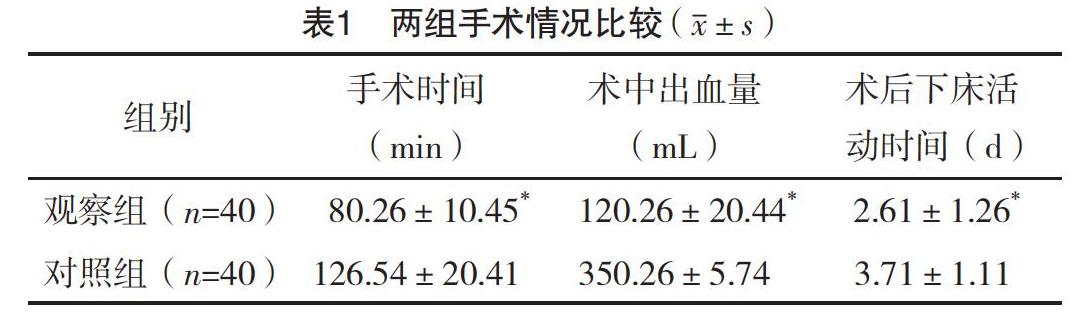
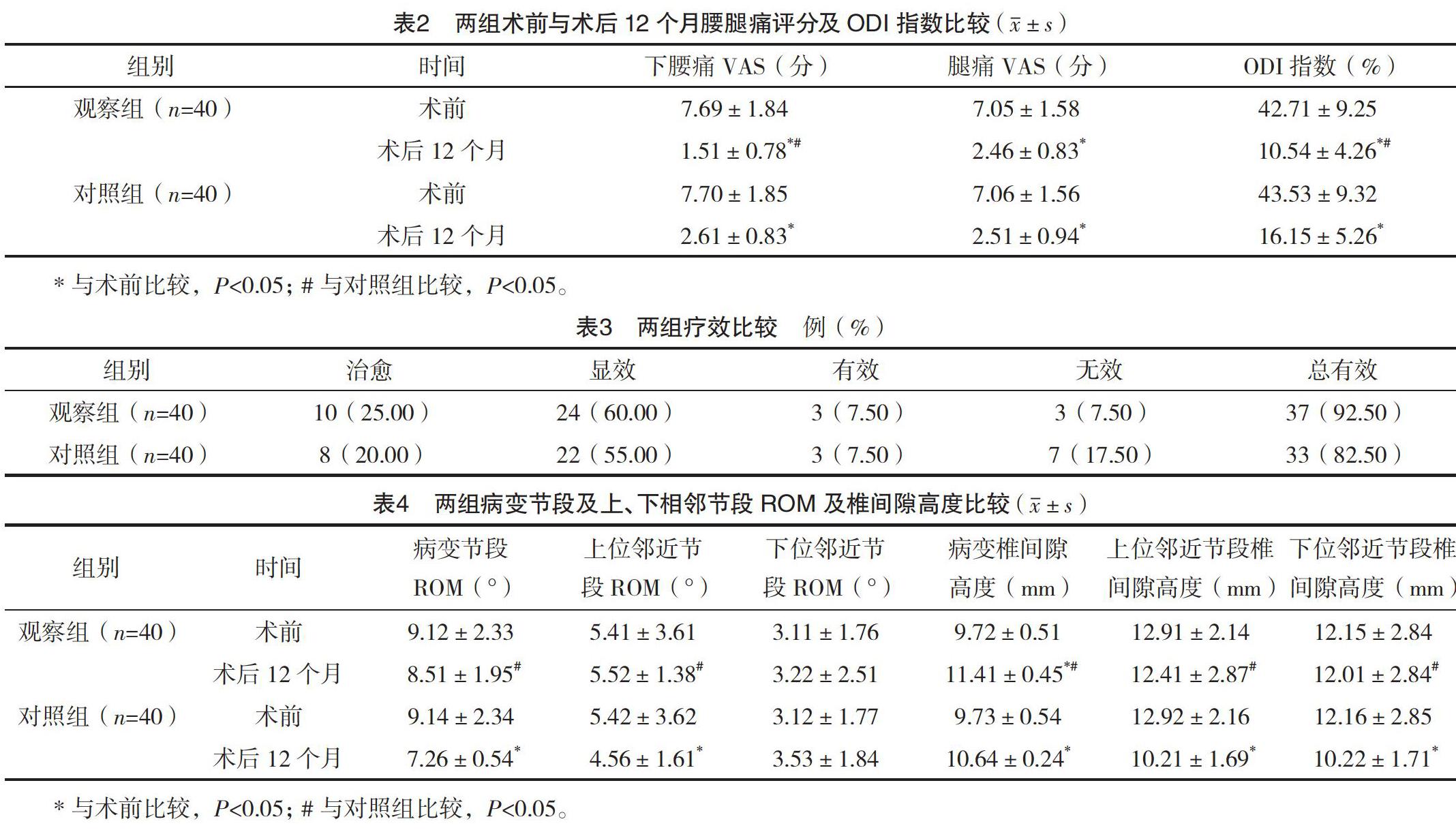
【摘要】 目的:比較Wallis棘突间动态稳定系统与传统钉棒系统治疗腰椎间盘突出症的效果及对邻近节段的影响。方法:选取2017年2月-2019年5月本院收治的80例腰椎间盘突出症患者,按随机数字表法将其分为对照组与观察组,各40例。对照组采用腰椎后路减压椎间融合联合传统椎弓根钉棒系统固定,观察组腰椎减压后采用Wallis棘突间动态稳定系统内固定治疗。比较两组手术情况及疗效,观察并发症发生情况。采用视觉模拟评分表(VAS)评定并比较两组术前及术后12个月腰腿痛情况。比较两组术前及术后12个月Oswestry功能障碍指数(ODI)、病变节段及上、下相邻节段活动度(ROM)及椎间隙高度。结果:观察组手术时间与术后首次下床活动时间均短于对照组,术中出血量少于对照组(P<0.05)。对照组术后1周出现暂时性神经牵拉损伤2例,1周后症状消失。术后12个月,两组下腰痛、腿痛VAS评分及ODI指数均低于术前,且观察组下腰痛VAS评分及ODI指数均低于对照组(P<0.05)。观察组治疗总有效率略高于对照组,但两组比较差异无统计学意义(P>0.05)。术后12个月,观察组病变节段及上位邻近节段活动度(ROM)均高于对照组,且病变椎间隙高度及上位、下位邻近节段椎间隙高度均高于对照组(P<0.05)。结论:腰椎间盘突出症患者采用Wallis棘突间动态稳定系统可缩短手术时间,减少术中出血量,减轻下腰痛程度,降低ODI指数,同时对相邻节段ROM及椎间隙高度影响小,不会引起邻近节段退变。
【关键词】 腰椎间盘突出症 钉棒系统 Wallis棘突间动态稳定系统 椎间隙高度
[Abstract] Objective: To compare the effect of Wallis interspinous dynamic stabilization system and traditional nail-rod system in the treatment of lumbar disc herniation and the influence on adjacent segments. Method: A total of 80 patients with lumbar disc herniation admitted to our hospital from February 2017 to May 2019 were selected. They were divided into control group and observation group according to random number table method, 40 cases in each group. The control group was treated with posterior lumbar decompression interbody fusion combined with traditional pedicle nail-rod system fixation, and the observation group was treated with Wallis interspinous dynamic stabilization system internal fixation after lumbar decompression. The operation situation and curative effect of two groups were compared, and the incidence of complications was observed. Visual analogue scale (VAS) was used to evaluate and compare the conditions of lumbar and leg pain between two groups before and 12 months after surgery. The Oswestry disability index (ODI), ROM and intervertebral space height of the affected segment, upper and lower adjacent segments were compared between two groups before and 12 months after surgery. Result: The operation time and the first time of getting out of bed after surgery in the observation group were shorter than those in the control group, and the amount of intraoperative blood loss in the observation group was less than that in the control group (P<0.05). In the control group, 2 patients developed temporary nerve tension injury at
1 week after surgery, and symptoms disappeared 1 week later. 12 months after surgery, VAS score of low back and leg pain and ODI index in both groups were lower than those of before surgery, and VAS score of low back pain and ODI index in the observation group were lower than those in the control group (P<0.05). The total effective rate of the observation group was slightly higher than that of the control group, but the difference between two groups was not statistically significant (P>0.05). 12 months after surgery, the ROM of the diseased segment and the upper adjacent segment in the observation group were higher than those in the control group, and the intervertebral space height of the diseased vertebral space, the upper and lower adjacent segments in the observation group were higher than those in the control group (P<0.05). Conclusion: Wallis interspinous dynamic stabilization system can shorten the surgical time, reduce intraoperative blood loss, the degree of low back pain and the ODI. It has little effect on the ROM and height of intervertebral spaces of adjacent segments in patients with lumbar disc herniation, without causing the degeneration of adjacent segments.
[Key words] Lumbar disc herniation Nail-rod system Wallis interspinous dynamic stabilization system
Intervertebral space height
First-authors address: Jiangxi Medical College, Shangrao 334000, China
doi:10.3969/j.issn.1674-4985.2021.09.002
腰椎间盘突出症系骨科常见病,由腰椎间盘纤维环破裂或髓核突出压迫神经所引起,是引起腰腿痛的主要原因,报道显示,有85%左右的腰椎间盘突出症患者可通过理疗、卧床等干预缓解腰腿痛症状,但仍有15%的患者需行手术治疗[1]。腰椎间盘髓内摘除内固定术是目前治疗腰椎间盘突出症常用术式,其可通过椎管减压、椎间融合减轻患者腰腿痛症状,但改变了患者脊柱正常生理结构,可能加速邻近节段椎间隙退变,引起继发性椎间狭窄、断钉断棒、椎间盘突出症复发及继发性滑脱等并发症,影响患者脊柱功能恢复[2]。……
登录APP查看全文
猜你喜欢
工业设计(2022年8期)2022-09-09 07:43:20
军民两用技术与产品(2021年10期)2021-03-16 06:05:30
北京测绘(2020年12期)2020-12-29 01:33:58
装备制造技术(2019年12期)2019-12-25 03:06:46
制造技术与机床(2019年10期)2019-10-26 02:47:06
中国洗涤用品工业(2019年4期)2019-05-11 09:27:34
铁道通信信号(2018年5期)2018-06-28 03:06:24
家庭影院技术(2017年9期)2017-09-26 03:41:45
通信电源技术(2016年6期)2016-04-20 06:21:32
智能系统学报(2015年4期)2015-12-27 09:37:59
