
基于TAS2R38探究黄连“苦寒败胃”的生物基础
2021-05-27 16:38:25陈昺伃张璐卢冬雪严晶孙志广
湖南中医药大学学报
2021年2期
陈昺伃 张璐 卢冬雪 严晶 孙志广
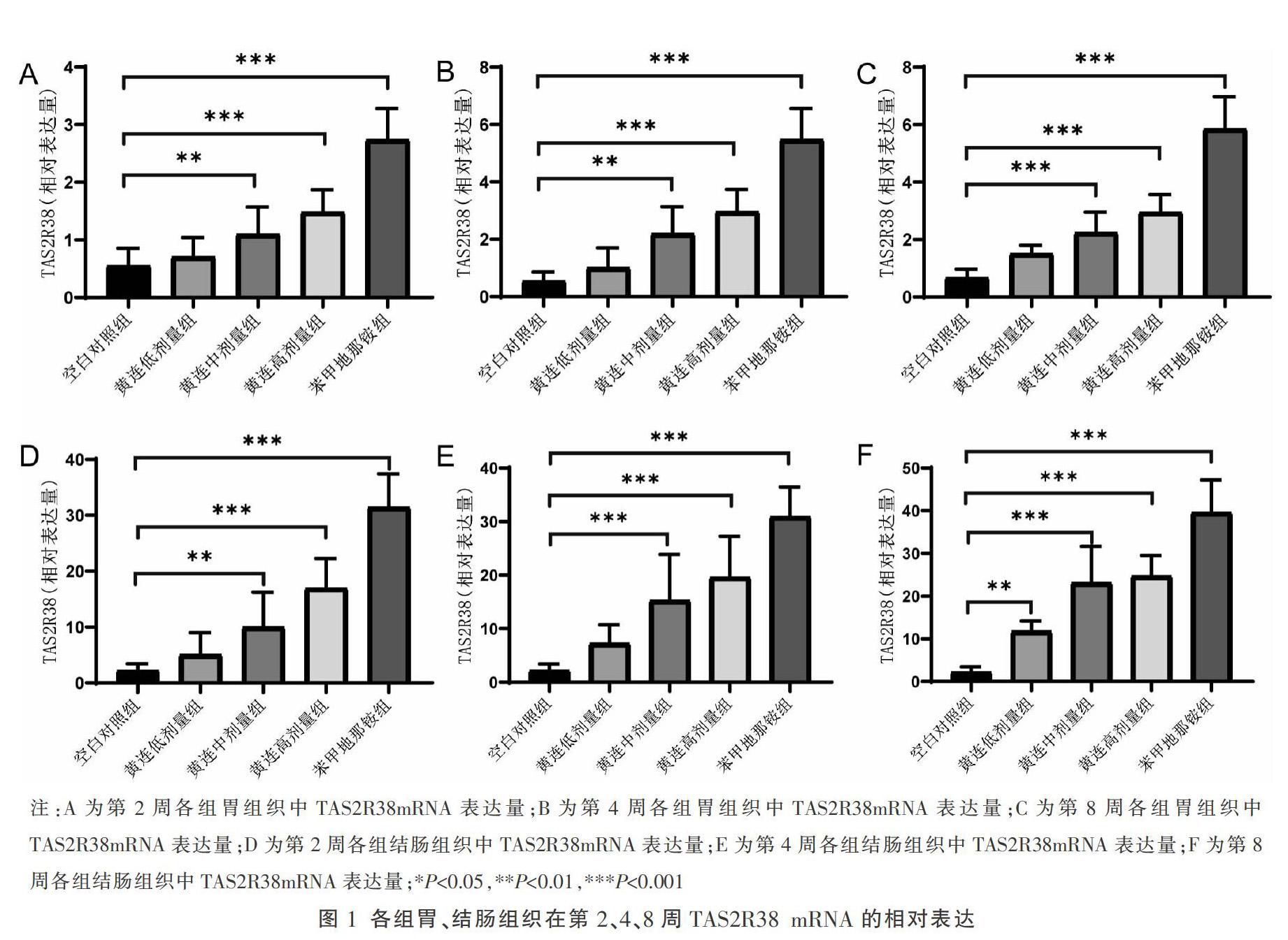
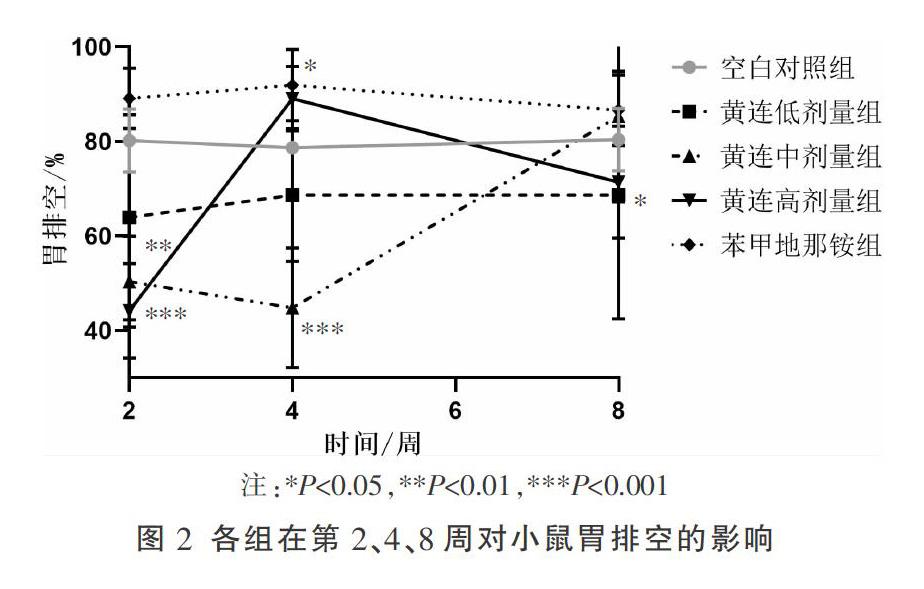

〔摘要〕 目的 基于苦味受體38(bitter taste receptor, TAS2R38)探讨久服、误服黄连导致“苦寒败胃”的生物基础。方法 ICR小鼠随机分为5组,分别为空白对照组、黄连低(0.5 g/kg)/中(1.5 g/kg)/高(4.5 g/kg)剂量组和苯甲地那铵组(0.225 g/kg),每组12只。各组小鼠分别灌胃给予相应的药物,持续8周。于第2、4、8周处理动物,RT-qPCR检测小鼠胃肠TAS2R38 mRNA表达水平;观察小鼠胃排空、肠推进;ELISA测定小鼠胃泌素和胆囊收缩素;HE染色评估胃肠黏膜损伤程度。结果 与空白对照组相比:苯甲地那铵和黄连均显著增加TAS2R38 mRNA表达水平,其中黄连组呈剂量依赖性(P<0.01);苯甲地那铵延缓胃排空(P<0.05),黄连在第2周时促进胃排空(P<0.01),但在第4、8周则延缓胃排空,特别是中、高剂量组(P<0.05);苯甲地那铵与黄连均呈时间依赖性地抑制肠蠕动,尤以黄连高剂量组表现明显(P<0.01);苯甲地那铵与黄连均抑制胃泌素的分泌、促进胆囊收缩素的分泌(P<0.05,P<0.01);HE染色显示苯甲地那铵和黄连均可损伤胃肠组织。结论 长期使用黄连可通过激动TAS2R38,影响小鼠胃肠动力,调节胃肠激素分泌,加重胃肠组织损伤,可能是其“苦寒败胃”的生物基础之一。
〔关键词〕 TAS2R38;黄连;苦寒败胃;生物基础
〔中图分类号〕R285.5 〔文献标志码〕A 〔文章编号〕doi:10.3969/j.issn.1674-070X.2021.02.012
〔Abstract〕 Objective Based on the bitter taste receptor 38 (TAS2R38) to explore the biological basis of "KuHanBaiWei" caused by long-term or mistaken intake of Huanglian (Coptidis Rhizoma). Methods ICR mice were randomly divided into five groups, including the control group, the Huanglian (Coptidis Rhizoma) in low-dose group (0.5 g/kg), middle-dose group (1.5 g/kg), high-dose group (4.5 g/kg) and denatonium benzoate group (0.225 g/kg), with 12 mice in each group. All mice were treated with the corresponding drugs by gavage for 8 weeks. The mice were killed at 2nd, 4th, and 8th weeks, RT-qPCR was performed to examine the mRNA expression of TAS2R38 in gastrointestinal tract of mice; the gastric emptying and small intestinal propulsion of mice were observed; ELISA was used to detect gastrin and cholecystokinin in mice; HE staining was used to assess the gastrointestinal mucosal lesions. Results Denatonium benzoate group and Huanglian (Coptidis Rhizoma) group could significantly increase the mRNA expression of TAS2R38 in a dose-dependent manner compared with the control group (P<0.01); denatonium benzoate delayed gastric emptying (P<0.05); Huanglian (Coptidis Rhizoma) could promote gastric emptying at the 2nd week (P<0.01), and delay gastric emptying at the 4th and 8th week, especially in the middle-dose group and the high-dose group (P<0.05); both denatonium benzoate and Huanglian (Coptidis Rhizoma) inhibited intestinal peristalsis in a time-dependent manner, especially in the high-dose group (P<0.01); both denatonium benzoate and Huanglian (Coptidis Rhizoma) inhibited the secretion of gastrin and promoted the secretion of cholecystokinin (P<0.05, P<0.01); HE staining showed that both denatonium benzoate and Huanglian (Coptidis Rhizoma) could damage gastrointestinal tissue. Conclusion Long-term use of Huanglian (Coptidis Rhizoma) can affect
gastrointestinal motility, regulate gastrointestinal hormone secretion and aggravate gastrointestinal injury in mice by activating TAS2R38, which may be one of the biological basis of "KuHanBaiWei".
〔Keywords〕 TAS2R38; Huanglian (Coptidis Rhizoma); "KuHanBaiWei"; biological basis
黄连因其有效性和功效多样性在临床被广泛应用,但长期使用或不当使用时极易引起纳差、腹泻、脘痞等症状,几千年的中医临床经验总结将这类情况称为“苦寒败胃”。所谓“苦寒败胃”,一方面是指苦药“能泻、能燥”,误服或过服均易耗伤津液及胃阴;另一方面是苦寒药清热力大,误服久服则必伤脾阳、助胃寒。后天之本受困于苦寒之品,水精不布,五经不行,气不得化,统摄无力,则倦怠消瘦、纳差痞满、腹痛、泄泻等症俱存,正所谓“百病皆由脾胃衰而生也”。有研究[1]发现黄连的有效成分如小檗碱等可以和苦味受体(bitter taste receptor, TAS2R)结合,而TAS2R被激活后可以影响胃肠功能[2]。TAS2R是一类表达于味蕾上的味觉受体细胞,作为味觉受体第二家族的成员介导苦味的感知。研究表明[3-8],TAS2R仅分布在口腔,还广泛分布在消化系统,特别是TAS2R38,它在消化系统的表达高且保守稳定[9-10],成为TAS2R家族的代表性研究对象。……
登录APP查看全文
