针刺对慢性萎缩性胃炎大鼠“足三里”穴区HRH2、SP及炎性因子表达的影响
2021-05-27 16:45:45尹鸿智赵娟刘倩金佳燕常小荣钟欢刘密
湖南中医药大学学报
2021年2期
尹鸿智 赵娟 刘倩 金佳燕 常小荣 钟欢 刘密
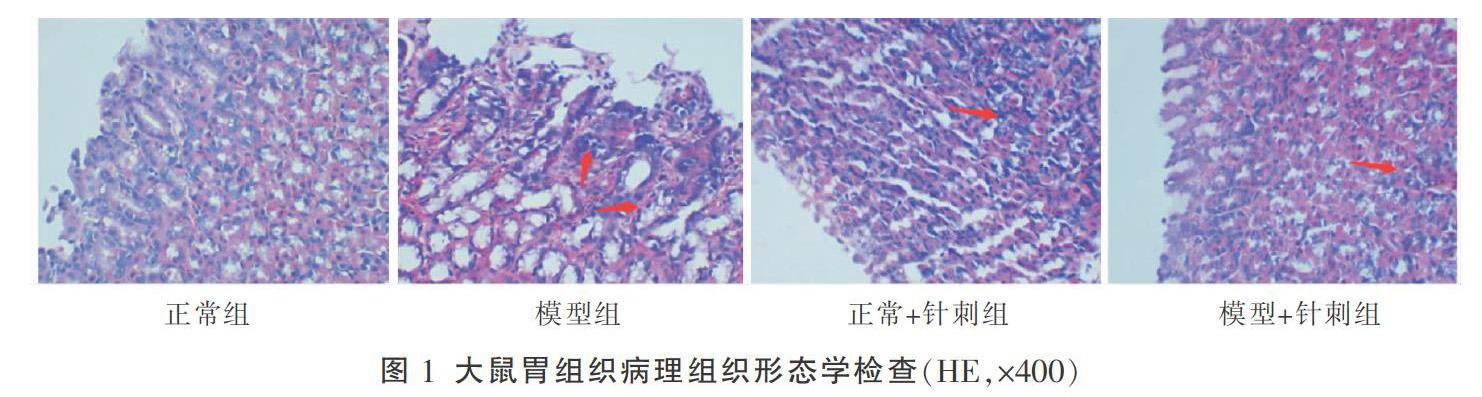
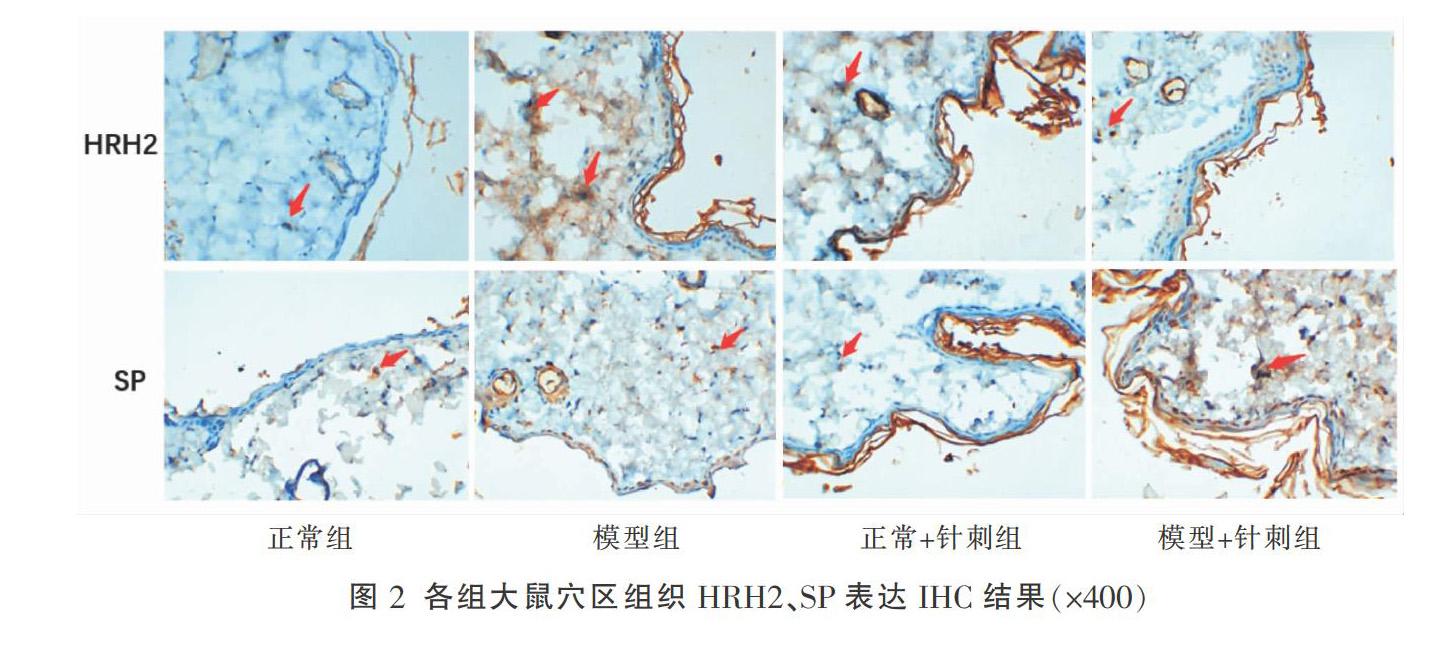
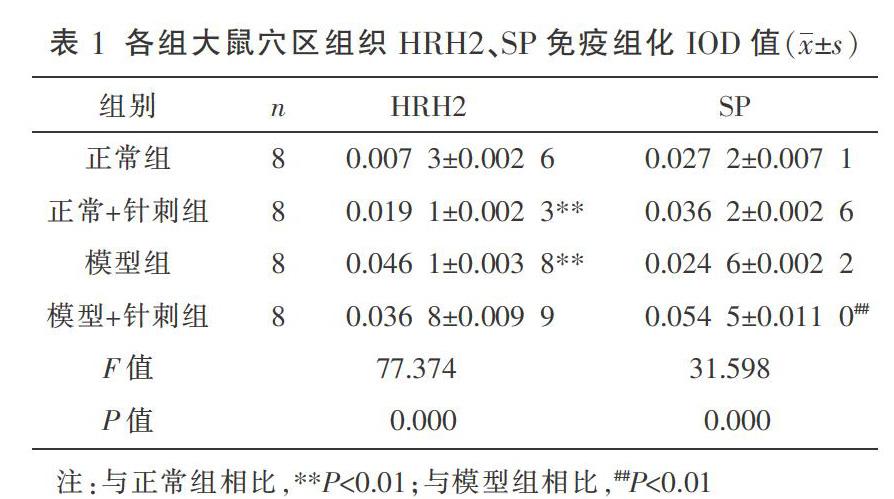
〔摘要〕 目的 觀察针刺对慢性萎缩性胃炎(chronic atrophic gastritis, CAG)大鼠及正常大鼠“足三里”穴区组胺H2受体(histamine H2 receptor, HRH2)、P物质(substance P, SP)及炎性因子(IL-6、IL-1β、TNF-α)的影响,并判断两者间是否存在差异。方法:将32只SD大鼠随机分为正常组、模型组、正常+针刺组和模型+针刺组,每组8只。采用1-甲基-3-硝基-1-亚硝基胍(1-methyl-2-nitro-1-nitrosoguanidine, MNNG)+乙醇灌胃+饥饱失常法建立大鼠CAG模型。针刺组每日治疗1次,每次20 min,连续针刺14 d。干预结束后,运用HE染色法观察胃组织病理学变化,运用免疫组化(immunohistochemistry, IHC)检测“足三里”局部穴区HRH2、SP、IL-6、IL-1β及TNF-α的表达。结果 造模后胃组织病理形态改变显著,光镜下可见大量炎症细胞浸润,腺体萎缩且结构紊乱,纤维组织增生充填,并伴有散在出血点,符合CAG病理诊断标准。IHC染色IOD值显示,与正常组相比,模型组、正常+针刺组均能升高局部穴区HRH2表达(P<0.01);与模型组相比,模型+针刺组可以显著上调穴区组织SP表达(P<0.01)。对于炎性因子而言,与正常组相比,模型组均能上调IL-6、IL-1β、TNF-α表达(P<0.05或P<0.01),正常+针刺组可使IL-6表达上调(P<0.01);与模型组相比,模型+针刺组可以降低IL-6、IL-1β表达(P<0.05),而升高TNF-α表达(P<0.01)。结论 针刺能对正常和CAG状态下大鼠“足三里”穴区HRH2、SP及炎性因子的表达产生影响,且所产生的生物学效应具有一定趋势,跟是否处于疾病状态有关。
〔关键词〕 慢性萎缩性胃炎;针刺;组胺H2受体;P物质;炎性因子
〔中图分类号〕R245 〔文献标志码〕A 〔文章编号〕doi:10.3969/j.issn.1674-070X.2021.02.018
〔Abstract〕 Objective To observe the effect of acupuncture on the expressions of histamine H2 receptor (HRH2), substance P (SP) and inflammatory factors (IL-6, IL-1β, TNF-α) in the "Zusanli" (ST36) acupoint area of chronic atrophic gastritis (CAG) rats and normal rats, and to determine whether there is any difference between them. Methods 32 SD rats were randomly divided into the normal group, the model group, the normal + acupuncture group and the model + acupuncture group, with 8 rats in each group. The CAG model of rats was established by 1-methyl-2-nitro-1-nitrosoguanidine (MNNG) + ethanol gavage + hunger and satiety disorder. The acupuncture group was treated with acupunctureonce a day, for 20 minutes each time for 14 days. After intervention, the changes of gastric histopathology were observed by HE staining, and the expressions of HRH2, SP, IL-6, IL-1β and TNF-α were detected by immunohistochemistry (IHC). Results The pathological morphological changes of gastric tissues were significant after the model construction. Under light microscope, a large number of inflammatory cells could be seen, the glands were atrophied and disorganized in structure, and the fibrous tissue was proliferated and filled, accompanied by scattered bleeding points, which met the CAG pathological diagnostic criteria. The IOD value of IHC staining showed that compared with the normal group, the expression of HRH2 of local acupoint area was increased in the model group and normal + acupuncture group (P<0.01); compared with the model group, the model + acupuncture group significantly increased the expression of SP of acupoint area (P<0.01). For inflammatory factors, compared with the normal group, the model group increased the expressions of IL-6, IL-1β and TNF-α(P<0.05), and the expression of IL-6 in the normal + acupuncture group could be up-regulated (P<0.01); compared with the model group, the expressions of IL-6 and IL-1β in the model + acupuncture group were decreased (P<0.05), while the expression of TNF-α was increased (P<0.01). Conclusion Acupuncture can affect the expressions of HRH2, SP and inflammatory factors in the "Zusanli" (ST36) acupoint area of rats under normal and CAG pathological conditions, and the biological effect has a certain trend, which is related to whether the rats are in the state of disease.
〔Keywords〕 chronic atrophic gastritis; acupuncture; histamine H2 receptor; substance P; inflammatory factors
《丹溪心法》记载:“欲知其内者,当以观乎外;诊于外者,斯以知其内。盖有诸内者,必形诸外”,说明体表皮肤与内在脏腑密切相关。慢性萎缩性胃炎(chronic atrophic gastritis,CAG)是一种主要表现为上腹部疼痛、胀满、厌食、嗳气等非特异性症状的常见消化系统疾病[1-2]。其病理特征以胃黏膜病变为主,常表现为胃黏膜萎缩、胃上皮异型增生、肠上皮化生等,CAG被认为是胃癌的癌前病变阶段[3-4]。随着经济发展,人们面临快节奏的生活方式、饮食习惯,导致CAG发病率逐年上升,发病年龄低龄化趋势明显,且预后逐渐不佳,故采取积极有效的方法防治 CAG 是防止其癌变的关键[5-6]。……
登录APP查看全文
猜你喜欢
中国民间疗法(2021年1期)2021-04-20 02:30:34
基层中医药(2021年7期)2021-03-26 18:00:27
云南中医中药杂志(2016年9期)2016-11-29 08:09:13
中国实用医药(2016年12期)2016-05-04 13:50:45
中国实用医药(2016年11期)2016-05-04 13:50:10
上海医药(2016年5期)2016-04-14 21:54:20
中国实用医药(2016年2期)2016-01-05 19:32:42
中医研究(2014年8期)2014-03-11 20:29:23
中医研究(2014年6期)2014-03-11 20:29:02
中国中医药现代远程教育(2014年17期)2014-03-01 04:29:28