信息化背景下“5A”管理模式用于痛风性关节炎患者的临床研究
2021-06-15 02:57:06张露月杨磊
风湿病与关节炎
2021年5期
关键词:管理
张露月 杨磊
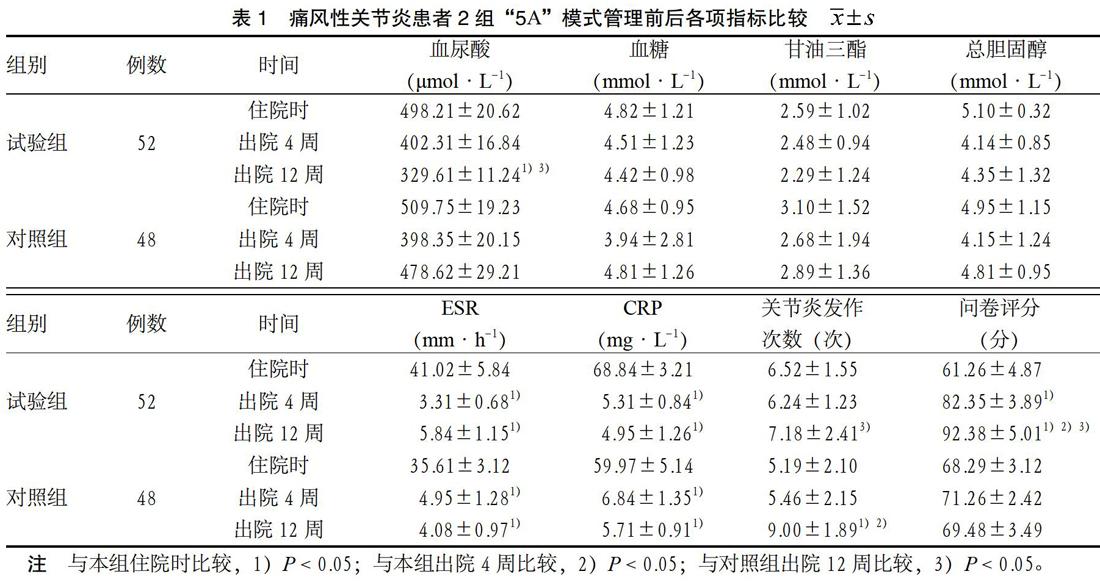
【摘 要】目的:探討“5A”模式管理痛风性关节炎的效果。方法:对100例痛风性关节炎患者进行评估(Access)、劝告(Advise),并进行相关信息登记,按患者是否接受Advise,分为试验组(接受Advise)和对照组(不接受Advise)。对照组出院后定期电话随访,试验组进入达成共识(Agree)、帮助(Assist)、安排随访(Arrange)环节。观察2组患者治疗前后血糖、甘油三酯、总胆固醇、血尿酸、红细胞沉降率(ESR)、C反应蛋白(CRP)、关节炎发作次数、问卷评分等。结果:“5A”模式管理4周(即出院4周),试验组ESR、CRP均低于管理前(即住院时),问卷评分高于住院时(P < 0.05);“5A”模式管理12周(即出院12周),试验组ESR、CRP、血尿酸水平均低于住院时,问卷评分高于住院时(P < 0.05);试验组出院12周问卷评分高于出院4周(P < 0.05)。出院4周,对照组ESR、CRP均低于住院时(P < 0.05);出院12周,对照组ESR、CRP均低于住院时,关节炎发作次数高于住院时(P < 0.05);对照组出院4周关节炎发作次数低于出院12周(P < 0.05)。出院4周,2组各项指标比较,差异无统计学意义(P > 0.05);出院12周,试验组血尿酸水平、关节炎发作次数均低于对照组,问卷评分高于对照组(P < 0.05)。结论:“5A”模式管理可以使痛风性关节炎患者血尿酸处于长期达标水平,减少痛风性关节炎的复发频率。
【关键词】 痛风性关节炎;信息化;“5A”管理;临床研究
Clinical Study of "5A" Management Model in Patients with Gouty Arthritis Under the Background of Informatization
ZHANG Lu-yue,YANG Lei
【ABSTRACT】Objective:To explore the effect of "5A" model in the management of gouty arthritis.Methods:One hundred patients with gouty arthritis were accessed and advised(advise),and related information was registered.According to whether the patients accepted advice,they were divided into the experimental group(accept advise)and the control group(not accept advise).The control group received regular telephone follow-up after discharge,and the experimental group entered into the process of agreement,assist and arrange follow-up.The blood glucose,triglyceride,total cholesterol,blood uric acid,erythrocyte sedimentation rate(ESR),C-reactive protein(CRP),number of arthritis attacks and questionnaire score were observed before and after treatment.Results:At the 4th week after management(i.e.4th week after discharge),the ESR and CRP of the experimental group were lower than those before the management(i.e. during hospitalization),and the questionnaire score was higher than that during hospitalization(P < 0.05).At the 12th week after the "5A" mode management(i.e.
12th week after discharge),ESR,CRP and blood uric acid levels of the experimental group were lower than those during hospitalization,and the questionnaire score was higher than that during hospitalization(P < 0.05).The questionnaire score in the experimental group at the 12th week after discharge was higher than that at the 4th week(P < 0.05).At the 4th week after discharge,ESR and CRP in the control group were lower than those during hospitalization(P < 0.05).At the 12th week after discharge,ESR and CRP in the control group were lower than those during hospitalization,and the frequency of arthritis attack was higher than that during hospitalization(P < 0.05).The number of arthritis attacks in the control group at the 4th week after discharge was lower than that at the 12th week(P < 0.05).At the 4th week after discharge,there was no significant difference between the two groups(P > 0.05).At the 12th week after discharge,the serum uric acid level and the number of arthritis attacks in the experimental group were lower than those in the control group,and the questionnaire score was higher than those in the control group(P < 0.05).Conclusion:"5A" mode management can make the blood uric acid of patients with gouty arthritis reach the standard level for a long time,and reduce the recurrence frequency of gouty arthritis.
【Keywords】 gouty arthritis;informatization;"5A" management;clinical study
随着人们生活水平的提高、生活方式的转变,痛风性关节炎的患病率呈逐年上升趋势,且有明显的年轻化趋势,逐渐成为严重威胁人类健康的常见病、多发病。但因本病发作的间歇性、间歇期无症状性,长期以来并未引起患者甚至医师的足够重视,多数患者对本病认知度低[1],常常导致延误诊治和治疗不规范,严重者甚至可造成骨侵蚀,是致残的原因之一,因此,使痛风性关节炎患者长期处于达标状态尤为重要。2017年更新的指南对反复发作的痛风性关节炎管理进行详细论述[2],我国对高尿酸血症和痛风提出专家意见,认为长期慢病管理可有效降低痛风性关节炎的复发[3-4]。本课题旨在运用现有信息化和通信技术的基础上,应用“5A”干预模式[评估(Access)、劝告(Advise)、达成共识(Agree)、帮助(Assist)、安排随访(Arrange)]对痛风性关节炎患者实施系统化、流程化的规范管理,提高患者的依从性,从而使患者能处于长期达标状态,减少关节损害。……
登录APP查看全文
猜你喜欢
今日农业(2022年15期)2022-09-20 06:56:20
水资源开发与管理(2021年12期)2022-01-15 08:54:58
——关注自然资源管理
辽宁自然资源(2021年3期)2021-05-19 06:39:04
水利建设与管理(2020年9期)2020-10-21 05:22:26
河南水利年鉴(2020年0期)2020-06-09 05:43:30
中国制笔(2019年1期)2019-08-28 10:07:26
建材发展导向(2019年10期)2019-08-24 06:26:30
建材发展导向(2019年10期)2019-08-24 06:26:20
中国眼镜科技杂志(2017年13期)2017-08-16 03:13:42
杂文月刊(2016年1期)2016-02-11 10:35:51