
高校双元创新与科技创新效率
2021-07-12 19:12:43高擎何枫吕泉
预测
2021年3期
关键词:科学研究
高擎 何枫 吕泉
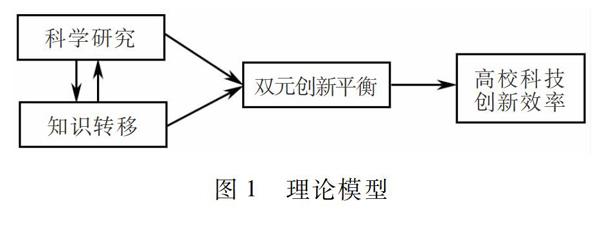

摘 要:经济发展方式的转变对高校的科技创新提出了更高的要求,如何协调双元创新行为成为学者关注的焦点。现有研究关于高校双元创新之间的关系没有形成统一认识,未能揭示二者关系的变化对高校科技创新效率的影响机制。本文以我国部属高校为研究对象,探讨并实证检验了科学研究和知识转移这对双元创新之间的关系,结果表明:第一,科学研究与知识转移效率呈倒U型关系;第二,高校双元创新之间存在动态关系,往期的知识转移效率对当期科学研究效率具有负向影响;第三,高校科学研究与知识转移的相对平衡会促进科技创新效率的提升。
关键词:科学研究;知识转移;双元创新;科技创新效率
中图分类号:G644文献标识码:A文章编号:1003-5192(2021)03-0076-07doi:10.11847/fj.40.3.76
Ambidextrous Innovation and S&T Innovation Efficiency in Chinese University
——Based on the Ambidextrous Innovation Theory
GAO Qing1, HE Feng1,2, LV Quan1
(1.School of Economics and Management, University of Science and Technology Beijing, Beijing 100083, China; 2.School of Economics and Management, Hubei Normal University, Huangshi 435002, China)
Abstract:The transformation of economic development pattern puts forward higher requirements for scientific and technological innovation in universities, how to coordinate the two pillars of ambidexterity in universities have aroused scholars great attention. In previous research, unified cognition has not been formed in the relationship between the two pillars, and the impact of this relationship on S&T innovation efficiency in universities has not been examined. Based on Chinese key universities, this research explores and tests the relationship between the two pillars of ambidexterity—research and knowledge transfer. The main findings are as follows: first, there is an “inverted U-type” relationship between research and knowledge transfer efficiency; second, the dynamic interlinkage between the two pillars of ambidexterity has been also examined, it indicates that past knowledge transfer efficiency has a negative impact on research efficiency. Third, the relative balance between research and knowledge transfer has a positive impact on S&T innovation efficiency in universities.Key words:research; knowledge transfer; ambidextrous innovation; S&T innovation efficiency
1 引言
科技創新尤其是前沿科技的发展是一个国家的核心竞争力,如今各国的科技投入在迅速增长,诸多国家在科技领域展开了激烈的竞争。随着我国政府财政科技投入的不断提高和实施的一系列科技发展计划,我国科技水平实现了较大发展。2015年全球R&D经费支出总和约为20000亿美元,美国以4960亿美元居于世界首位,约占全球总额的26%;中国以4080亿美元,位居世界第二,占全球总额的21%。虽然我国R&D经费投入在追赶美国,但在基础研究领域差距明显。2015年我国高校基础研究经费为104.01亿美元,而美国为377.08亿美元,这形成了鲜明对比。同时,在科技成果收益方面,我国高校的表现也不理想。……
登录APP查看全文
猜你喜欢
林业科学研究(2022年5期)2022-10-12 06:50:18
老龄科学研究(2022年9期)2022-10-12 01:48:30
环境科学研究(2022年2期)2022-02-28 02:37:54
环境科学研究(2021年12期)2021-12-21 04:14:36
环境科学研究(2021年11期)2021-11-22 12:28:00
纺织科学研究(2021年9期)2021-10-14 08:52:14
环境科学研究(2021年9期)2021-09-27 02:17:28
纺织科学研究(2021年7期)2021-08-14 01:42:38
环境科学研究(2021年3期)2021-03-25 08:07:58
纺织科学研究(2020年1期)2020-05-21 00:31:08