基于转录组的剑麻SSR标记开发与筛选
2021-07-20 14:00:52张燕梅李俊峰杨子平鹿志伟陆军迎周文钊
热带作物学报
2021年5期
张燕梅 李俊峰 杨子平 鹿志伟 陆军迎 周文钊
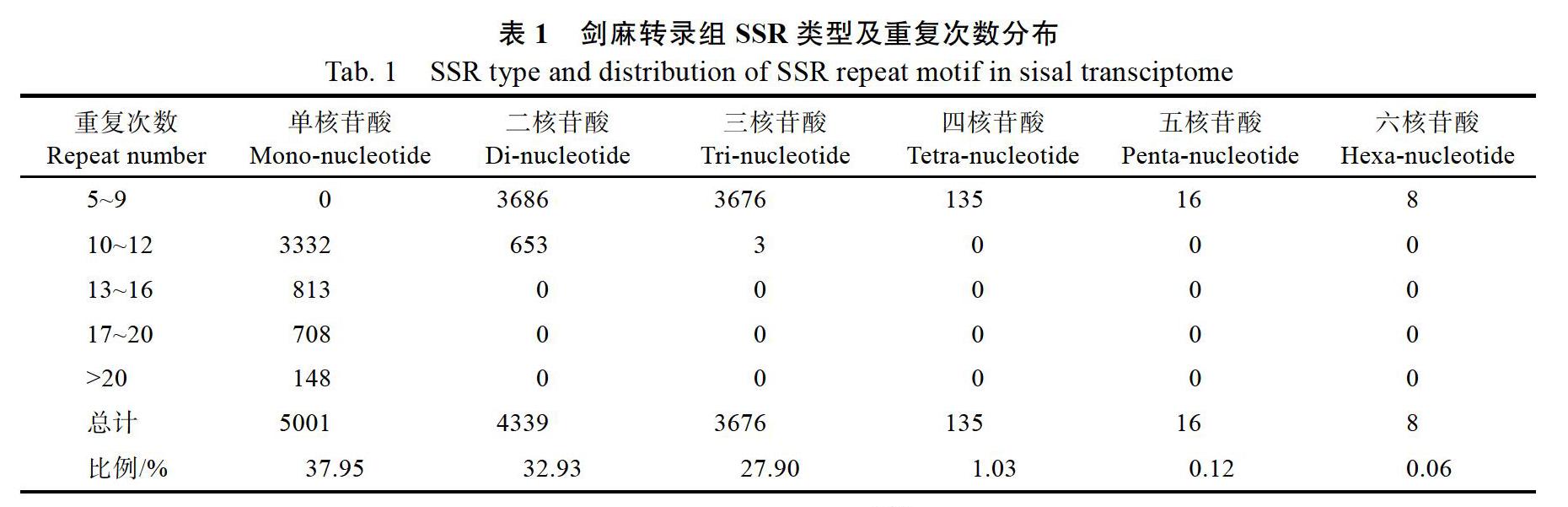


摘 要:本研究基于剑麻转录组测序获得的70 110条Unigene序列,采用MISA 1.0软件查找SSR位点,利用Primer 3.0设计SSR引物,通过聚丙烯酰胺凝胶电泳技术对其中的100对SSR引物有效性进行验证。总计获得了13 175个SSR位点,SSR的分布频率为15.61%。70 110条Unigene序列总计包括60种重复基元,其中单核苷酸重复为主导重复类型(37.96%),其次是二核苷酸重复和三核苷酸重复,比例分别为32.92%和27.90%,四核苷酸、五核苷酸、六核苷酸重复所占比例总计为1.21%。A/T、AG/CT和AGG/CCT分别为单核苷酸、二核苷酸和三核苷酸重复的优势基元。100对SSR引物中有68对引物可扩增出目标产物,其中18对引物在6份剑麻种质中表现出多态性,该结果为利用SSR分子标记技术开展剑麻种质资源鉴定、遗传多样性分析等奠定基础。
关键词:剑麻;转录组测序;SSR
中图分类号:S563.8 文献标识码:A
Abstract: In this study, the high-throughput sequencing of the transcriptome of sisal was used to seek SSR loci and de-velop SSR markers by MISA 1.0 and Primer 3.0 softwares, respectively, and preliminary primer verification and poly-morphic primer analysis were performed by vertical acrylamide gels. A total of 13 175 of SSR loci were found in the 70 110 unigene sequences. The SSR distribution frequency was 15.61%. In total, 60 repeat elements were obtained, among them, mono- nucleotides were the domiant repeat motif (37.96%), followed by di-nucleotides (32.92%), and tri-nucleotides repeats (27.90%), the other repeat types occupied 1.21% in all. The most dominant mono-nucleotide, di-nucleotide and tri-nucleotide repeat motif was A/T, AG/CT and AAG/TTC, respectively. Among the 100 pairs of SSR primers randomly selected from the designed SSR primers of Rema No. 1, sixty-eight pairs of primers could amplify the expected size bands, and eighteen primers showed polymorphism among six sisal germplasms. The obtained primers would provide effective molecule markers for genetic diversity analysis and germplasm identification of sisal.
Keywords: sisal; RNA-seq; simple sequence repeats
DOI: 10.3969/j.issn.1000-2561.2021.05.009
劍麻是一种重要的热带纤维作物,有重要的经济价值。由于剑麻自然条件下变异频发且倍性复杂[1],现有保存的种质资源中,主要是通过麻园选育、杂交和引种获得,遗传背景模糊,命名极不规范,有的很难从表型加以辨别,给剑麻种质资源的保存利用以及育种工作带来极大不便。分子标记技术的出现给遗传育种研究注入了新的活力,并且在剑麻品种鉴定以及遗传多样性分析等方面得到广泛的应用[2-8]。
微卫星DNA(microsatellite DNA)又称简单重复序列(simple sequence repeat,SSR),是由1~6个核苷酸为重复单位串联而成的长达几十个核苷酸的重复序列,按其来源可分为基因组SSR(gSSR)和表达序列标签SSR(EST-SSR)。与其他分子标记相比,SSR标记具有多态性高、重复性好、共显性遗传等优点,可以区分纯合子和杂合子,广泛应用于遗传多样性分析[9]、种质资源鉴定[10]以及遗传作图[11]等领域。……
登录APP查看全文