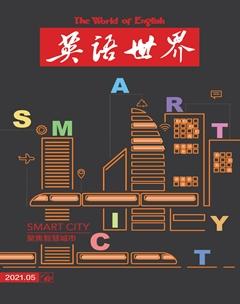
What Does a Smart City Look Like? 智慧城市什么样?
2021-07-25 09:26:04卡亚·伊斯梅尔
英语世界
2021年5期
关键词:智慧
卡亚·伊斯梅尔
Humans are flocking to cities, and cities are rapidly evolving—not just to accommodate more people, but to help them flourish.
With the UN forecasting that 68% of the worlds population will live in urban areas by 2050, an increasing number of cities are turning to Internet of Things (IoT) technologies to make their streets, trains, taxis and government services “smarter” to improve efficiency and quality of life.
But what exactly does a smart city look like, and are there any good examples already leading the way?
What exactly is a smart city?
A smart city refers to a metropolitan or cosmopolitan city that utilizes IoT technology to effectively manage the citys assets and resources which include sustainable energy, transportation, waste management and more. The main objective of using this technology is to improve the quality of life of the citys citizens from an economic, social and environmental level.
Kenta Yasukawa, co-founder and CTO of Soracom1, said any city that collects and analyzes data can be considered a smart city. “In practice, cities around the world are using connected sensors and big data analytics to improve life for residents and visitors across areas of governance ranging from traffic and transportation to power and water delivery, waste management, municipal services and law enforcement,” said Yasukawa.
As for the characteristics that define a smart city, Yasukawa shared that each smart city will have their own unique objective, but they all acknowledge the importance of IoT technology. “Some [smart cities] focus on innovation, others on infrastructure or overall efficiency. What they share in common is an understanding that emerging IoT and cloud capabilities offer a meaningful opportunity to better understand the intimate2 workings of an urban center. … and ultimately better serve its population while reducing both cost and waste.”
How can cities become smart?
Chris Wiegand, CEO and co-founder of Jibestream3, shared that the key for a city to become smart lies in how it can leverage4 both IoT technology and location-awareness. “By using sensors to process data and facilitate edge computing, they are able to manage infrastructure and resource allocation efficiently, resulting in a removal of friction from daily interactions and experiences for both municipal employees and city residents,” said Wiegand. He went on to explain that to make any space smart, “It is crucial to have a digitized representation of the city that is geospatially accurate at both street level and at the underground level, with indoor maps of subway paths and concourses and large public buildings.” This visual context of the city makes it easier to interpret the data provided by the IoT technology.
Wiegand also mentioned that you need to have the “requisite connectivity for devices and sensors to function properly.”
When asked whether any city can become smart, Wiegand said, “Any city can become a smart city, regardless of size, as long as it lays the key supporting infrastructure and has the commitment of citizens, municipal officials and local government and collaboration between public and private companies with the different levels of government.”
Examples of smart cities
To give you an idea of what a smart city looks like, we have identified the following “smart” cities:
Singapore—When Singapore rolled out its Smart Nation program5, the city embraced new technologies in every aspect of its infrastructure and operations. And in doing so, the city became a leading example for energy-efficient street lighting, which is responsive to weather changes. “The city of Singapore is arguably already the smartest city in the world, with the minute workings of the city rendered in data down to the backyard shortcuts children take on their way home from school,” said Wiegand.
Barcelona, Spain—In 2017, the city of Barcelona rolled out a mandate to “rethink the smart city from the ground up. ” Barcelona has, for time, been using IoT and cutting edge digital devices to municipal operations, but with the 2017 mandate there is now an emphasis to introduce a shift from “technology-first” to “citizen-first.”
“Barcelona expanded its smart applications and implemented open stand-ards-based platforms that integrate data from thousands of IoT devices that previously did not communicate with each other. Through reforming the citys network to become more adaptable and connected, Barcelona is considered one of the leading examples of smart cities,” said Daniele Loffreda, market development advisor and consultant for Ciena6.
Songdo, South Korea—Deborah Andrade, communication specialist at SlicingDice7, said Songdo in South Korea is considered to be a “world reference” for a smart city. “Songdo has Smart Work centers with teleconferencing systems that allow a third of its government staff to work closer to their homes that are equipped with Wi-Fi and sensor networks,” said Andrade.
Andrade added that Songdo was the first city to implement the Online Electric Vehicle Technology8 (OLEV) transportation system, which utilizes magnetic fields to generate electricity for buses.
“[Songdo] has an innovative IoT Cube9s lab, where different technology companies obtain real-time data from Songdos citizens and work together towards bringing better solutions and smart innovations for them,” said Andrade. ■
人们正涌向城市,城市也在迅速发展——不仅仅是为了容纳更多的人,也是为了让人们富足。
联合国预测,到2050年,世界上生活在城市地区的人口将达到68%,越来越多的城市开始使用物联网技术,从而使它们的街道、火车、出租车和政府服务“更有智慧”,以提高效率,改善生活质量。
但是,智慧城市到底是什么样子的呢?是否已经有一些成功范例了呢?
智慧城市到底是什么?
智慧城市是指利用物联网技术对城市资产和资源,包括可持续能源、交通、垃圾管理等,进行有效管理的大都市或国际大都市。使用这项技术的主要目的是从经济、社会和环境层面提高城市居民的生活质量。
Soracom联合创始人兼首席技术官安川健太表示,任何收集和分析数据的城市都可以被视为智慧城市。他说:“实际上,世界各地的城市都在使用互联的传感器和大数据分析来改善居民和访客的生活,涉及从交通运输到供电供水、垃圾管理、市政服务和执法等各个治理领域。”
至于用哪些特征来界定智慧城市,安川认为,每个智慧城市都有自己独特的目标,但所有城市都认可物联网技术的重要性。“一些(智慧城市)注重创新,另一些城市注重基础设施或整体效率。它们的共同之处在于,明白新兴的物联网和云端能力提供了一个重要的机会,让我们更好地了解城市中心的各种运作细节……最终在减少成本和损耗的同时更好地服务于居民。”
城市如何变得有智慧?
登录APP查看全文
猜你喜欢
金桥(2022年10期)2022-10-11 03:29:32
智富时代(2019年2期)2019-04-18 07:44:42
阅读与作文(小学高年级版)(2019年2期)2019-03-27 03:48:04
文苑(2018年20期)2018-11-09 01:36:02
文史春秋(2017年12期)2017-02-26 03:16:10
小天使·一年级语数英综合(2014年6期)2014-07-22 23:32:38
智慧与创想(2013年7期)2013-11-18 08:06:04
网球俱乐部(2009年9期)2009-07-16 09:33:54